Nobel Prize in physics 2026 announced: Who is this year's winner

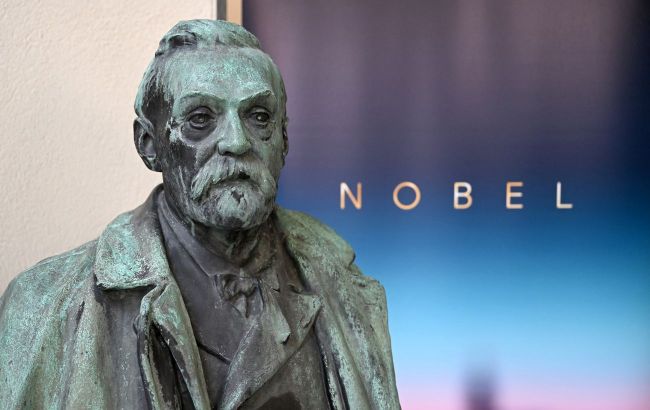 Photo: The Nobel Prize in Physics laureates announced (Getty Images)
The Nobel Committee announced the winner of the 125th Nobel Prize in physics on Tuesday, October 6, according to the Nobel Foundation.
“The Royal Swedish Academy of Sciences has decided to award the Nobel Prize in Physics 2026 to Francis Halzen “for decisive contributions to the IceCube Neutrino Observatory and the discovery of high-energy neutrinos of astrophysical origin,’” the Nobel Prize organization said on social media.
Why Francis Halzen received the Nobel Prize
According to the press release, Francis Halzen realized that ice at the South Pole could be used to track particles known as neutrinos. His vision and scientific leadership laid the foundation for the IceCube neutrino observatory — a cubic kilometer of ice equipped with light sensors.
Using IceCube, researchers can detect neutrinos produced by extremely energetic processes in the distant universe.
“Francis Halzen has led an international team of researchers and engineers who have provided us with a fantastic instrument. His tenacity and scientific vision has paved the way for a new kind of astronomy,” said Mark Pearce, chair of the Nobel Committee for Physics.
Who won the prize last year
The Nobel Prize in physics is the highest international award in the field. It has been awarded since 1901 in accordance with the will of Alfred Nobel, the Swedish chemist, inventor and philanthropist. The prizes are presented each year at a ceremony on December 10 at the Stockholm Concert Hall, the anniversary of Alfred Nobel’s death.
Among the best-known Nobel Prize winners in physics are Albert Einstein, Marie Curie, Max Planck and others.
Last year, on October 7, the Nobel Committee announced three laureates in physics. John Clarke, Michel H. Devoret and John M. Martinis received the Nobel Prize “for the discovery of macroscopic quantum mechanical tunnelling and energy quantisation in an electric circuit.”
In 1984 and 1985, their colleagues conducted a series of experiments with an electrical circuit built from superconductors, which can conduct electricity without electrical resistance. These studies became the basis for the discovery that earned them the prize.
By improving and measuring various properties of their circuit, the three Nobel laureates demonstrated that quantum mechanical properties can be observed on a macroscopic scale, because when a large number of particles are involved in a process, quantum mechanical effects normally become negligible.
In other words, quantum processes are usually thought of as something occurring on a very small scale. However, these experiments made it possible to observe quantum effects in a much larger electrical system.
Their discovery opened the door to the development of quantum technology. Building on the work of last year’s laureates, artificial quantum bits were created, forming the basis of superconducting quantum processors. Their research also made it possible to develop ultrasensitive sensors and detectors for measuring magnetic fields and weak electrical signals.
Last year, Clarke, Devoret and Martinis shared a prize of 11 million Swedish kronor, equivalent to approximately $1.05 million–$1.19 million.
Nobel Prize week
Active preparations begin approximately a year before the awards ceremony. Starting in September, the Nobel Committees send invitations to those eligible to nominate candidates. The group includes members of the Nobel Committees, previous Nobel laureates, prominent professors and scientists, as well as members of international courts and governments. Only these individuals are eligible to nominate candidates for the prize.
Yesterday, October 5, the first Nobel laureates in physiology or medicine were announced. Karl Deisseroth, Peter Hegemann, and Georg Nagel were recognized for discoveries concerning light-controlled ion channels and optogenetics. The scientists discovered a unique protein — channelrhodopsin — which made it possible to control the activity of nerve cells.
Tomorrow, October 7, the Nobel laureates in chemistry will be announced. Nobel Prize week will conclude on October 12 with the announcement of the laureates in economic sciences.
Read also: International Space Station emerges as Nobel Peace Prize contender, Ukrainian also in the running