Migrants who broke through from Morocco protest in Ceuta, seek to stay in Spain

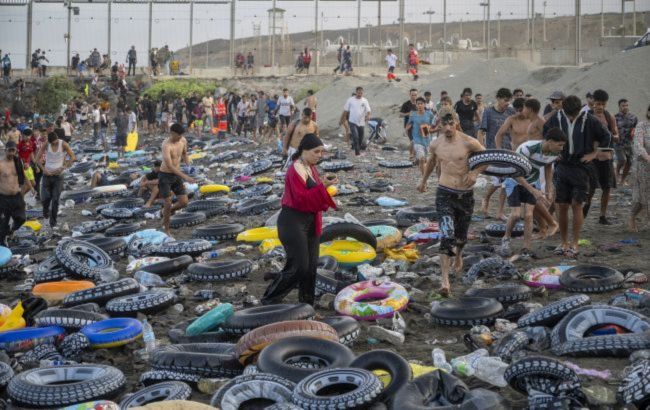 Migrants in Spanish exclave of Ceuta (photo: Getty Images)
Hundreds of migrants protest on a city beach in Ceuta, demanding asylum in Spain. They are among thousands who have been stranded in the exclave since a mass border crossing two weeks ago, according to Reuters.
What migrants demand
Hundreds of migrants who recently arrived in the Spanish exclave of Ceuta staged a protest on a popular city beach. They called on Spanish authorities to grant them asylum rather than send them back to Morocco.
Protesters held Spanish flags and banners reading "We don't want to go back to Morocco" and "We are also human," while chanting "We're tired" and "We need a solution."
They are among an estimated 5,000-8,000 people who remain in Ceuta after a mass border crossing two weeks ago.
With the city's resources overwhelmed, most migrants are living in unsafe conditions on El Trampolin beach or on the outskirts, waiting for an opportunity to reach mainland Europe.
"We're sleeping next to the sea, with cold and bad smells. We're suffering a lot," said Ayoub Elarroud from the Moroccan city of Tetouan. According to him, police are preventing migrants from reaching the city center.
Authorities' stance
Earlier this week, Interior Minister Fernando Grande-Marlaska said migrants who entered illegally would not be allowed to remain in the exclave, travel to mainland Spain or obtain legal status, except in rare cases involving extreme vulnerability.
Ceuta Medical Board head Enrique Roviralta said the city's limited number of medical workers were exhausted and criticized what he described as the central government's slow response.
According to him, cases of infectious diarrhea and scabies have emerged in the city, while the number of injuries associated with violence—including broken noses and stab wounds—is also increasing.
Health Minister Monica Garcia rejected claims on Sunday that local health services had "collapsed," but acknowledged that they were under pressure.
Why people are fleeing
Most of the Moroccan migrants interviewed by Reuters said poor living conditions at home had forced them to leave, despite many of them being highly qualified.
Mohammed Ouanzar, a 39-year-old automation specialist from Fez, said an average monthly salary of 3,000 dirhams ($324) makes it impossible for him to buy a home or start a family.
"Once I reached Spanish soil, I felt like I was born again. I'd rather die than return," he said.
As previously reported, two weeks ago, Ceuta faced its largest migration crisis in years. Around 60,000 people crossed into the exclave within a single day.
In recent days, Spain and Morocco again stepped up border security amid new calls on social media for another mass crossing. Barbed wire, water cannons and patrol boats have been deployed on the Moroccan side.