Israel deploys next-gen artillery against Hezbollah on battlefield

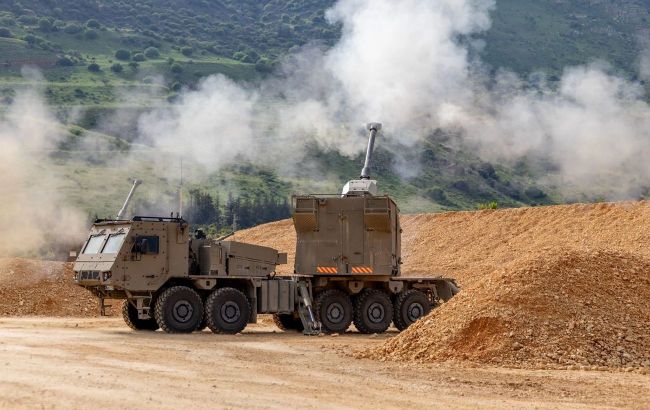 Ro'em artillery of the Israeli army (Photo: IDF)
The Israel Defense Forces (IDF) have deployed the newest self-propelled howitzer Ro'em to fight Hezbollah terrorists. The weapon has already seen its baptism of fire during the fragile ceasefire in Lebanon, reports Fox News.
The name of the system translates from Hebrew as Thunder, and it is not just another cannon, but a true breakthrough, engineers claim. It fires faster, hits more accurately, and completely changes the logic of using firepower.
IDF Chief Artillery Officer Ehud Bibi said in a comment to Fox News:
"The Ro’em brings a new capability to the Artillery Corps and the IDF as a whole, reshaping how firepower is employed on the battlefield. This marks a historic milestone, introducing a new era of more precise, faster, and more flexible fire enabling us to support troops on the ground more effectively."
The system was developed by Elbit Systems, which is known on the international market as SIGMA. Production is handled by a subsidiary in South Carolina, US.
Key features of the Ro'em howitzer:
- Crew: only 3 soldiers (instead of the large crew of older systems);
- Range: approximately 40 kilometers;
- Full automation: the system selects the shell and propellant charge by itself;
- Speed: the gun automatically locks onto the target and fires at a high rate.
The new weapon allows for lightning-fast action: the howitzer quickly takes up a position and opens fire. Ro'em leaves the firing position just as quickly, minimizing the risk of return fire.
Baptism of fire during the ceasefire
Israel has already tested Ro'em in action. This happened despite a 10-day ceasefire. The military emphasizes that the fire was purely defensive, as terrorists were preparing attacks against the Israeli army.
According to a statement from the Israel Defense Forces:
"During the activity, the troops conducted precise artillery fire on several Hezbollah anti-tank and surface-to-surface missile launch positions, from which attacks had been launched against IDF troops. The firing was effective, achieving operational results and introducing new artillery capabilities, thereby reducing the threat posed to IDF troops and Israeli civilians."
What is happening in Gaza and Lebanon
Earlier, it was reported that the head of Hezbollah stated readiness for a ceasefire but set conditions for Israel. One of them is a permanent cessation of Israeli attacks on Lebanese targets and the complete withdrawal of Israeli forces.
The ceasefire between Lebanon and Israel regarding Hezbollah was brokered by the US on April 16. Lebanon's prime minister welcomed Trump's announcement of a ceasefire. Israel's prime minister stressed that the IDF would remain in strategic positions during the 10-day ceasefire.
Meanwhile, the UN and the EU have calculated that rebuilding Gaza will cost at least 71.4 billion dollars. The reconstruction of the region could take 10 years, and action is needed now.