Iran vs. Israel and US: Answers to key questions and consequences for Ukraine


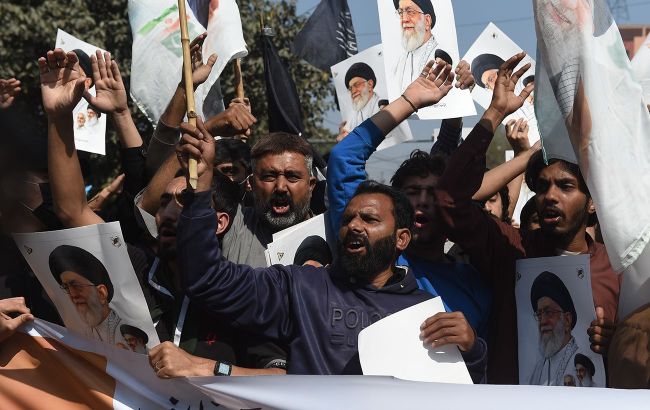 Supporters of the ruling regime in Iran (photo: Getty Images)
Israel, with US support, attacked Iran and eliminated the country’s supreme leader, prompting Tehran to strike across the region. The large-scale conflict has already affected global oil prices and created a risk of shortages in air defense missiles.
RBC-Ukraine provides the key answers about what is happening in the Middle East and how it may affect the lives of Ukrainians.
Key points
-
Elimination of the leadership: Iran’s supreme leader, Ali Khamenei, and the entire top command of the Quds Force have been destroyed in Tehran.
-
Gas station prices: Gasoline in Ukraine is expected to rise by 5–10 UAH ($0.12-0.23) due to the jump in Brent oil prices.
-
Threat to air defense: The US could exhaust its annual supply of interceptor missiles within 48 hours of operations.
-
NATO trap: Strikes on British bases in Cyprus do not trigger collective defense under Article 6 of the NATO Treaty.
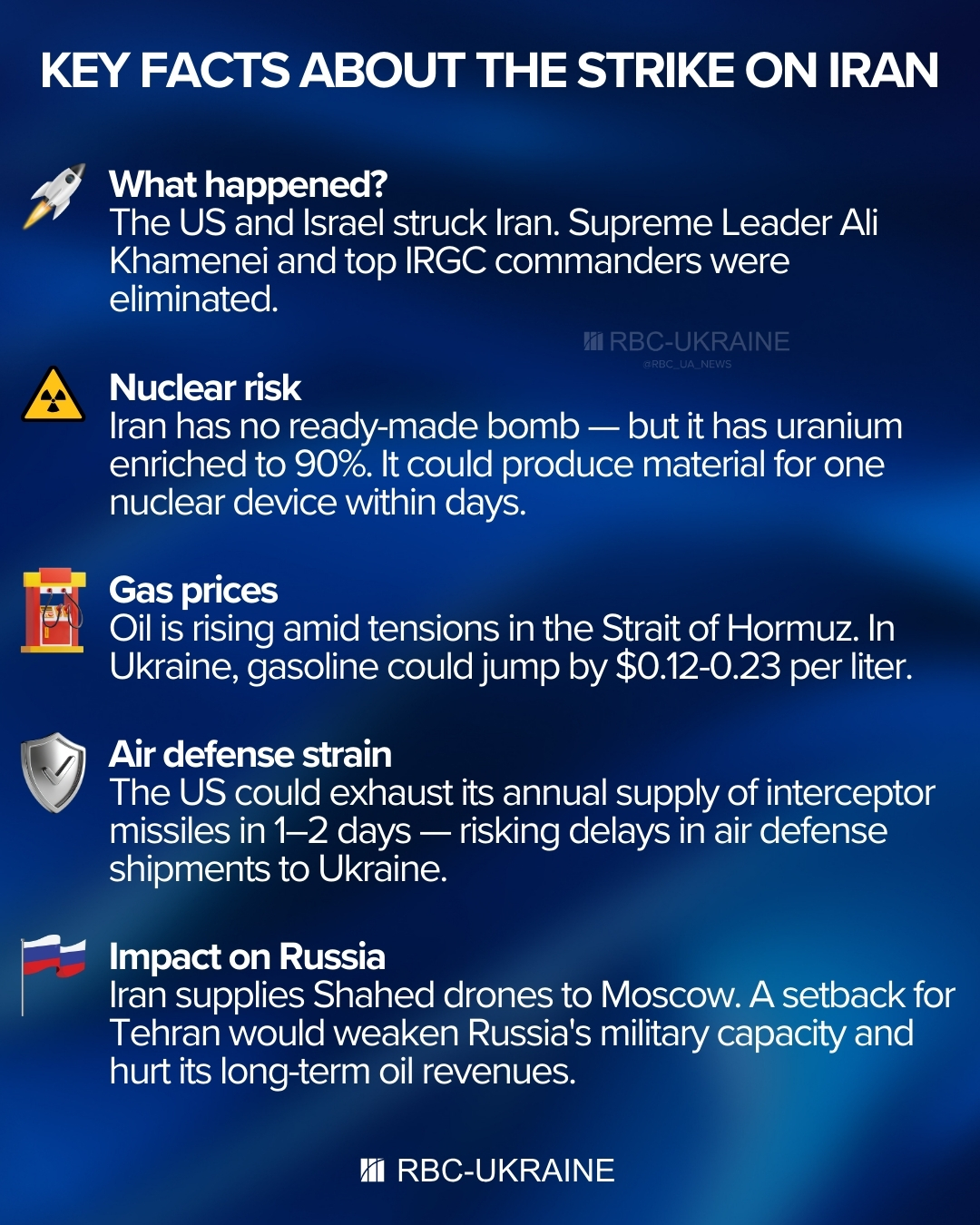
Key changes due to the escalation in the Middle East (infographic: RBC-Ukraine)
– Why are Israel, the US, and Iran even fighting? They don’t share a border.
– Tehran has long conducted a proxy war against Tel Aviv through allied groups. Iran has declared that the state of Israel must be destroyed. At the same time, the Iranian leadership has been developing nuclear weapons to protect itself against potential retaliation for its actions.
All of this led to a 12-day war in June of last year. At that time, Israel, with US support, carried out a preemptive strike on Iran’s nuclear facilities but was unable to destroy them completely. From June of last year until the start of the current escalation, the US attempted to reach an agreement with Iran that would allow control over Tehran’s nuclear program. After negotiations reached a deadlock, Israel and the US attacked Iran.
– Did Iran attack Israel, or was it the other way around? Who struck first?
– In the current stage of the confrontation, Israel and the US struck first. They targeted a number of command centers and military facilities in Iran. The strike on Tehran killed Iran’s 86-year-old supreme leader, Ali Khamenei. Alongside him, Defense Minister Aziz Nasirzadeh, Armed Forces Commander Abdolrahim Mousavi, and Islamic Revolutionary Guard Corps (IRGC) commander Mohammad Pakpour were also killed.
– Does Iran already have a nuclear bomb?
– According to the International Atomic Energy Agency (IAEA), Iran does not yet have a completed nuclear warhead. However, the country is at the so-called "nuclear threshold." The latest IAEA reports indicate that Iran has accumulated enough uranium enriched to 60%, and some facilities were found to contain uranium enriched up to 90%.
This is the level needed to create a warhead. According to foreign intelligence, Iran’s "breakout time" — the period required to obtain weapons-grade uranium for a single device — has been reduced to just a few days.
The main challenge for Iran has remained the metallization process and the creation of a compact warhead that can be mounted on a missile. US intelligence reports that, prior to the February strikes, Iranian scientists were actively working on integrating the nuclear component into Shahab-3 ballistic missiles. Currently, the IAEA has lost access to surveillance cameras at Iranian facilities due to the fighting, so no more up-to-date data is available.
– Why is Iran attacking other countries in the Middle East?
– Tehran views neighboring Arab countries as allies of the US and Israel if they provide airspace or bases for strikes on Iranian territory. Iran’s official position is that attacks on facilities in the UAE, Jordan, and Kuwait constitute "legitimate self-defense" against those assisting the aggressor.
Read also: 'We haven't even started.' Trump threatens Iran with far larger attack
At the same time, the Atlantic Council points to Iran’s strategy of "regionalizing chaos": following the elimination of Ali Khamenei, the regime is attempting to destabilize global oil and logistics markets to pressure the international community into acting against Israel and the US. In this way, Iran is demonstrating that despite the loss of its leadership, it is still capable of paralyzing the entire region and driving the cost of war to a level unacceptable for the West.
– Iran launched missiles at a British military base in Cyprus, which is considered UK territory. Why isn’t NATO responding to attacks on a NATO member’s base?
– The situation with the strikes on Akrotiri Air Base is legally complex due to NATO’s own treaty limitations. Under Article 6 of the North Atlantic Treaty, the collective defense mechanism (Article 5) applies only to attacks within Europe, North America, Turkey, and islands in the North Atlantic north of the Tropic of Cancer.
Although Cyprus is an EU member, geographically it is part of Western Asia, and when the UK joined the Alliance, it did not include its overseas territories and sovereign bases in Cyprus within NATO’s "area of responsibility." This is the same legal reason NATO did not intervene during the 1982 Falklands War between the UK and Argentina.
– Why is the US helping Israel shoot down missiles, but not Ukraine?
– Washington explains this by the differing partnership status and the risks of direct war with a nuclear state. Unlike Ukraine, Israel holds the status of a "Major Non-NATO Ally" of the US, formalized through bilateral security agreements that obligate the US to assist in defending Israeli airspace.
The Pentagon notes that American pilots’ participation in intercepting Iranian missiles over the Middle East does not carry a risk of global nuclear war, since Iran officially does not possess nuclear weapons.
At the same time, in Ukraine’s case, the White House consistently emphasizes its goal of avoiding a confrontation with Russia, which could lead to a Third World War. Ukraine’s Ministry of Foreign Affairs has repeatedly called this position a "policy of double standards," stressing that Iranian Shahed drones and missiles in both conflicts are identical.
– How will this affect the war in Ukraine?
– The renewed conflict in the Middle East creates serious risks for Ukraine due to the "diversion" of US resources, especially regarding air defense. As the Financial Times notes, American stocks of interceptor missiles could be depleted extremely quickly. This raises the risk that munitions originally intended for Ukraine could be redirected to the Middle East.
Additionally, the attention of key American negotiators, such as Steven Witkoff and Jared Kushner, is now split between Kyiv and Tehran, which has already led to delays in rounds of meetings on the Ukrainian issue.
The economic impact of the conflict will be felt directly by Ukrainians through fuel prices and the stability of the hryvnia. Global oil prices have already reached a seven-month high due to the threat of closure of the Strait of Hormuz.
However, in the long term, the complete removal of the Iranian regime could be advantageous for Kyiv: it would not only stop the supply of Shahed drones to Russia but also allow large volumes of Iranian oil to enter the market. Such a collapse in energy prices could significantly drain Russia’s military budget.
– Why could this conflict cause gasoline prices to rise in Ukraine?
– The direct link between the strikes on Tehran and fuel prices at Ukrainian gas stations is driven by two factors: global oil prices and logistical risks. Since Ukraine imports almost 100% of its fuel from EU countries, any jump in Brent crude prices is quickly reflected in the cost of European gasoline and diesel.
Additionally, fighting near the Strait of Hormuz, through which 20% of the world’s oil passes, forces tankers to halt. This, in turn, drives up insurance rates and creates shortages of raw materials on the global market.
In practice, this means Ukrainian gas station networks will begin adjusting prices within the next few days. If the active phase of the war in Iran lasts more than two weeks, the price of a liter of gasoline in Ukraine could rise by 5–10 UAH.
At the same time, Oleksandr Sirenko, an analyst at Naftorynok, notes that there will not be a sharp fuel shortage in Ukraine, as the Ministry of Energy has accumulated sufficient reserves and European refineries have diversified sources of oil supply. Therefore, the main pressure on Ukrainians’ wallets will come from global market panic rather than an actual lack of fuel.
– Is Russia helping Iran?
– According to Western intelligence, Russia previously supplied Iran with modern electronic warfare (EW) and radar systems, which are currently helping Tehran detect American aircraft. Russia has also begun delivering Su-35 fighter jets to modernize Iran’s aging air fleet.
However, The Wall Street Journal notes that after the US and Israel launched their operation, Russia’s assistance has been mostly informational and diplomatic. Moscow is avoiding direct military involvement, as its own resources are drained by the war in Ukraine.
– Could a Third World War start?
– Among military analysts and politicians, the view is increasingly voiced that a Third World War is already underway, though it does not resemble the linear confrontations of large armies seen in the last century. Instead of a single front, the world is witnessing a series of separate but interconnected conflicts in Ukraine, the Middle East, and potentially around Taiwan.
Experts at the RUSI think tank point to the formation of a new "axis of evil" – Russia, Iran, and North Korea, with support from China. According to the center, this axis is waging a coordinated campaign against the Western world order, not only through missiles but also via cyberattacks, energy blackmail, and destabilization of global trade routes.
At the same time, official statements from Western leaders remain cautious: the US and NATO are trying to localize strikes on Iran to prevent a local war from escalating into a broader global conflict.
However, as The Economist notes, the world has already entered the most dangerous period since the Cuban Missile Crisis. The main risk is a domino effect: if the international legal system stops functioning in one region, it could trigger simultaneous outbreaks of conflict worldwide.
Sources: materials and data from Reuters, Bloomberg, Financial Times, The Wall Street Journal, The Economist, IAEA, Atlantic Council, RUSI, ISW, and expert commentary by Oleksandr Sirenko for RBC-Ukraine.