Far-right AfD leads in Germany election, win could cost Merz his job

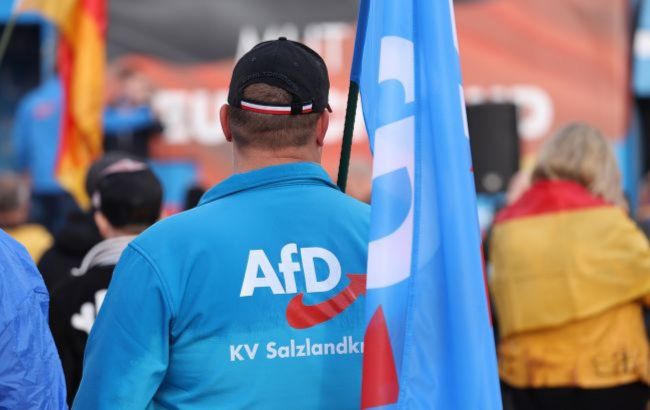 AfD supporters at a campaign event in Germany (photo: Getty Images)
Far-right Alternative for Germany (AfD) is winning record support in Saxony-Anhalt state parliament election, more than doubling the vote share of Chancellor Friedrich Merz's CDU, Politico reports.
Key points:
- AfD results. The far-right party is winning 44.2% of the vote and is on track for the best result in its history.
- Can AfD form a government? The party has already claimed a mandate to form a government, but the final outcome will depend on the distribution of seats and whether it can secure a majority.
- How the CDU performed. Friedrich Merz's party is winning 18.5% of the vote, down from 37.1% in the 2021 election—a major blow to the Christian Democrats.
- Why voters backed AfD. The party campaigned on a hard-line migration policy, conservative values, criticism of mainstream political forces and the region's economic problems.
Latest results
According to an ARD projection released at 8:27 p.m., the AfD, led by 35-year-old Ulrich Siegmund, is winning 44.2% of the vote. That is roughly 23 percentage points more than the party received in the previous election.
This puts AfD on track for its best result since its founding in 2013. At the same time, for Germany, this is far more than the success of a single political force in a regional election.
The significance of the election extends far beyond one eastern German state.
AfD moves closer to power
The key question now is whether AfD will have enough seats to form a government in Saxony-Anhalt on its own.
If the party secures an absolute majority in the state parliament, it would be a historic development for modern Germany: AfD would be able to take control of a state government on its own for the first time. Most mainstream parties categorically reject forming a coalition with the far right, so the outcome will depend on the final distribution of seats.
AfD co-leader Alice Weidel has already called the result historic and said the party had received a clear mandate to form a government.
"This is a historic result, and it is a very clear mandate to form a government," Weidel said.
At the same time, the final results will determine whether AfD can carry out those plans. If the party falls short by a few seats, it will have to seek ways to secure a majority.
Particular attention is focused on the Sahra Wagenknecht Alliance (BSW), which is fighting to clear the 5% threshold. If it enters the state parliament, the party could potentially influence the formation of a majority.
BSW has already said it is willing to cooperate with AfD and could help the far right secure victory in the election.
Major blow to Merz's party
For the Christian Democratic Union (CDU), the result is a major setback. The party, led by Merz at the federal level, is winning just 18.5% of the vote, according to the ARD projection.
By comparison, the CDU received 37.1% of the vote in Saxony-Anhalt in the 2021 election. That means the party's support has been nearly halved over five years.
The CDU has governed the region for the past 24 years. The party's general secretary, Franziska Hoppermann, called the result very difficult and a general defeat for the Christian Democrats.
AfD's top candidate in Saxony-Anhalt, Ulrich Siegmund, said his party had effectively made history and hinted that, in his view, the current chancellor's time in office should come to an end.
"Of course, this is also a message addressed to Berlin. We are well aware that he is a very effective campaigner. For us, Friedrich Merz was the face of this campaign. Every day this man remains in the Chancellery is one day too many," the politician said.
Policies proposed by AfD
Saxony-Anhalt is one of Germany's smallest states, with a population of just over 2 million. At the same time, the region has become one of the country's main strongholds of support for AfD.
The party built its campaign around a hard-line stance on migration, criticism of mainstream political forces and calls for a return to more conservative social policies.
Its proposals include increasing migrant deportations as part of the so-called "remigration offensive," restricting migration, changing school education, banning rainbow flags in schools, placing greater emphasis on traditional values and providing payments to families after the birth of children.
AfD also advocates closer ties with Moscow, including the restoration of school exchange programs with Russia. The party has also proposed changing how German history is taught in schools by reducing the amount of material devoted to the country's Nazi past.
AfD's activities have previously raised concerns in Germany over possible contacts with Russia and the risk of sensitive information being disclosed to Moscow.
In December 2025, representatives of Germany's centrist parties accused AfD of collecting information that could be of interest to Russian intelligence services. The allegations included parliamentary inquiries about weapons deliveries to Ukraine and drone defense systems in Germany.