EU increasingly sidelines Hungary over leak fears to Russia — Politico

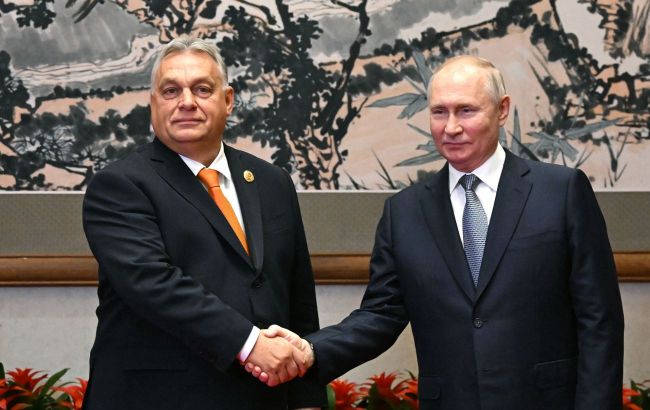 Photo: Hungarian Prime Minister Viktor Orbán and Russian President Vladimir Putin (Getty Images)
European Union countries are increasingly excluding Hungary from discussions on sensitive issues due to fears that it may pass information on to Russia, according to Politico.
Due to the threat of information leaks, EU countries are using smaller meeting formats instead of meetings with all member states, so that Budapest does not know the details.
"Overall the less-than-loyal member states are the main reason why most of relevant European diplomacy is now happening in different smaller formats — E3, E4, E7, E8, Weimar, NB8, JEF, etc," the official says.
Politico explains that the numbers refer to the number of European leaders in the group. For example, the Weimar Alliance consists of France, Germany, and Poland. The NB8 comprises eight countries in Northern Europe and the Baltics, while the JEF is the Joint Expeditionary Force, consisting of 10 Northern European countries.
One diplomat says that in light of new accusations against Hungary regarding the leaking of information to Russia, the EU may classify some information and documents.
Although assigning classified status "isn’t a silver bullet," it could "serve as a deterrent against leaks and the passing of sensitive info to third parties. It would also make investigations more automatic."
Furthermore, the Bucharest Nine on NATO’s eastern flank considered excluding Budapest from this format next year due to Budapest's inability to agree on support for Ukraine.
Five EU diplomats said they were not surprised by the news, but the bloc will not issue a formal response to the new allegations for the time being, due to the potential impact on Hungary's April 12 elections. Any official response depends on whether Hungarian Prime Minister Viktor Orbán is re-elected.
"It undermines trust, cooperation, and the integrity of the European Union. It’s a deplorable situation. If he stays after [the] election, I think the EU need to find ways to deal with this in another manner," says a diplomat, commenting on the allegations against Hungary.
Background
Just a few days ago, Polish Prime Minister Donald Tusk voiced long-standing suspicions that Viktor Orbán’s government was sharing information with Russia.
"The news that Orbán’s people inform Moscow about EU Council meetings in every detail shouldn’t come as a surprise to anyone. We’ve had our suspicions about that for a long time. That’s one reason why I take the floor only when strictly necessary and say just as much as necessary," he wrote on social media.
Also on Saturday, The Washington Post reported that Orbán’s government maintained close contact with Moscow throughout the war with Ukraine, and that Foreign Minister Péter Szijjártó used breaks during meetings with other EU countries to brief Russian Foreign Minister Sergey Lavrov.
Gabrielius Landsbergis, the former Lithuanian foreign minister who frequently attended Security Council meetings—where Szijjártó was also often present—also shared some details with Politico. As early as 2024, he was warned that Hungary might be passing information to Russia, and that he and his colleagues had limited the amount of information they shared while Szijjártó was present.
According to Landsbergis, even on the eve of the 2023 NATO summit in Vilnius, representatives of the member states took steps to exclude the Budapest delegation from important negotiations.