EU diplomacy chief slams Russia's delegation lineup in Abu Dhabi talks

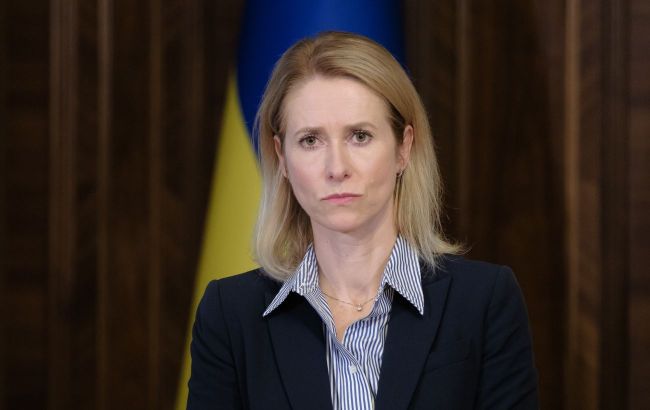 Photo: EU High Representative Kaja Kallas (Vitalii Nosach, RBC-Ukraine)
The composition of the Russian delegation at the talks in Abu Dhabi indicates that Russia has no serious intentions to achieve peace, according to the EU High Representative for Foreign Affairs and Security Policy.
"On the Russian side, there are only military personnel present who do not have a mandate to agree on anything, which means that they are definitely not serious about peace," Kallas says.
She stresses that the Russians, on the contrary, continue to attack Ukrainians, "trying to bomb and freeze them to surrender." Therefore, the EU must be clearly aware of this context and increase pressure on Russia.
"it is important that that we really see, that we push Russia into really having negotiations. Right now, they are just pretending to have them. We see them increasing their attacks on Ukraine because they cannot make moves on the battlefield, so they are attacking civilians," says the head of European diplomacy.
Kallas believes that it is Russia that must make concessions.
"My worry is that we have seen a lot of concessions also on the Ukrainian side, but that is blurring the picture, because Ukraine is not the one who is doing the aggression. It is Russia who is doing this. We should put more pressure on Russia so that we would see concessions on the Russian side," she stresses.
Negotiations in Abu Dhabi
On January 23-24, two days of negotiations between delegations from Ukraine, the US, and Russia on ending the war took place in Abu Dhabi.
The Russian delegation included, in particular, GRU chief Igor Kostyukov (head of the Russian negotiating team) and Russian dictator Vladimir Putin's envoy, Kirill Dmitriev, head of the Russian Direct Investment Fund (RDIF).
According to the Russian side, its delegation mainly consists of representatives of the Ministry of Defense.
Ukraine was represented by:
- Secretary of the National Security and Defense Council Rustem Umerov (head of the Ukrainian negotiating team),
- Head of the President's Office Kyrylo Budanov and his deputy Serhii Kyslytsia,
- Chief of the General Staff of the Armed Forces of Ukraine Andrii Hnatov,
- People's Deputy, head of the Servant of the People faction in the Verkhovna Rada, Davyd Arakhamia,
- Vadym Skibitskyi, representative of the Defense Intelligence of Ukraine,
- Oleh Ivashchenko, head of the Defense Intelligence of Ukraine,
- Yevhen Ostrianskyi, first deputy secretary of the National Security and Defense Council,
- Oleksandr Poklad, first deputy head of the Security Service of Ukraine,
- Oleksandr Bevz, advisor to the Cabinet of the President of Ukraine, Office of the President of Ukraine.
The first round was introductory in nature, and the next day the negotiations continued in an expanded format. After that, the parties divided into two subgroups - political and military.
The greatest progress was achieved in the military bloc, while no agreements on territorial issues have been reached yet.
The military subgroup discussed the possible withdrawal of forces, mechanisms for monitoring the ceasefire, and the creation of a center to coordinate these processes.
The parties agreed to prepare their own proposals on the further ceasefire regime a week before the next meeting.
At the same time, according to media reports, Moscow insists on the distribution of electricity produced by the temporarily occupied Zaporizhzhia Nuclear Power Plant between Ukraine and Russia.
According to Axios, the next round of trilateral talks is scheduled for February 1 in Abu Dhabi.
US representatives also do not rule out that a meeting between Ukrainian President Volodymyr Zelenskyy and Russian President Vladimir Putin may take place in the near future.