Defense stocks fall in Europe and the US as wars stop delivering big profits

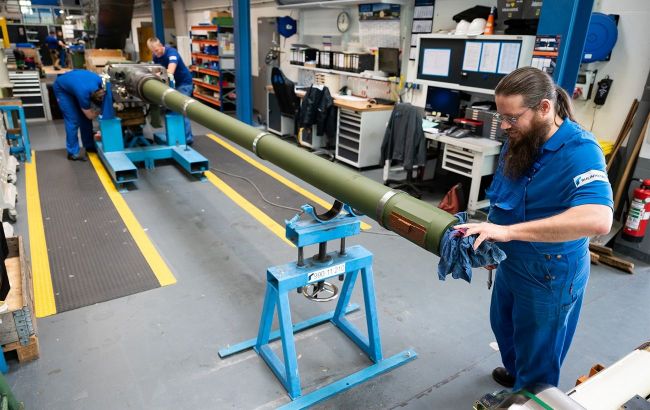 Rheinmetall's German plant (Photo: Getty Images)
Shares of US and European defense giants have unexpectedly taken a nosedive. Despite the prolonged conflict in the Middle East and massive Pentagon spending, investors are dumping defense stocks in droves, reports the Financial Times.
Stock prices of major defense contractors — including Lockheed Martin, Northrop Grumman, RTX, L3Harris, and General Dynamics — began falling right after the US launched strikes on Iran in late February. The market is reacting to a production bottleneck: battlefield demand is outstripping factory output.
According to analyst estimates, the US military has fired roughly 1,000 Tomahawk missiles at Iran over the past two months. That’s 20 times more than the number funded in the Navy’s annual budget.
Steven Gray, chief investment officer at Grey Value Management, explained that the US was burning through munitions much faster than it could produce them. He added that defense companies might receive some money upfront, but they typically did not book profits until they actually delivered. He questioned why stock prices should rise any further from already elevated levels based on earnings that would not materialize for years if it took years to deliver.
Market Paradox: Buy the tension, sell the war
Investors have shifted strategies, and money is now flowing out of defense funds. Nearly $1 billion was pulled from the $14 billion iShares US Aerospace & Defense ETF alone. Capital is rotating into safe havens: energy and utilities.
Scott Mikus, analyst at Melius Research, calls this a classic market dynamic:
"It is what we call a 'buy the tension, sell the war' dynamic."
A similar pattern played out during the 2003 invasion of Iraq and after Russia's full-scale invasion of Ukraine in 2022. Shares of Lockheed Martin and RTX fell 5–10%, even though they had previously posted 50% annual gains.
Trump promises $1.5 trillion, but the market is skeptical
Donald Trump has proposed raising the US defense budget to $1.5 trillion by 2027. That would be a 50% increase over current spending — yet investors aren't rushing to buy defense stocks.
Bank of America analyst Ron Epstein stresses that the problem isn't even about money — it's about factories. Production capacity simply cannot keep up with demand.
Europe is also losing ground
The crisis has hit European markets as well. The MSCI Europe Aerospace & Defense Index fell 9.2% in March — its worst performance in five years.
The biggest losers include:
- Germany's Rheinmetall — down 10%;
- Sweden's Saab — down 12%;
- Czech CSG — shares dropped nearly a third.
Analysts suggest the defense sector may have already peaked. Weapons makers are facing a new reality: modern warfare demands cheap drones, not just expensive missiles.
Current state of the defense market
Donald Trump has acknowledged that the wars in Ukraine and Iran have drained US defense stockpiles. Officials are now in talks with industry about tapping civilian production lines to manufacture ammunition and military equipment — negotiations are underway with both General Motors and Ford Motor.
With US arsenals running empty, NATO and the EU are pushing to accelerate weapons production in Europe — focusing not just on volume but on production speed.
Meanwhile, Japan is beginning to mass‑sell lethal weapons due to dangerous neighbors. Prime Minister Sanae Takaichi has finally scrapped long‑standing restrictions on arms exports during a cabinet meeting in Tokyo.