Constant air raid alerts in Kyiv: Expert explains Russia's strategy against businesses


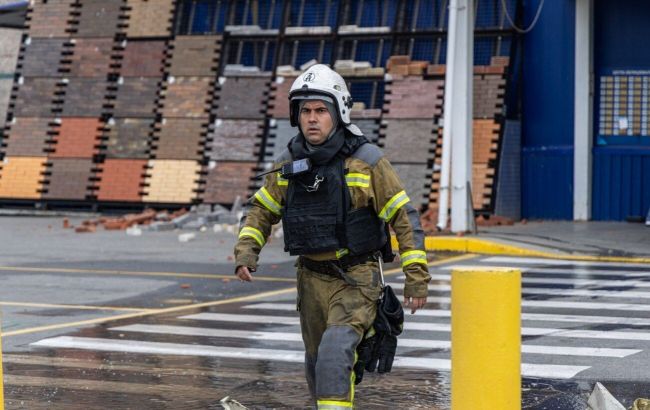 Photo: Russia has begun targeting Ukraine’s economic rear (t.me/dsns_telegram)
Since the night and throughout the day on August 27, Kyiv and parts of Ukraine have been under continuous Russian air attacks. Critical infrastructure and warehouses belonging to retail chains have been among the targets.
RBC-Ukraine explains what is behind the prolonged Russian air attacks and what to expect next.
Russia has been attacking Ukraine since the night of August 27. Kyiv and the Kyiv region, Kryvyi Rih, Odesa region, Kharkiv, Zaporizhzhia, Sumy region, Poltava region, Cherkasy region and other regions have come under attack.
During the day, waves of jet-powered drones continued to target the capital and gradually merged into the evening attack. Debris fell near schools and kindergartens, while one drone crashed directly onto a roadway in the central part of the city. Four people were injured.
In Kharkiv, Russian forces struck the Epicentr shopping center during the day. One man was killed and five other people were injured in the attack.
At the same time, the strike once again highlighted another trend: Russia is targeting Ukraine’s economic infrastructure and businesses. During the attack, Russian forces damaged logistics centers belonging to Budynok Igrashok, Fora and Comfy, as well as destroyed a Roshen warehouse.
Residential buildings in the Kyiv region were also damaged, while energy facilities in the Poltava and Kherson regions came under attack. Russian forces shelled Nikopol and attacked Kramatorsk with guided aerial bombs.
Warehouses and logistics under attack
According to Ukrainian Armed Forces serviceman and military-political expert Oleksandr Musiienko, the shift in targets is not accidental.
"The enemy is focusing on weakening the overall economic potential of Ukraine and the capital," he told RBC-Ukraine.
According to him, while critical infrastructure facilities such as energy, gas and water supplies were previously the main targets, Russia is now increasingly striking industrial facilities, civilian production, warehouses, logistics hubs and ports.
"One feature of the current attacks is that the enemy is indeed concentrating its strikes on Kyiv. And it should be said that the capital has been and will remain a focus for Russian attacks. The number of attacks will not decrease," Musiienko said.
According to the expert, the goal is to weaken Ukraine economically and inflict maximum damage on the rear. This involves a deliberate attempt to disrupt logistics, retail and businesses away from the front line, while Russian forces are unable to make significant advances on the battlefield.
Russia ramps up its arsenal of jet-powered drones
The expert also highlighted Russia’s development of jet-powered drone production and the growing number of launch sites. In addition, it is increasingly relying on the use of cheap Banderaol-type cruise missiles.
According to him, jet-powered drones can currently travel 500–600 km. This poses a threat primarily to Ukraine’s northern, eastern, southern and central regions, including the capital.
There have also been cases of these drones being used against western regions. This may indicate that Russia is working to increase the range of such UAVs.
Moreover, isolated flights of these drones toward western Ukraine suggest that the enemy may be reducing their warheads to make room for additional fuel tanks, testing the UAVs as reconnaissance platforms ahead of missile strikes.
"Russia is increasing the number of these drones. The war is increasingly moving into the air domain," the expert explained.
Will such drones be able to attack Kyiv regularly?
Such scenarios cannot be completely ruled out. The expert notes that Russia could conduct individual or group launches toward the capital, sometimes involving up to 20 jet-powered drones.
At the same time, Ukraine is already working on countermeasures. Jet-powered drones can be destroyed by air defense units, aircraft and, under certain conditions, air defense artillery. Work is also underway on interceptor drones. However, according to the expert, mass deployment of such systems is not yet possible, as manufacturers are still completing testing.
Thus, Russia is not only increasing the number of its air attacks but also changing their targets — from strikes on critical infrastructure to systematic pressure on Ukraine’s economy, logistics and rear.