Coalition of the Willing at risk of collapse as Europe faces political shake-up

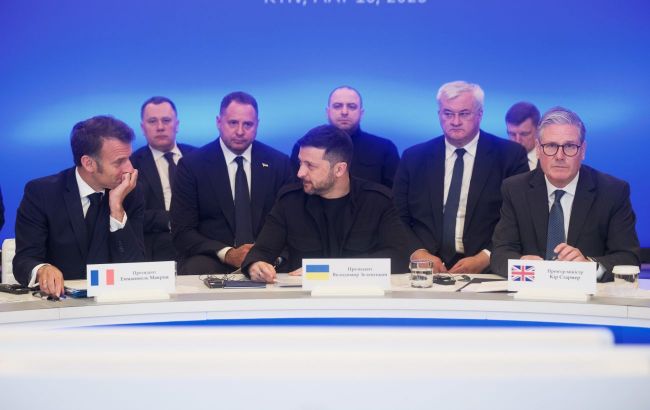 Photo: Ukrainian President Volodymyr Zelenskyy, French President Emmanuel Macron, and former British Prime Minister Keir Starmer (Vitalii Nosach, RBC-Ukraine)
Europe risks losing two key architects of support for Ukraine—Starmer has already left, and Macron will not be able to run in the next French election, according to The Telegraph.
The diplomats' main concern centers on Macron’s impending departure—the French President is set to leave office after next year's election, and there is no obvious successor who would continue his course.
The bookmakers' favorite is far-right leader Marine Le Pen, who has promised to withdraw France from NATO’s military command, lift sanctions against Russia, and force Kyiv to agree to peace on Moscow's terms. Her rival on the left, Jean-Luc Mélenchon, has gone even further, promising a complete withdrawal from the Western alliance.
According to a source cited by The Telegraph, British officials are already assessing what a victory for either of them would mean for the future of the coalition and the sharing of classified intelligence. A Western official explicitly warned of a major problem for NATO in such a scenario.
Who could take up baton and why they're not ready
The most obvious candidate to replace Macron, alongside Britain, is German Chancellor Friedrich Merz, who is reforming the Bundeswehr into Europe’s largest army. But Merz himself is mired in a domestic crisis and is increasingly facing doubts about how much longer he will remain in office.
Roderich Kiesewetter, a member of parliament from his own party and a former colonel, called the CDU leader "no Churchill." According to him, both the CDU and the Social Democrats are plagued by the so-called Moscow connection—some members of both ruling parties are ready to return to normal relations with Russia once the war ends.
This, according to the lawmaker, explains why Merz is holding onto the Taurus long-range missiles and not confiscating Russia's shadow fleet vessels.
"Mr Merz must also fight against this Moscow connection," Kiesewetter says.
The chancellor also thwarted EU attempts to ban the free movement of Russian diplomats within the Schengen Area and refused to close Berlin’s Russian House—a cultural center believed to be a front for a network of Moscow spies.
"This is no leadership, and so who might lead Europe then? We need a Churchill. We have had several Churchill moments, but we have no Churchill in Europe so far," the lawmaker concluded, warning that the West’s indifference could force the Ukrainian government to seek support from other powers in the region.
Poland and Italy are also unlikely to fill the vacuum: both leaders, Donald Tusk and Giorgia Meloni, have refused to send troops to Ukraine and face elections by the end of next year, so they are in no position to claim the role of Europe’s new leaders.
And what about UK?
Starmer’s successor, Andy Burnham, has a firmer grip on domestic policy but limited experience in foreign affairs. He held his first meeting with a foreign leader in his new role with Zelenskyy, hosting him in Portsmouth, thereby signaling to allies that the course of supporting Ukraine and NATO will remain unchanged.
It was the Starmer-Macron partnership that, in its time, overcame years of disputes between London and Paris in the pursuit of shared leadership in Europe amid Trump's indifference, uniting more than 30 countries in support of Ukraine and the plan to clear mines from the Strait of Hormuz.
While Starmer’s departure was accompanied by recognition of his achievements, Macron’s exit will likely be viewed with much greater concern, unless Burnham manages to single-handedly assume the role of leader of the Coalition of the Willing.
The Coalition of the Willing has repeatedly served as a platform for specific defense initiatives in support of Ukraine. In July, Ukraine, together with nine European countries, formed an anti-ballistic missile coalition, whose members agreed to strengthen missile defense jointly.
At that time, on July 13, members of the Coalition of the Willing were preparing a significant boost to Ukraine’s air defense; according to Reuters, Kyiv’s allies already had a concrete plan of action.