China issues official ID card to AI singer, opening door to banking and business

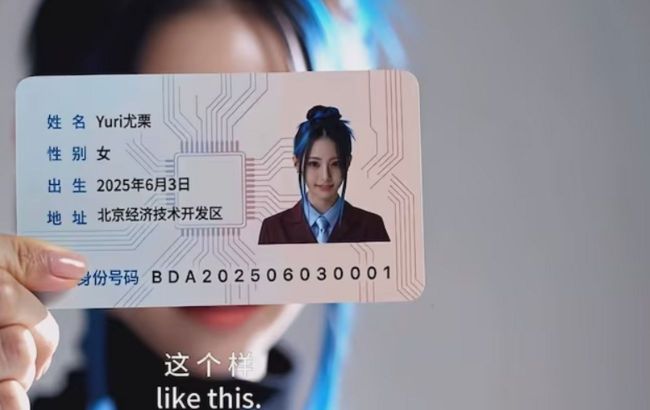 Chinese authorities issue passports to AI celebrities (screenshot: Yuri)
Chinese virtual singer Yuri has become the first digital human to receive an official government-issued ID card. The document includes her name, date of birth, address, and biometric data, ABC News reports.
Official passport, bank accounts, and business
Obtaining an official ID card allows the virtual singer's operators to open a digital currency wallet for financial transactions.
This creates opportunities to sign commercial contracts with fashion brands, car dealerships, and game developers.
Yuri was created using generative AI and performs at virtual concerts attended by thousands of viewers. The digital avatar speaks several languages.
A team of technical specialists is responsible for her development and interactions with more than 100,000 fans on social media.
According to industry reports, China's digital human market is worth tens of billions of yuan, with more than one million businesses operating in the industry.
Where are digital humans used?
Virtual avatars have become widespread in China's media landscape. They host round-the-clock livestreams to sell products, appear in television series, and present the news.
Government agencies are also actively using the technology:
-
Virtual officials respond to citizens' inquiries at government institutions.
-
AI presenters cover annual political congresses and government reports.
-
Digital avatars participate in professional development and ideological education programs.
Fighting fraud and new challenges
The introduction of a registration and identification system is linked to the growing number of fraud cases.
There have been cases online in which virtual AI doctors provided questionable medical advice, while the faces of real celebrities were used to create pornographic deepfakes and unauthorized advertisements.
Digital ethics experts note that since artificial intelligence cannot be held criminally liable or sued, registration and ID verification make it possible to identify the specific company that owns the AI avatar and is responsible for violations of the law.
However, cybersecurity experts warn that mandatory registration of digital avatars deprives users of anonymity and could increase censorship and self-censorship online.