Can Ukraine’s nature recover from war? Experts warn of critical ecological damage

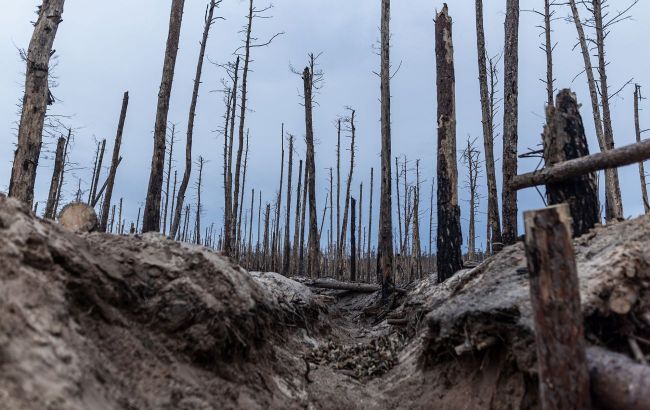 The forests have been the most severely damaged as a result of the war (illustrative photo: Getty Images)
Today, every ecosystem in Ukraine is suffering from the destructive impact of the war. In some places, these processes have turned into a real chain reaction, the consequences of which may become critical for the environment.
This was stated by an academician of the National Academy of Sciences of Ukraine, head of the Department of Geobotany and Ecology at the M.G. Kholodny Institute of Botany, Yakiv Didukh.
Main points:
- Catastrophic losses: the war is destroying unique ecosystems, including the Serebrianskyi Forest and relic chalk pine forests, which were protected at the European level.
- Problem of minefields: large areas of steppe have become inaccessible, leading to their gradual degradation.
- Chain reaction: the destruction of forests is not only the loss of timber, but also the death of biodiversity and the destruction of soil cover, which requires decades to recover.
- Difficulty of rehabilitation: Nature is mostly unable to quickly “absorb” trenches and craters, and full restoration of forests requires not only time but also significant technical and financial resources in some cases.
Which ecological losses are the most painful
According to the expert, forests in Ukraine have been most severely damaged by the war.
“They suffer not so much from direct strikes as from fires. Sometimes the enemy sets them on fire deliberately so that our soldiers have nowhere to hide,” the scientist explained.
He noted that the loss of the Serebrianskyi Forest in the Luhansk region is “one of the greatest environmental damages caused by the war.”
“Once these were wonderful pine forests, although partly artificially planted. But there were also natural alder groves and wetland areas. Now these vast forest areas have been destroyed,” the expert said.
A unique habitat of relic chalk pine forests in the “Sviati Hory” National Park has also been lost.
“This site was included, according to our proposals, in Appendix 4 of the Bern Convention. That means it was subject to protection at the European level,” Didukh reminded.
Another problem affecting forests is trenches, which “disrupt the entire structure of ecosystems and soil cover.”
“They are difficult to fill in because machinery cannot access many areas,” the academician said.
Didukh explained that steppe areas have suffered less from fires, but they are heavily mined.
“This year we worked in the Kherson and Mykolaiv regions — we were basically walking through ‘minefields.’ These territories will remain inaccessible for mowing or grazing for decades, because demining is first focused on agricultural land,” the expert said.
In addition, many villages have been destroyed due to the fighting (people have left, and there is nowhere to return).
“This means that even mine-free steppe areas are abandoned. No one goes there, and cattle are not grazing. Over time, they will begin to be overgrown with shrubs, and we may lose them. In other words, every ecosystem is suffering from a specific type of impact,” the scientist noted.
Can nature absorb trenches on its own?
Didukh recalled that in Ukraine, there are places where trenches from World War I are still visible.
The restoration of microrelief, he said, depends on the soil.
“Sandy, mobile substrates level out more quickly. But if such trenches are in steppe areas on limestone or chalk outcrops, they will never disappear on their own,” the expert explained.
He added that “trenches and craters from mines and shells become colonized by invasive (alien) species, which facilitates their further spread into natural ecosystems.”
“And if they are filled in, natural vegetation will recover within a few years. However, this requires additional costs, and machinery cannot reach all areas,” the academic said.
At the same time, he acknowledged that “natural absorption of trenches will take a very long time.”
Why the loss of forest plantations is critical
“We need to understand that with the loss of forests we lose not only timber, but also herbaceous plants, animals, and soil microorganisms,” said Didukh.
In other words, a “chain reaction” occurs.
“Such losses of ‘ecosystem services’ must be assessed, because their restoration requires both time and technical and material resources,” the academician noted.
As an example, he mentioned the fires in the Chornobyl exclusion zone.
“As a result of the hostilities, the trees burned down, and the remains could not be removed. This hinders the restoration of natural species,” the expert explained.
He added that “since the processes were disrupted,” invasive (alien) species began to spread there, displacing native plants.
That is why, according to him, foresters must monitor restoration processes.
“Somewhere trees should be replanted, and elsewhere, on the contrary, excess vegetation should be removed… For a full-fledged forest to form, it takes at least 60 years,” the scientist concluded.