Bulgarian 'Orbán-style' leader scores landslide parliamentary win, exit polls say

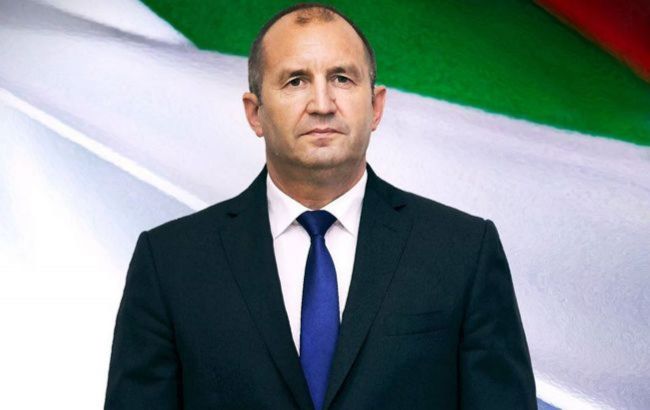 Former Bulgarian President Rumen Radev (photo: facebook.com/President.bg)
The Progressive Bulgaria party of former president Rumen Radev is securing a decisive victory in early elections to the National Assembly, according to News.bg and Alpha Research.
Voting results, balance of power
Radev's political force is leading with 35.7% (or up to 37.5% by other estimates), based on preliminary exit polls.
Second place goes to the Citizens for European Development of Bulgaria – Union of Democratic Forces (GERB-UDF) bloc with about 16.2%, followed by the We Continue the Change – Democratic Bulgaria (PP-DB) coalition with 14.3%.
According to preliminary counts, the following parties are also entering the 52nd National Assembly:
- Movement for Rights and Freedoms (DPS) — 8.4%
- Revival — 4.8%
- Bulgarian Socialist Party (BSP) — 4.1%.
Other political forces, including There Is Such a People (ITN) party, are currently failing to cross the required threshold, receiving around 1% of the vote.
Seat distribution in parliament
According to preliminary counts, Progressive Bulgaria could secure around 110 seats in the new parliament, making it the key force in forming a future coalition.
The GERB-UDF bloc is projected to win 44 seats, while the PP-DB coalition could obtain 39 mandates. The remaining seats are expected to be distributed among DPS (21 seats), Revival (14 seats), and BSP (12 seats). In total, 240 lawmakers are elected to the 52nd National Assembly.
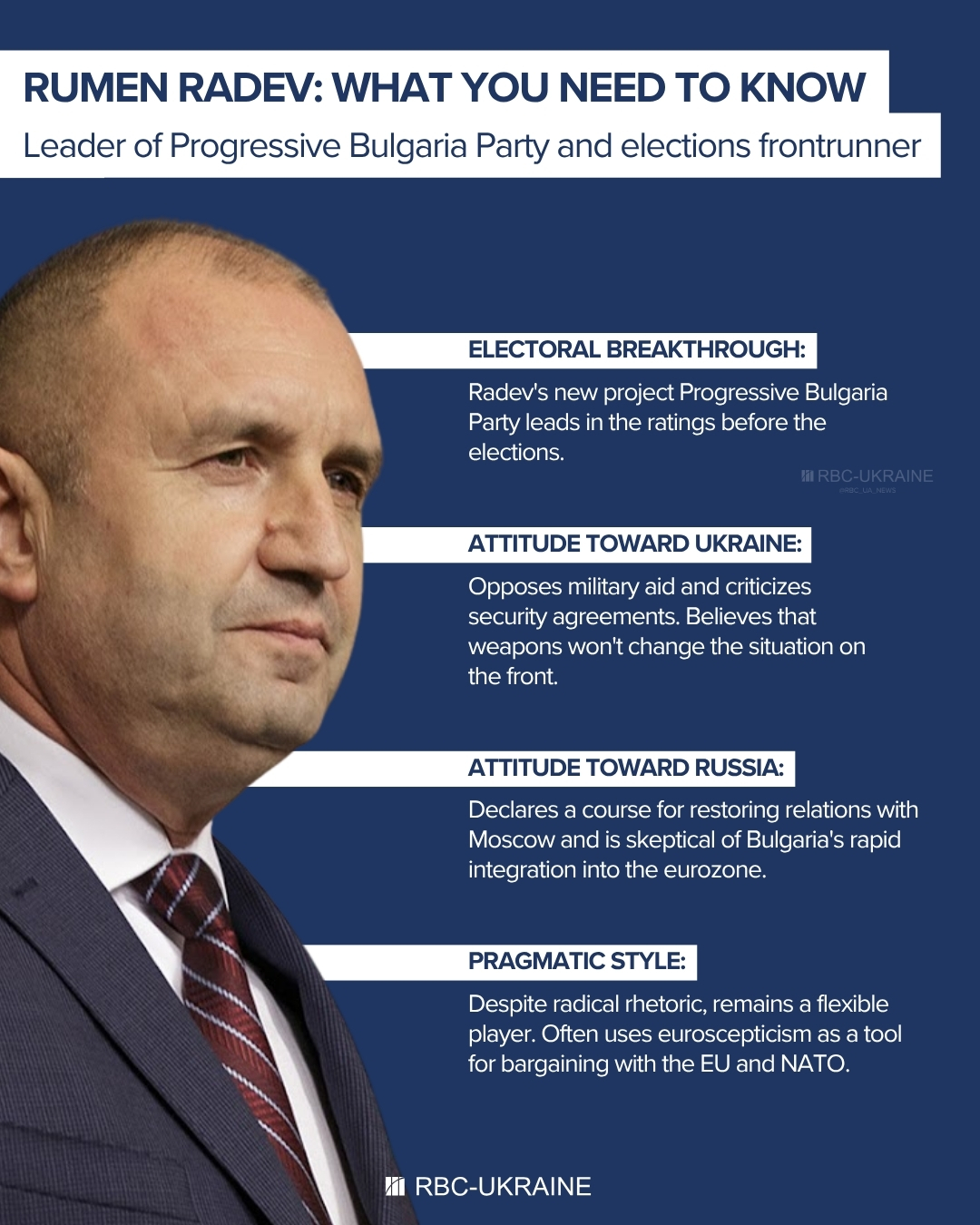
Key facts about Rumen Radev (infographic: RBC-Ukraine)
Electoral process
The April 19 vote marked Bulgaria's eighth election since 2021. Citizens elected 240 members of parliament across 31 multi-member constituencies.
The electoral process was organized by a caretaker government headed by Andrey Gyurov.
The official results will determine the composition of the new parliament, which will be responsible for forming the government and adopting the state budget.
Potential political deadlock
Despite a strong showing, the election winner does not have enough seats to form a government on its own. At the same time, key pro-European forces, including GERB-UDF and PP-DB, have already publicly rejected the possibility of joining forces with Radev's party.
This situation indicates a high likelihood of another political crisis. If no compromise is reached, the country could face the appointment of another interim technical government and the prospect of new snap elections.
Risks for Ukraine
This election in Bulgaria is taking place amid concerns about a strengthening pro-Russian orientation.
RBC-Ukraine previously reported that Rumen Radev has emerged as a leading figure in public support. He is often compared to Hungarian Prime Minister Viktor Orbán due to his rhetoric and openness to contacts with the Kremlin. His potential influence on the government could create additional obstacles to support for Ukraine within the EU and NATO.
In addition, Bulgaria has recently been included in the list of countries where systemic problems with democracy are recorded.
Earlier reports also stated that human rights defenders named five EU countries, including Bulgaria, whose governments are consistently and deliberately undermining the rule of law and democratic standards.