Artemis II astronauts return to Earth as NASA details landing risks

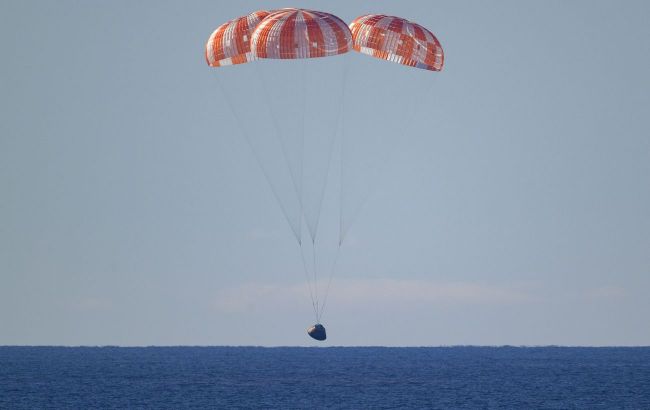 Photo: Artemis II mission astronauts return to Earth (NASA/Bill Ingalls)
An international crew of astronauts successfully splashed down in the Pacific Ocean off the coast of California inside the Orion spacecraft capsule. However, there was a major risk that the return to Earth could become problematic, according to CNN.
The astronauts covered a record distance from Earth, farther than any human had previously reached. The previous record belonged to the Apollo 13 mission, set back in 1970.
Fortunately, the flight was successful, and all systems operated normally. Immediately after splashdown, spacecraft commander Reid Wiseman radioed the mission control center in Houston.
"What a journey. We are stable. Four green crewmembers," Wiseman said.
This means that all four astronauts are in excellent condition. At the Johnson Space Center, there was tense silence. Dozens of journalists were waiting for the signal. When communication was restored after re-entering Earth's atmosphere, the hall burst into applause.
Hell in the atmosphere: 4,000 degrees and purple plasma
Returning to Earth is the most dangerous phase. It is more difficult than landing an airplane. The process began at an altitude of 122 kilometers. Orion slammed into the dense layers of the atmosphere at tremendous speed.
Outside, something incredible was happening — physical processes were tearing apart air molecules. A purple mass of plasma formed around the capsule and completely blocked radio communication for a full six minutes.
The astronauts felt tremendous pressure on their chests. The G-forces reached 4 G (4 times each person's body weight). The external temperature was extreme. NASA representative Kenna Pell explained the scale of the ordeal:
"Depending on the trajectory, the heating can range between 3,000 and 5,000 degrees. We are expecting it to be around 4,000 degrees for today’s trajectory."
If something had gone wrong, Orion would have switched to an emergency trajectory. In that case, the crew would have experienced 7.5 G-forces.
Parachutes and pinpoint landing accuracy
The speed was tremendous, exceeding the speed of sound by 30 times. The brutal physics of braking helped shed velocity. At an altitude of 7.6 kilometers, the first parachutes were deployed.
NASA needed to precisely record the capsule's GPS coordinates. Intelligence systems manager Sean Quinn noted that this allows the Integrity recovery team to reach the object within minutes. The capsule was to be found at point Bravo.
A special series of parachutes slowed the vehicle to 32 km/h. After the impact with the water, the team confirmed that Orion was standing vertically.
Two hours of full evacuation
The astronauts cannot immediately go ashore. First, the crew was transferred to a special front porch raft. Then they were picked up by a helicopter. The final destination is the US Navy ship USS John P. Murtha.
The entire process took about two hours. Why so long? The crew powered down Orion's systems. Divers checked the water for toxic fuel or ammonia, and medics conducted the first examination right inside the capsule.
The astronauts exited one by one. First was Christina Koch. Then Victor Glover and Jeremy Hansen. The last to leave the spacecraft was Commander Reid Wiseman.
Currently, all four researchers are safe and under medical supervision. This flight paves the way for the next stage of the program — landing humans on the surface of the Moon.
What other interesting space news is there
China, after the failure of Russia's space industry, is set to become the main space competitor to the US. Beijing will prioritize space, artificial intelligence, and humanoid robotics for development over the next five years.
Meanwhile, the Ukrainian Hydrometeorological Center showed the trace of a cold front from space. Meteorologists also explained how polar air flows into our latitudes and affects the weather.
Additionally, it has become known that a meteorite fragment fell onto a house in Germany. A piece the size of a soccer ball hit the roof and then fell into a bedroom.