Antarctic ice transformed into giant detector to study cosmos

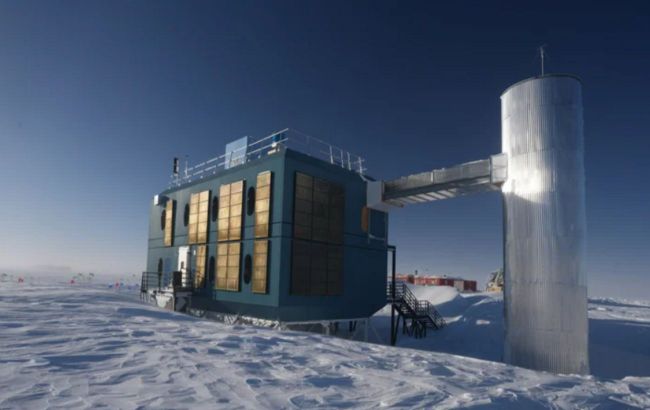 Antarctic ice became the IceCube telescope (photo: IceCube Neutrino Observatory)
The IceCube Observatory has undergone its first major upgrade since 2010, adding hundreds of ultra-sensitive light detectors. Thanks to this, scientists will be able to study supernova explosions, black hole mergers, and the origin of cosmic rays in greater detail, according to the IceCube Neutrino Observatory.
How does the telescope work?
Neutrinos are formed during nuclear reactions and particle decay throughout the Universe. They have virtually no mass, carry no electric charge, and extremely rarely interact with ordinary matter.
Instead of directly observing neutrinos, IceCube records the results of their rare collisions with ice atoms:
- As a result of the interaction, charged secondary particles are produced.
- They move through the ice and emit blue Cherenkov radiation.
- This light is detected by over 5,000 optical sensors embedded in the transparent and stable Antarctic ice.
Why was the equipment upgrade necessary?
Natural ice contains dust and crystals that scatter and refract light rays. To improve measurement accuracy, scientists have added hundreds of new sensors that are 2–3 times more sensitive than the previous generation.
Scientists have also installed new calibration instruments. They will allow more precise measurement of the optical properties of the ice around the observatory and reassessment of the accumulated 15-year data archive.
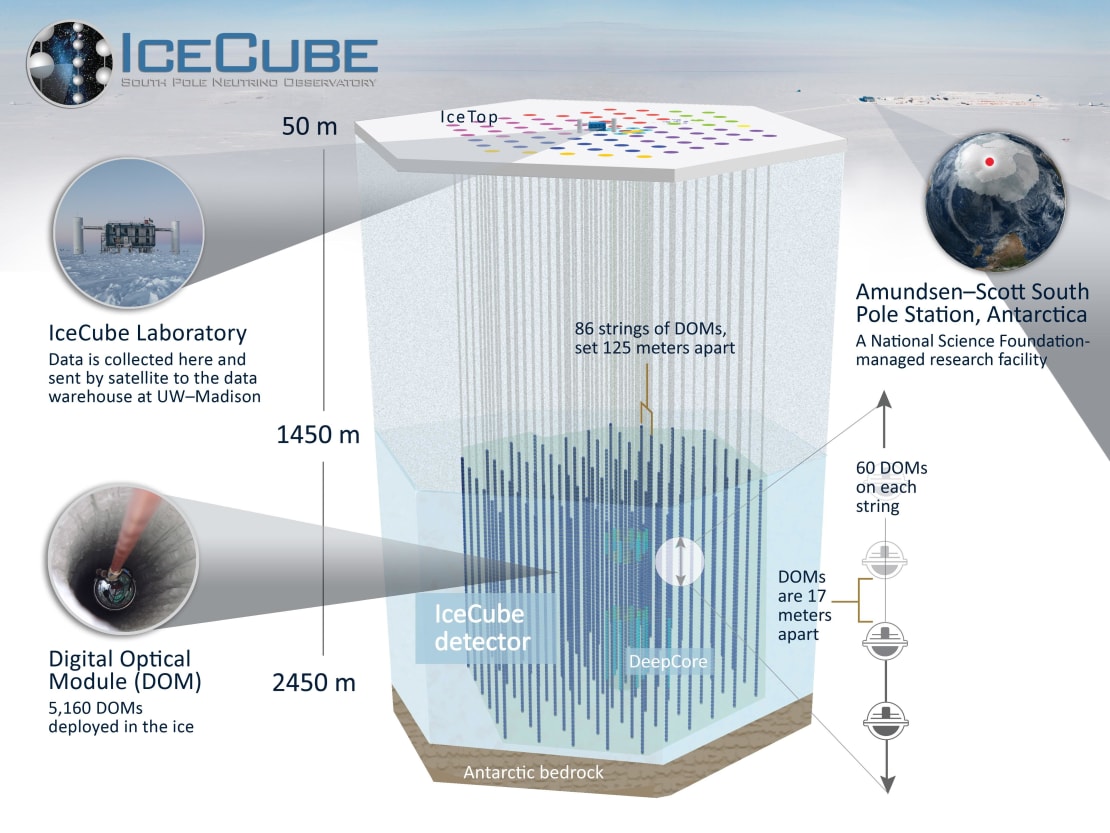
In Antarctica, the unique IceCube telescope has been upgraded for $53 million (diagram: IceCube Observatory)
What will IceCube help scientists discover?
Tracking the direction and energy of neutrinos allows scientists to identify the sources of the most powerful explosions in the Universe.
Which ones exactly?
Black hole and neutron star mergers: Combining neutrino data with gravitational waves will reveal particle acceleration mechanisms during cosmic catastrophes.
Galactic supernova explosions: Neutrinos escape from the depths of a dying star almost instantly, while light gets trapped in gas and dust.
Detecting a neutrino burst will serve as an early warning for astronomers, allowing them to point optical telescopes at a supernova even before the first visible light appears.
Gamma-ray bursts: Detecting neutrinos from these explosions will provide the first direct evidence that gamma-ray bursts are the source of ultra-high-energy cosmic rays.
Even more interesting reads:
Earth is not unique: 1,000 simulations debunked the main cosmic myth