Ukraine disrupts operations at 9 of Russia's largest oil refineries, cutting oil processing by 30%

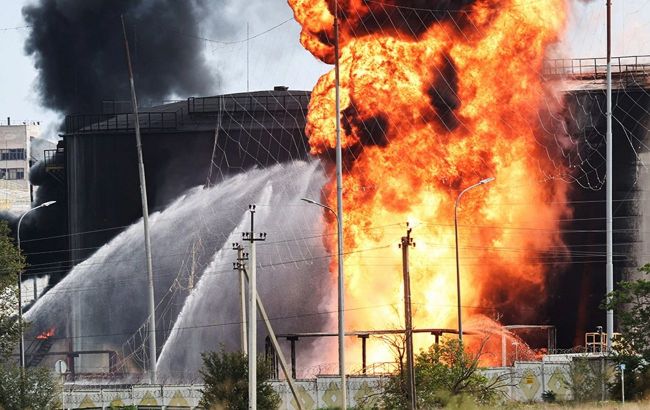 Photo: Russia's largest oil refineries are on fire again (Russian media)
Ukraine's attacks on Russia's oil infrastructure have consequences that go beyond localized fires at oil refineries, according to Ukraine's Ministry of Defense.
The ministry emphasizes that Russia is not only losing part of its oil refining capacity but also facing domestic fuel market problems and is forced to strengthen protection along key routes used to export energy resources.
In late October and November 2026, Ukraine stepped up its long-range strikes on facilities in Russia's oil industry. Major oil refineries, oil storage facilities, pumping stations, and export terminals came under attack. This points to a systematic campaign targeting not individual facilities but multiple links in the production and supply chain of petroleum products.
In just one week, Ukrainian strikes disrupted the operations of nine of Russia's 35 largest oil refineries. Actual oil refining volumes may have fallen by approximately 30%, to 200,000 metric tons per day.
These losses are significant for the Russian economy, which relies heavily on energy exports. At the same time, petroleum products are essential not only for supplying civilian consumers, but also for meeting military logistics needs.
The effects of the attacks are already being felt on Russia's domestic market. In particular, on November 9, reports emerged that Rosneft had reinstated restrictions on fuel sales at its gas stations. In some regions, drivers were allowed to purchase no more than 30 liters of gasoline in cities and 50 liters per vehicle on highways. Restrictions were also introduced on fuel sales in jerrycans.
Fuel supply disruptions were reported in Karelia, Buryatia, Zabaykalsky Krai, Krasnoyarsk Krai, and the Novosibirsk, Arkhangelsk, and Penza regions.
Previous restrictions had only begun to be lifted in late October. This means Russia's fuel market had not fully recovered from earlier disruptions before a new wave of Ukrainian strikes complicated the situation once again.
Having its own oil production does not automatically mean a country has enough gasoline and diesel fuel. Producing them requires the uninterrupted operation of oil refineries, specialized equipment, storage facilities, and transport infrastructure, alongside reliable delivery routes for finished products.
Due to damage and shutdowns, between 20% and 35% of Russia's oil refining capacity may have been out of operation. Reports also indicated that Russia had begun importing gasoline by sea, including from Türkiye, Morocco, and Egypt.
As a result, one of the world's largest oil producers has found itself in a position where it must look abroad for finished fuel to meet its own domestic needs.
At the same time, what matters is not only the number of oil refineries hit but also the nature of the damage. Strikes on key processing units that are essential for producing finished petroleum products can be particularly critical.
An oil refinery is a complex industrial facility where primary oil processing is only the first stage. Producing market-ready gasoline, diesel, and aviation fuel requires secondary processing units. These include equipment for catalytic cracking, hydrocracking, reforming, and hydrotreating.
According to estimates by the International Energy Agency (IEA), minor damage to primary processing units can be repaired within one to two weeks. However, restoring complex secondary processing equipment takes considerably longer — an average of six to eight months.
This means that even after a fire has been extinguished and some parts of a facility have resumed operations, a damaged refinery may remain unable to operate at full capacity for an extended period.
Earlier, we reported that Ukraine had struck five of Russia's largest oil refineries in several days.
It was also reported that Ukraine's Armed Forces had attacked more than a third of Russia's total oil refining capacity in just two weeks.