Another war ahead? Why Trump is warning Venezuela and what it could mean


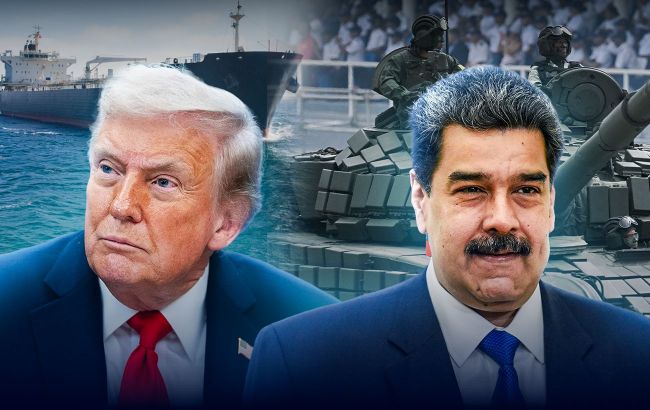 Donald Trump, President of the United States, and Nicolás Maduro, President of Venezuela (collage: RBC-Ukraine)
The United States is increasing pressure on Venezuela by beginning to detain tankers transporting its oil. Increasingly threatening rhetoric toward the Venezuelan regime is coming from Washington.
RBC-Ukraine explains why Trump has turned his attention to Venezuela, what interests the United States is pursuing, and whether the situation could escalate into an armed confrontation.
Key questions:
- How is the United States increasing pressure on Venezuela?
- What do Trump's statements about returning US assets mean?
- What should be expected next?
After months of focusing on the Russia–Ukraine war, Donald Trump has once again shifted attention to another part of the world. On December 16, the US president announced "a total and complete" blockade of ports in Venezuela through which its oil exports pass. This represents a radical increase in pressure on the South American country.
What began as a fight against drug trafficking has already grown into a conflict over oil assets and a threat to the regime of Nicolás Maduro, who rules Venezuela.
From drugs to oil
In September, the United States deployed a powerful military flotilla off the coast of Venezuela, including destroyers, a submarine, and several thousand Marines. In addition, combat aircraft were stationed in Puerto Rico.
Although relations between the United States and Venezuela have been difficult for many years, with Trump's return to the White House, tensions have reached a new level. The US president has emphasized the fight against illegal migration and drug trafficking. In this context, his attention was drawn to the Venezuelan cartel Tren de Aragua.
This year, the United States officially designated it a transnational terrorist organization. The US accuses Tren de Aragua of drug trafficking, human trafficking, and several other serious crimes. Moreover, according to Washington, the regime of Nicolás Maduro is closely linked to the cartel.
It was precisely to combat Tren de Aragua that the US fleet was deployed off the coast of Venezuela. However, over time, Trump's rhetoric began to include other claims against Venezuela. From mid-December, the US president began speaking about the return of assets that, in his view, Venezuela illegally expropriated from American companies.
"They (the Venezuelans - ed.) took all of our oil not that long ago. And we want it back," the US president said on December 17.
According to him, the pressure will continue until Venezuela compensates for these losses, including oil fields and infrastructure.
Which assets Trump is referring to
The issue primarily concerns oil assets in the Orinoco Belt region — a large basin of the river of the same name in eastern Venezuela, where some of the world's largest reserves of heavy crude oil are concentrated.
During the presidency of Hugo Chávez, who ruled Venezuela from 1999 to 2013, the country's government carried out large-scale nationalization of the oil industry.
In 2007, the state-owned company PDVSA forcibly seized assets from US giants ExxonMobil and ConocoPhillips, which refused new partnership terms with the government that required transferring majority ownership to the Venezuelan side. These companies had invested billions of dollars in developing the fields, but Chávez justified the nationalization as necessary to return the oil to the people.
The assets are now under PDVSA's complete control. Still, their condition is far from ideal due to chronic underfunding, corruption, and the impact of US sanctions imposed during the former US President Barack Obama administration and later strengthened under Trump.
Oil production in Venezuela has fallen from more than 3 million barrels per day in the early 2000s to less than 1 million barrels per day now, and the fields require urgent investment to increase output again.
According to the International Centre for Settlement of Investment Disputes, Venezuela has still not paid full compensation to US companies — ExxonMobil received only part of the $10 billion it demanded. In comparison, ConocoPhillips continues legal battles over $2 billion.
Threat to Maduro's power
Officially, the White House insists that the primary goal of the pressure is the fight against narco-terrorism and the return of assets. At the start of the operation in September, when the focus was exclusively on drugs, mainly military options were considered for intercepting cartel vessels and striking their bases.
At the same time, even then, the US media cited evidence from White House sources that Trump was considering various options for further action — including the overthrow of the Maduro regime. Moreover, US Secretary of Defense Pete Hegseth directly accused the Venezuelan leader of involvement in drug trafficking, calling him an illegitimate leader.
Similar rhetoric has also been heard from other members of Trump's team. Most recently, on December 23, US Permanent Representative to the UN Michael Waltz said that the United States does not recognize Maduro and his associates as legitimate leaders of Venezuela, adding that Maduro and his regime had rigged elections and that the international community has evidence of this.
Trump's contacts provided additional grounds for such discussions with María Corina Machado. She is the leader of the Venezuelan opposition, who this year received the Nobel Peace Prize. After the award was announced, Machado dedicated this prize "to the suffering people of Venezuela and to President Trump for his decisive support of our cause."
When Trump's rhetoric shifted to the issue of assets, the United States began considering new courses of action. White House sources cited by the Los Angeles Times report a combination of economic pressure through a tanker blockade and possible cyberattacks on PDVSA's oil infrastructure to accelerate the regime's fall.
The New York Times notes that the Trump administration is considering "maximum pressure" scenarios, including recognizing the opposition as Venezuela's legitimate authority and supporting internal uprisings, but without a direct invasion.
Escalation: Pros and cons
The situation around Venezuela remains extremely complex. The country's authorities continue to rely on support from China and Russia, which provide economic assistance and political backing on the international stage despite intensified US sanctions.
The Maduro regime has already survived numerous attempts to remove it and has experience in surviving under sanctions. At the same time, the social base of power in Venezuela, although weakened by the economic crisis, still exists.
The forces currently available to the United States in the region are not sufficient for a full-scale invasion.
"So far, if we look at the military equipment available in the region, everything points to the fact that if Trump decides to do some sort of attack, it would be something similar to Iran. Something fast, something aiming at military targets," Brazilian international relations expert Uria Fancelli previously noted to RBC-Ukraine.
In addition, such a step would undoubtedly put an end to all of Trump's plans to receive the Nobel Peace Prize. A limited operation, if successful, would make it possible to remove the Maduro regime while minimizing the risk of civilian casualties.
At the same time, according to European intelligence agencies and US media, Russia has already begun evacuating the families of its diplomats from Venezuela, which may indicate growing risks of escalation and preparations for possible complications in the region.
From the US side, the Venezuelan case demonstrates the features of Trump's approach to international conflicts — rapid escalation and pressure using a combination of different levers of influence. From military presence off the coast to economic blockade, from recognition of opposition leaders to threats against the regime. However, the question of whether this will lead to the result desired by the United States remains open, especially since Trump tends to shift attention to other issues when he fails to achieve success quickly.
All of this also applies to Venezuela. The coming weeks will show whether a combination of military, economic, and diplomatic levers of influence can produce results. However, the history of the Latin American region shows that quick solutions to such conflicts are rare — even when a powerful country exerts pressure.
For Ukraine, this experience is particularly instructive — it shows that even intense US pressure does not guarantee quick results if a conflict has deep internal contradictions and involves external players such as Russia.
Sources: CNN, El Pais, Los Angeles Times, New York Times, Bloomberg, and Reuters.