Air Force clarifies remarks about 'two-thirds of jet-powered drones' in Russian attacks

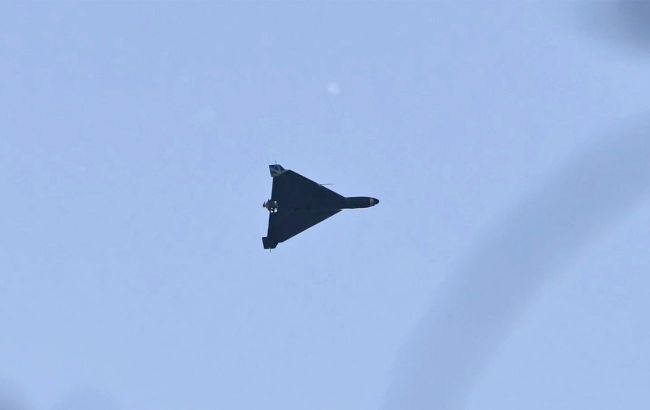 Photo: a Russian jet-powered Shahed drone (Getty Images)
Jet-powered Shahed drones sometimes account for up to two-thirds of the UAVs used in Russian attacks on Ukraine, though not in every strike, according to Ukrainian Air Force spokesperson Yurii Ihnat.
Ihnat clarified figures on jet-powered Shahed drones
Earlier, Ihnat's remarks were interpreted as meaning that up to two-thirds of the drones used in a single Russian attack were jet-powered UAVs.
The colonel provided updated figures on Shahed drones equipped with jet engines.
"During some attacks, Russia's jet-powered UAVs account for up to two-thirds of the total number of drones launched," he said.
Situation is evolving
"The enemy is increasing the share of jet-powered UAVs. In July, for example, Russia used five times more jet-powered UAVs than it did in June," he said.
At the same time, Ihnat added that in August, Russia has been launching more conventional Shahed drones.
"For example, during the overnight attack on August 14, Russia launched 108 UAVs. More than 30 of them were jet-powered," he said.
Jet-powered Shaheds used against Ukraine
Earlier, RBC-Ukraine reported that jet-powered Shahed drones are difficult to intercept. As a result, Russia is increasingly relying on this type of weapon in attacks against Ukraine.
Russia is also expanding infrastructure at its air bases to support the launch of jet-powered drones. This includes the use of long launch rails that accelerate the UAV before its engine is activated.
It was also reported that Ukrainian company SkyFall has developed a new high-speed interceptor drone, the P1-SUN Jetkiller, which is designed to effectively destroy Russian jet-powered Shahed drones.
Meanwhile, the Kremlin has focused on increasing production of jet-powered drones. The move is seen as a direct response to Ukraine's rapid development of its own interceptor UAVs.
In addition, on July 28, Russia attacked Kharkiv with a jet-powered Shahed-type drone. The UAV struck a five-story residential building, sparking a fire.