Scientists created AI chip that works like human brain

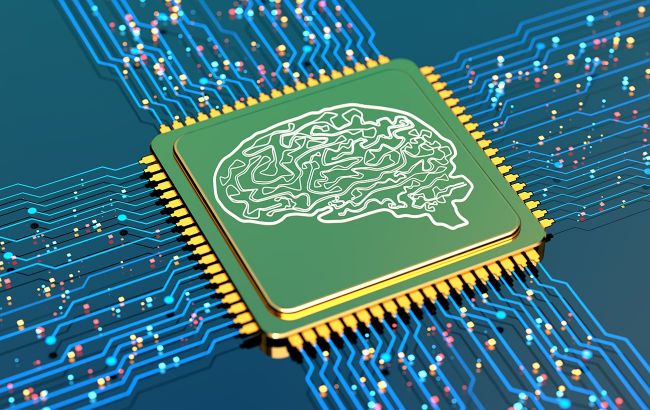 New chips learn to think like humans (photo: Getty Images)
British physicists have developed a new type of computer chip that could make AI systems thousands of times more energy-efficient. The device processes data directly in hardware, according to Interesting Engineering.
How the new chips work
A team at Loughborough University created devices with a special structure – microscopic pores in metal (niobium oxide). The design mimics the human brain, where signals are transmitted instantly through millions of neural connections.
Thanks to this structure, the chip can perform complex tasks without standard software:
- Making predictions: forecasting chaotic events based on previous data
- Restoring information: independently completing missing data fragments
- Pattern recognition: instantly identifying numbers and images at the hardware level
During tests, the system successfully handled butterfly-effect forecasting – a mathematical model in which the smallest initial error can lead to unpredictable results.
Energy savings of 2,000 times
The main advantage of the development is minimal electricity consumption. Because the chip does not require heavy software running continuously, it only uses energy for the physical transmission of signals.
Researchers claim that in some tasks, the device consumes 2,000 times less energy than standard modern methods.
“We showed how one can predict the future evolution of a complex time series using these devices at up to two thousand times lower energy consumption compared to a standard software-based solution,” the scientists said.
The researchers are confident that this innovative development opens the way to next-generation electronics capable of performing ultra-complex calculations in real time without overheating or massive resource consumption.