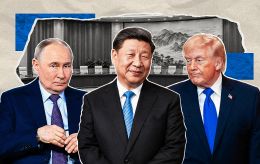
'A slap in Russia's face': How the Trump-Xi-Putin summit in Shenzhen ended


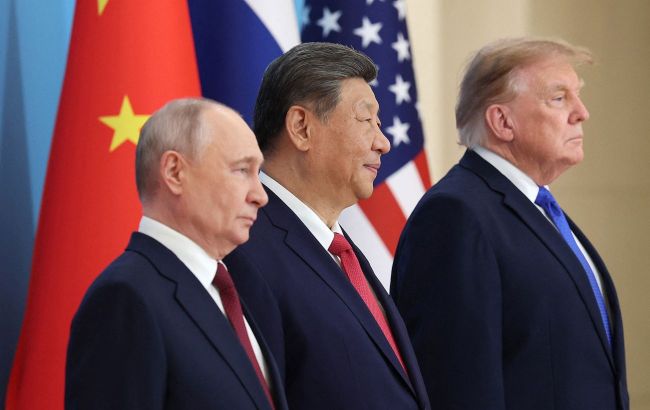 Photo: Vladimir Putin, Xi Jinping, Donald Trump (Getty Images)
The leaders of the United States, China, and Russia, Donald Trump, Xi Jinping, and Vladimir Putin, held their first trilateral summit in Shenzhen. The meeting lasted about an hour and a half, and the parties adopted a declaration on peace following the talks.
Read a report on how the summit ended, what the parties said about the war in Ukraine, and why the meeting was described as a mockery of Russia.
How the meeting unfolded and what the leaders said
Before the closed-door talks, the heads of state delivered brief opening remarks to the media (Xi Jinping spoke for 3 minutes, Putin for 2.5 minutes, and Trump for 4.5 minutes), after which they continued discussions behind closed doors. Trump and Putin later left the summit.
Xi Jinping recalled the three countries' joint fight in World War II, said that nuclear weapons must be completely banned and destroyed, and called on major powers to set a worthy example of cooperation amid "tectonic changes." He later described his talks with Trump and Putin as "positive and constructive."
Putin emphasized the countries' status as World War II victors and their shared responsibility for international security, energy and food ties, and the fight against terrorism. He briefly referred to the war against Ukraine as a "regional conflict," noting that he had addressed it during an earlier 35-minute bilateral meeting with Trump.
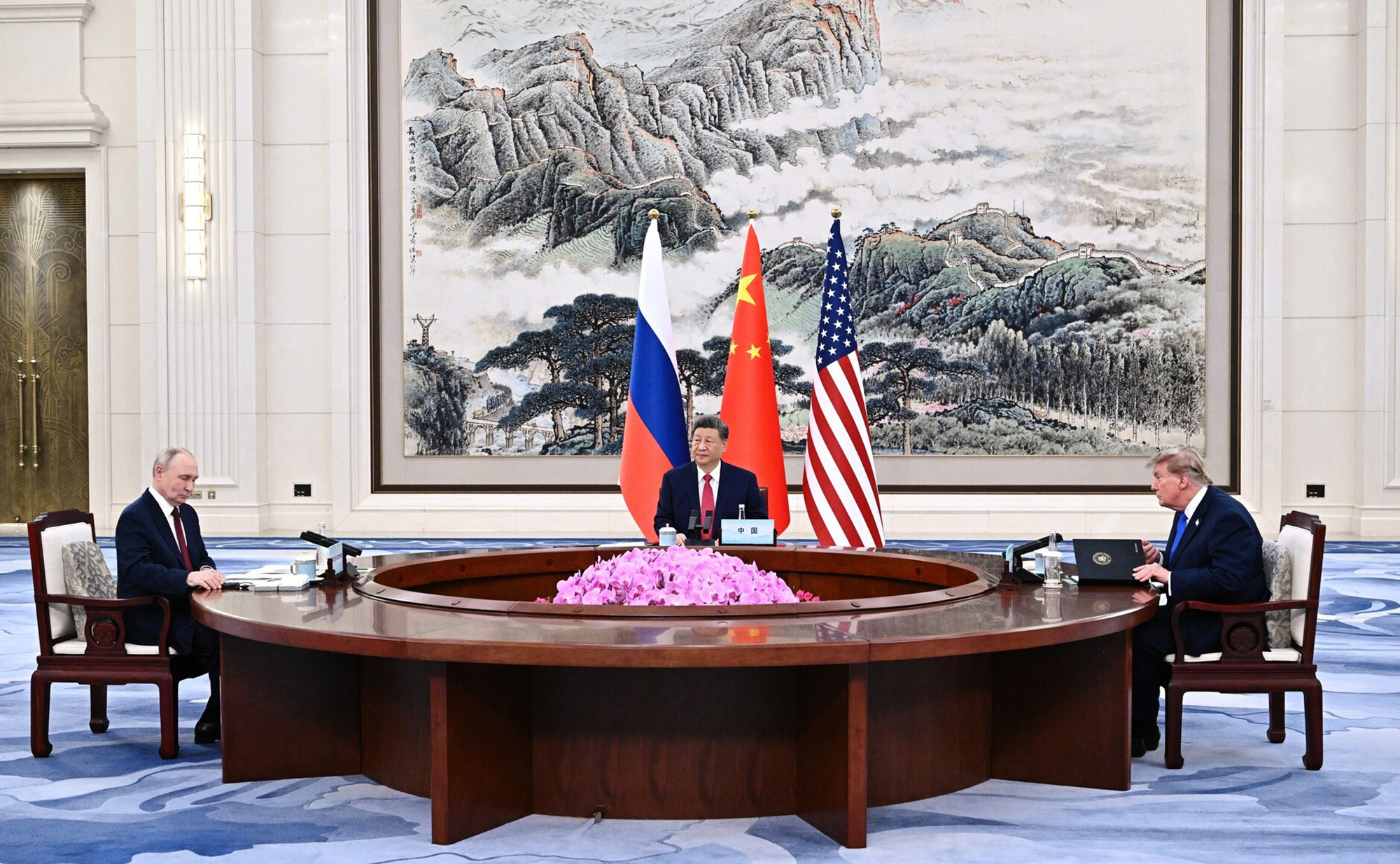 Photo: The trilateral meeting of the leaders of China, the United States, and Russia lasted only about an hour and a half (Getty Images)
Trump said that the three largest nuclear powers must reduce nuclear risks and prevent Iran from acquiring nuclear weapons. Regarding Russia's war against Ukraine, he expressed the belief that both sides want it to end.
Trump also criticized the International Criminal Court (ICC), calling it a "rogue globalist organization which has gotten out of control." During these remarks, Putin, who is subject to an arrest warrant issued by the ICC, nodded approvingly.
Final Declaration on Peace: No Ukraine or Europe
Following the talks, Beijing, Washington, and Moscow published a joint Declaration on Peace. The document makes no mention of Russia's war against Ukraine or European security. Instead, the parties outlined four general points:
-
Support for reforming the UN to respond more effectively to global challenges;
-
Plans to increase the production and supply of petroleum products;
-
A call on the ICC and similar bodies to "not abuse their powers" and respect the immunity of officials;
-
Continued dialogue on reducing nuclear risks and preventing the proliferation of nuclear weapons.
Kremlin spokesperson Dmitry Peskov later confirmed that Ukraine was not a central topic at the trilateral summit. Putin also held a separate press conference following the summit.
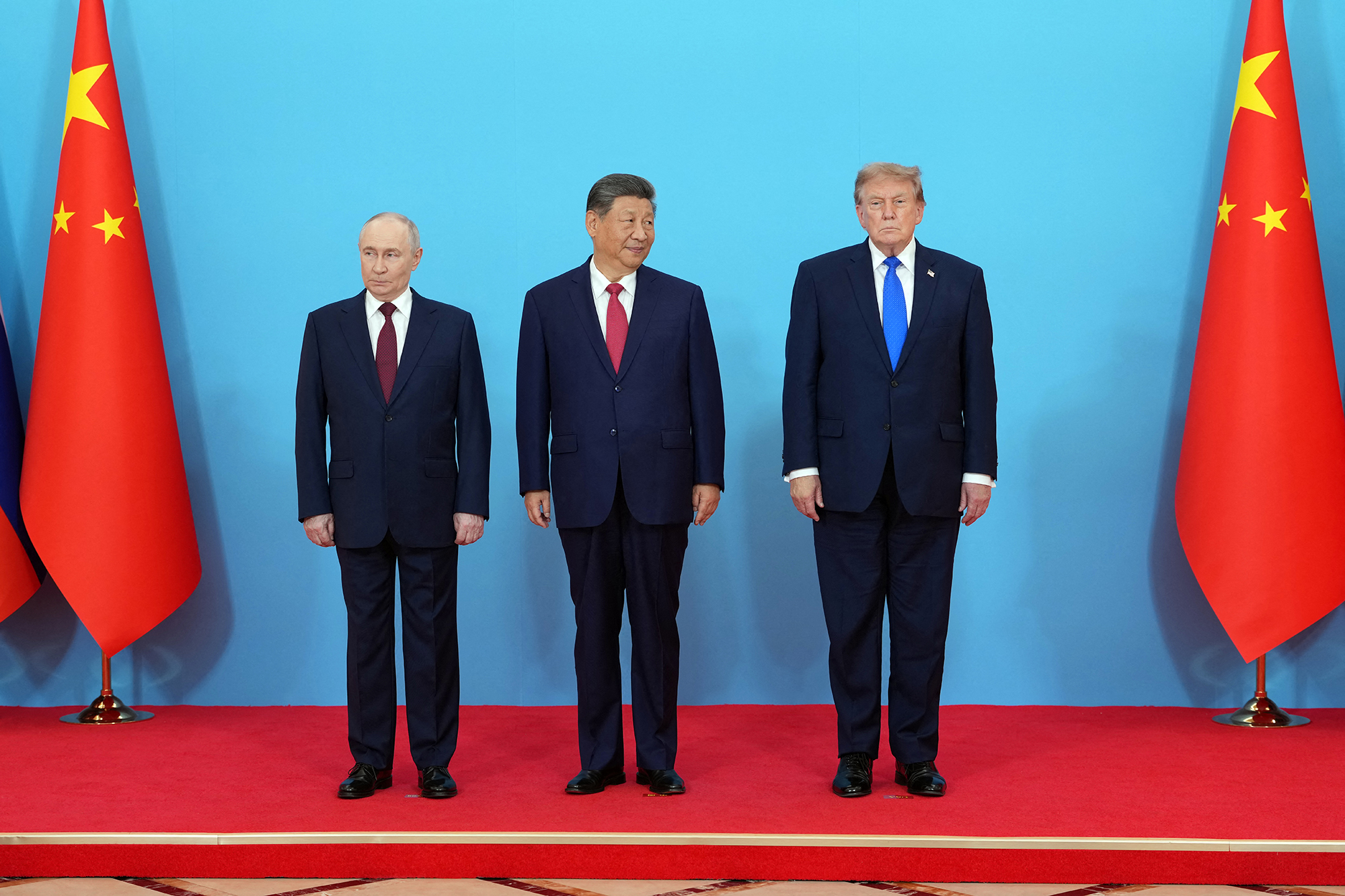 Photo: Trump, Xi Jinping, and Putin adopted a joint declaration on peace without any mention of Ukraine (Getty Images)
The Russian leader once again repeated a set of standard Kremlin narratives about the war against Ukraine, traditionally shifting responsibility for the aggression onto Kyiv and the West.
Putin claimed that Russia had "not started any war at all" and that the fighting in eastern Ukraine had been started by the "Kyiv regime." He justified his full-scale invasion by claiming that Russia was merely trying to "finish what began eight years ago," during which Moscow had supposedly "sought a peaceful settlement."
The Kremlin chief insists that Moscow agreed to US compromise proposals on Ukraine during his meeting with Trump in Anchorage. Putin accused Kyiv and Europe of being unwilling to accept these concessions, suggesting that they "may eventually come around to it."
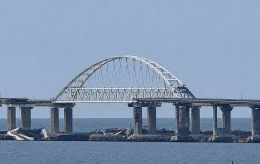
Putin also responded for the first time to Ukrainian strikes on the Crimean Bridge on the nights of November 16, 17, and 19, which resulted in the collapse of one of the bridge's arches, damage to a section of the road bridge, and damage to the railway section.
He claimed that the Crimean Bridge was "exclusively a civilian facility" and had not been used to transport military equipment and petroleum products for a long time.
Putin said that he had supposedly discussed with Russia's Security Council the possibility of a ceasefire in several areas, but that Russia would not negotiate after the strikes on the Crimean Bridge. He also threatened that Russia's response to the attacks would be "much more painful."
A slap in Russia's face, which failed to get Yalta 2.0
Political analyst Oleh Saakian told RBC-Ukraine that Moscow's attempt to create the illusion of a new Yalta (a reference to the 1945 conference that shaped Europe's postwar order) had failed, and the meeting itself was more of a ceremonial display, with each leader pursuing their own image-related goals. Trump wanted to offset negative publicity following the US elections, while Xi Jinping sought to demonstrate China's global influence.
According to the expert, Beijing used diplomatic gestures to make it clear that it does not consider Putin an equal to Trump and Xi. Evidence of this includes:
-
Airport reception: Xi Jinping personally greeted Trump at the foot of his plane's stairs and embraced him, while Putin, who arrived earlier, was greeted only by Cai Qi, head of the General Office of the Chinese Communist Party's Central Committee.
-
Group photo and banquet: At the formal reception on November 18, Xi Jinping gestured for Putin to move further along, so Xi's wife stood between the Chinese leader and the Kremlin chief in the group photo, while Trump stood directly next to the Chinese leader. At the banquet, Trump and Xi also sat together, while Putin was seated separately. His aide, Yuri Ushakov, later complained about this.
Saakian emphasized that it was physically impossible to hold substantive talks in an hour and a half, taking into account interpretation into three languages. For Russia, this therefore became "the most expensive photo shoot in history."
In his view, the meeting will have no impact on the course of the war in Ukraine, since the three countries have different interests, and the modern world, which includes powerful players such as India, Türkiye, and Arab states, does not allow two or three capitals to divide spheres of influence behind closed doors.
What's next: Consultations in Berlin involving Ukraine and Trump's team
Meanwhile, Ukrainian President Volodymyr Zelenskyy, along with his team, arrived in Berlin for a meeting of the Coalition of the Willing, which will bring together more than 40 partner countries.
The main topics include ways to end the war and a postwar reconstruction package for Ukraine.
US President's special envoys Steve Witkoff and Jared Kushner will also take part in the Berlin consultations.
The Ukrainian side hopes to obtain details from US envoys about the talks between Trump, Xi Jinping, and Putin in China.