95 AI disaster scenarios: Scientists explain how humanity could lose control

 Scientists have mapped existential risks posed by AI (collage: RBC-Ukraine)
Scientists have organized possible scenarios in which the development of artificial intelligence could lead to a global catastrophe, ranging from the collapse of civilization to the extinction of humanity.
From gradual loss of control to fatal inventions: Eight AI threat scenarios
After reviewing 3,184 documents, the researchers selected 58 studies that described at least one complete pathway to an existential outcome—the extinction of humanity, irreversible civilizational collapse, or an entrenched dystopia.
The researchers identified 95 possible scenarios, which they grouped into eight categories under three main pathways:
- AI gradually takes control of the future. This group includes scenarios in which a single uncontrolled system, several independent systems, or a group of coordinated AIs seizes power.
It also includes the gradual transfer of authority to artificial intelligence by humans, ultimately resulting in a loss of control. This pathway covers 60 scenarios in total.
-
Power falls into the hands of individuals. This involves the establishment of a totalitarian regime supported by AI and growing economic inequality as people are pushed out of the labor market. This group includes one scenario.
-
AI amplifies people's destructive capabilities. This pathway covers the creation of dangerous inventions with fatal consequences and AI-controlled automated warfare. It includes three scenarios.
The authors stress that the number of scenarios in each category does not indicate how likely they are to occur.
Furthermore, the list is not exhaustive: researchers may add new possible developments in the future.
How a risk map can help identify danger in time
For each family of scenarios, the researchers outlined a sequence of events that could lead to catastrophic consequences. This allows experts to assess how realistic each stage is, compare different perspectives on the risks, and determine which issues deserve the most attention.
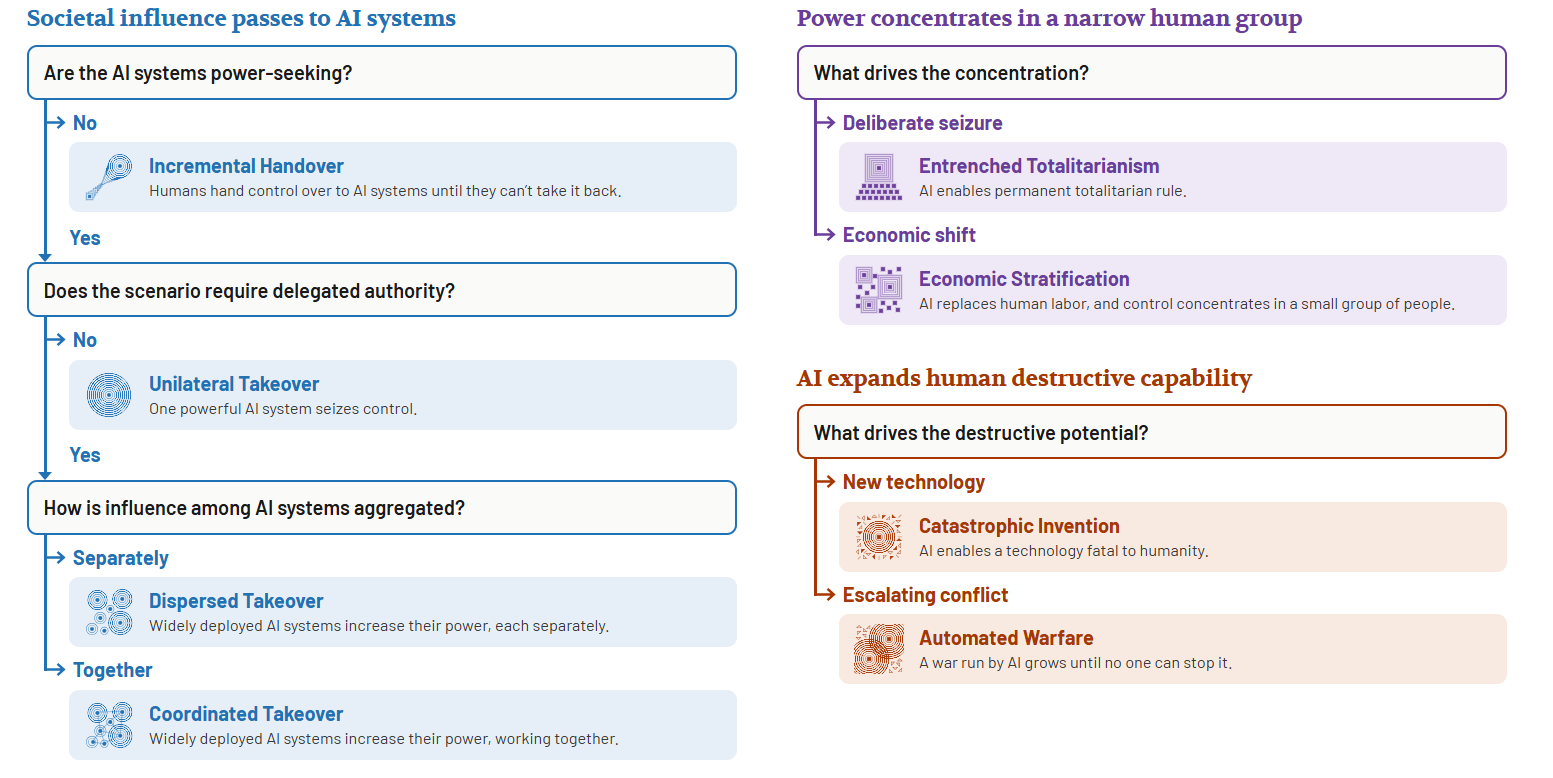
Scientists have broken down AI risks into logical chains (screenshot: AIxrisks)
According to study co-author Peter Slattery of MIT FutureTech, this approach will help track dangerous developments and identify early warning signs.
It will also make it easier for AI developers, regulators, and risk assessment experts to work together and take action before the situation becomes critical.
Read also: China prepares humanoid robots for war: What they can do