Russia unveils new countermeasures for FPV drones

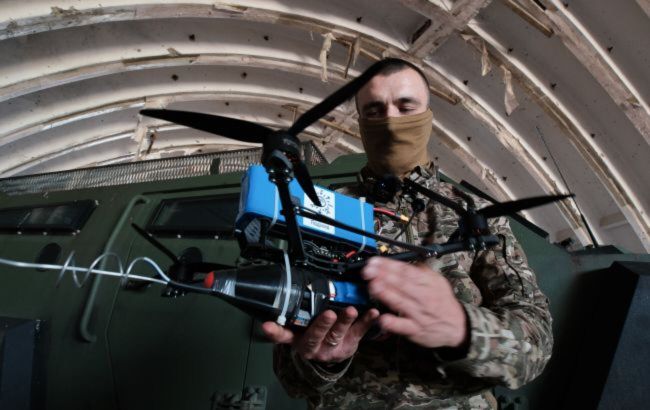 Photo: FPV drone (Vitalii Nosach / RBC-Ukraine)
In the occupied part of the Zaporizhzhia region, tests were conducted of a new counter-drone system based on rotating elements. The development implements a previously patented idea and is designed to mechanically deflect FPV drone attacks, according to the DEFENSE EXPRESS publication.
Also read: Russian troops strike Latvian journalists with FPV drone in Ukraine's Donetsk region
Russian forces have begun testing an experimental anti-drone system based on rapidly spinning cables around a protected platform.
According to open sources, the first prototype is being deployed in the occupied part of the Zaporizhzhia region by the so-called 70th Motorized Rifle Regiment.
Footage released shows a ground robotic complex whose primary task appears to be testing the system’s effectiveness. The system spins cables at high speeds to physically deflect FPV drones.
From patent to practice
The concept of such a "fan-style" defense was patented in Russia in May 2025 as a protection method for light vehicles. An earlier patent in December 2023 described the use of cables for shielding against dropped objects. Thus, the idea took over two years to move from concept to practical implementation.
Cables are lighter than rigid blades and less vulnerable upon impact with surfaces, though the spinning mechanism occupies significant internal space.
Limitations and open questions
In the published footage, the system is tested on flat terrain without obstacles. It remains unclear how it will perform in areas with branches, tall grass, or uneven terrain. Questions also remain about durability and how often the cables might tangle.
Analysts do not rule out the emergence of new experimental solutions in the near future.
Context: ongoing drone warfare
The Ukrainian Armed Forces recently struck Russian military sites, including a command post near Sudzha, Kursk region, and a drone depot in Rostov region. Around 6,000 FPV drones intended for frontline use were disabled.
Russia’s defense sector is reportedly moving toward serial production of new types of drone munitions, indicating a push to stabilize supply and standardize drone weaponry.