Russia unlikely to seize all of Donetsk any sooner than 2027-2028: ISW analysts interview


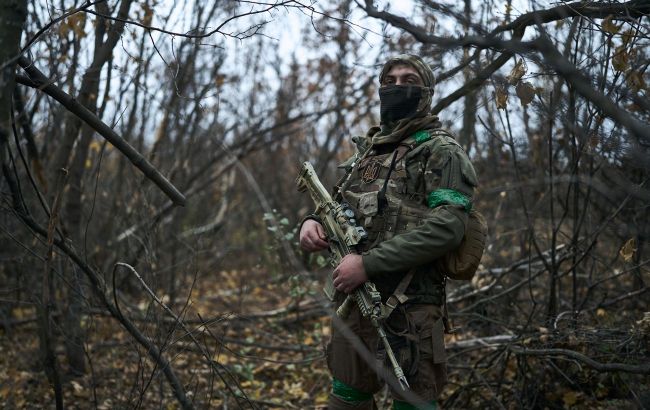 Ukraine's Defense Forces can hold Donetsk region at least until 2027 if partner support continues (photo: Getty Images)
ISW Russia Researchers Jessica Sobieski and Jennie Olmsted told RBC-Ukraine what to expect on the front line by the end of this year, what Russia may be planning, the risks for Ukraine in 2026, and whether Moscow is ready to end the war.
In Moscow, officials are systematically pushing the narrative that a breakthrough of Ukraine's defenses and the capture of the entire Donbas is imminent — either as a deliberate bluff or as a result of a distorted view of the real situation on the battlefield. Against this backdrop, and alongside negotiations, Russia is increasingly inflating its own gains on the battlefield.
What Russian forces are actually capable of by the end of this year, what they might plan for 2026, and whether the Kremlin is showing any readiness for peace and negotiations are explained by Russia Researchers at the Institute for the Study of War (ISW), Jessica Sobieski and Jennie Olmsted.
— In your view, what can the Russian army realistically achieve by the end of this year?
Russia may be able to complete its 22-month campaign to seize Pokrovsk and close the Myrnohrad pocket before the year's end. Russia will likely also use the remaining weeks of 2025 to set conditions to leverage current advances in the Donetsk and Zaporizhzhia regions to prepare for pitched battles against Kostiantynivka and Huliaipole in 2026.
Russian forces expanded efforts to not only seize Pokrovsk but also to close the Pokrovsk-Myrnohrad pocket in mid-October and early November 2025, during which time Russia expended massive quantities of manpower and resources on closing the pocket, which they have not managed to do as of yet. Russian forces have allocated significant manpower, resources, and time to seize the Pokrovsk-Myrnohrad pocket, and Russia's continued efforts to seize the pocket prevent Russia from redeploying personnel to aid Russian efforts in other directions, such as the Huliaipole and Kostiantynivka directions.
Russia's final seizure of Pokrovsk, possibly by the end of 2025, would have constituted an operationally significant gain if not for the fact that Russian forces had already deprived Ukraine of its use of Pokrovsk as an operationally significant logistics hub by July 2025. The final seizure of the town will be a tactical Pyrrhic victory.
Russian forces will also likely set conditions for further operations in Kostiantynivka, one of Ukraine's Fortress Belt strongholds. Ukraine's Fortress Belt is a major defensive line constituted of four large cities and several towns and settlements that run north to south along the H-20 Kostiantynivka-Sloviansk highway. Russia has been unsuccessfully attempting to seize the Fortress Belt since 2014.
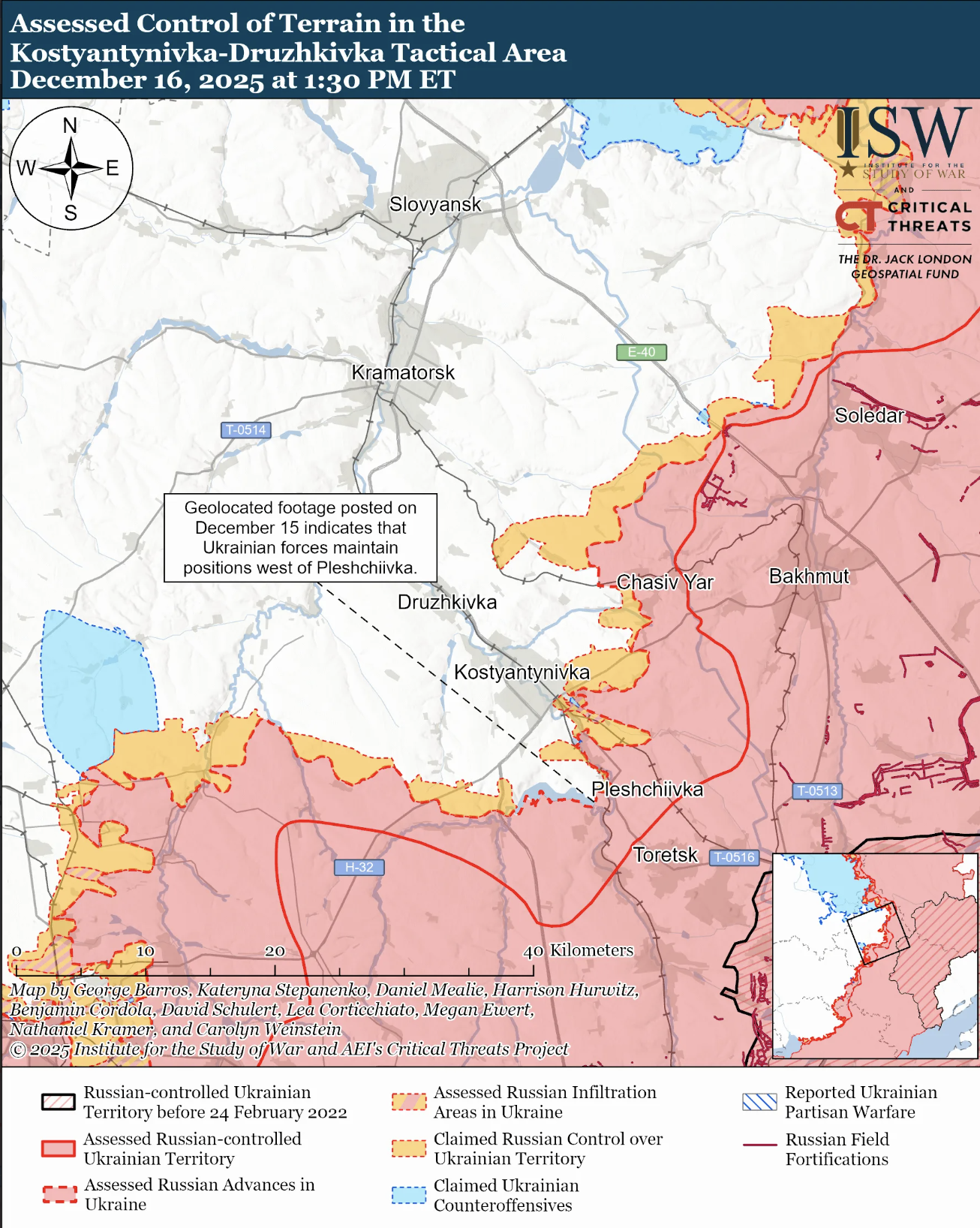
ISW map
Russian forces began infiltrating into Kostiantynivka, the southernmost town in the Fortress Belt, in late September 2025. Russian forces are using new offensive tactics in which they attempt to bypass Ukrainian strongpoints and conduct infiltration missions to slowly build up personnel behind Ukrainian defensive lines and begin assaults to seize Ukrainian positions. Russian forces are increasingly using this tactic for seizing settlements in lieu of more traditional frontal assaults, which Russian forces have repeatedly failed at executing effectively – including during initial attempts in March 2024 to seize Pokrovsk.
While Russian forces have managed to achieve marginal advances and limited infiltration operations into eastern Kostiantynivka itself, the effort to seize one of the Forest Belt's highly fortified cities will take significant resources. Russian forces are unlikely to seize all of Donetsk and the fortress belt any sooner than 2027 or 2028, assuming Ukraine's international partners continue supporting Ukraine.
Russia will also likely set conditions for battles within Huliaipole itself. Russian forces began to advance southwest of Velykomykhailivka, and to the north and northeast of Huliaipole in mid-October 2025, and Russian forces have continued to exploit these advances throughout the fall 2025 campaign. Russian forces will not likely seize the town by the end of 2025, but Russia can set conditions to envelop the settlement and begin fighting within the settlement, similarly to what Russian forces have done in Kostiantynivka in 2026.
— What risks does Ukraine face on the front following the loss of Pokrovsk?
The loss of Pokrovsk will not immediately unhinge Ukraine's defense in the Donetsk region. Russian forces are unlikely to achieve an operational breakthrough immediately following the fall of Pokrovsk because of the positional nature of the current war and because Ukrainian forces maintain strong field fortifications and natural terrain that complicate advance west of Pokrovsk.
The fall of Pokrovsk will free up Russian combat power, however. After the fall of Pokrovsk, Russia will have the flexibility to redeploy elements of at least two combined arms armies (CAAs) that are currently fighting in Pokrovsk elsewhere on the frontline. The Russian command deployed the 51st CAA (formerly 1st Donetsk People's Republic, Southern Military District) and the 2nd CAA (Central Military District) to conduct Russia's efforts to seize Pokrovsk.
The 2nd CAA is currently operating within the Pokrovsk-Myrnohrad pocket, and the 51st CAA is splitting efforts between attempting to close the Pokrovsk-Myrnohrad pocket on the northern shoulder and attempting to expand Russian advances north and northwest of Pokrovsk toward Dobropillia. Russian efforts in Pokrovsk have tied up significant Russian combat power, and the 51st CAA's attempts to seize Pokrovsk have limited its ability to advance toward Dobropillia while still making gains in the Pokrovsk-Myrnohrad pocket itself.
Once Pokrovsk falls, Russia will have the flexibility to redeploy these forces to different efforts, such as toward Huliaipole and the eastern Zaporizhzhia region and western Dnipropetrovsk region, where recent Russian gains threaten Ukraine's defensive lines in both regions, or toward the Fortress Belt. Russian forces will likely need time to reconstitute these forces before committing them to different sectors of the front, since Russian forces suffered significant casualties in the campaign for Pokrovsk, however.
— In your assessment, why has the Russian military managed to achieve such significant advances (compared to other axes) in Zaporizhzhia and Dnipropetrovsk regions?
The Russian military command concentrated elements of at least three CAAs and one division of combat power – comparable to the concentration of forces operating in the Pokrovsk-Dobropillia direction – to the areas east and northeast of Huliaipole, indicating that the Russian command has made a concerted effort to prioritize advancing in the Huliaipole direction.
Russian forces committed and redeployed elements of 35th CAA (Eastern Military District), 5th CAA (EMD), 36th CAA (EMD), 29th CAA (EMD), and the 76th Airborne Division from other sectors of the front, including from the Sumy direction and the Pokrovsk-Dobropillia area, over a series of several months prior to the recent Russian tactical breakthrough in the Huliaipole direction. Russia deprioritized other sectors of the frontline, including the Sumy region and potentially the western Zaporizhzhia, Kherson, Kupiansk, and Lyman directions, to support Russia's advances in the Huliaipole direction.
Russian forces also exploited the fact that Ukrainian forces were not heavily defending the areas of the line it attacked in the Zaporizhzhia and Dnipropetrovsk regions. Russian forces also exploited foggy weather that undermined Ukrainian drone operations in the area during their initial tactical breakthrough. The rural terrain west of Uspenivka (northeast of Huliaipole) also likely facilitated relatively rapid Russian advances toward the Haichur River, as Ukrainian forces likely struggled to defend positions in the open fields, allowing Russian forces to make relatively rapid advances, roughly 17 kilometers deep. Russian advances have notably slowed since reaching the Haichur River.
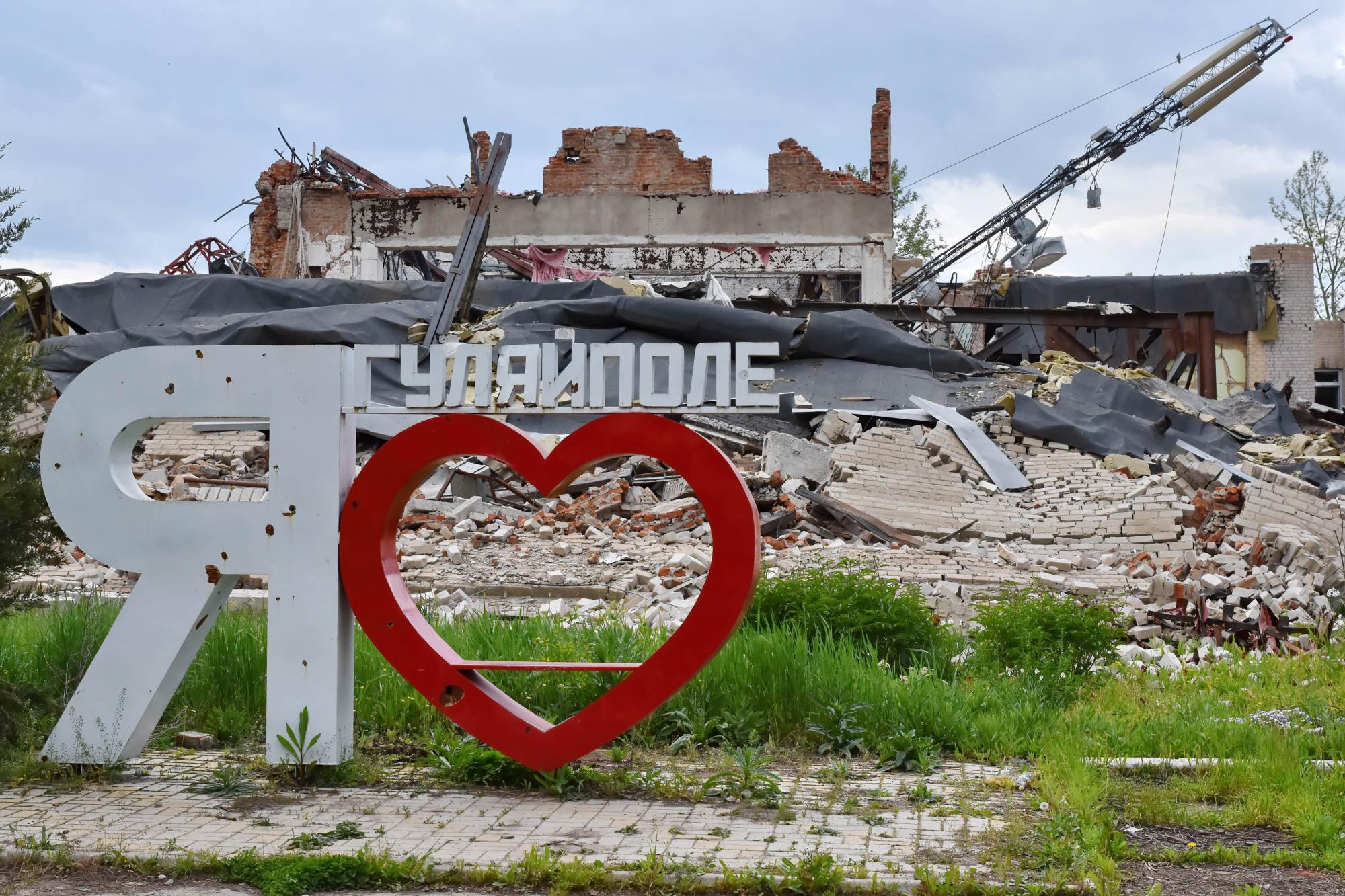
Russia is advancing toward Huliaipole, with this axis among Moscow's priority directions (photo: Getty Images)
Russian forces now face the difficult task of crossing the Haichur River, which, if successful, could allow Russian forces to then isolate Ukrainian groupings in both the Huliaipole and Orikhiv areas.
Ukrainian forces have been successful so far at restraining further Russian advances northeast of Oleksandrivka – a key settlement near the junction of the Haichur and Vovcha Rivers – and continued Ukrainian success in this area could complicate Russian attempts to cross the Haichur River and encircle Huliaipole from the north and northwest.
— What prevents the Ukrainian Armed Forces from stopping the current Russian offensive?
Russia has developed a new offensive template that seeks to make territorial gains in two steps. The first step is to deny Ukrainian logistics by interdicting Ukrainian ground lines of communication (GLOCs) at operational depths. Russian operational-level interdiction campaigns have facilitated recent Russian advances by denying Ukrainian forces the use of supply lines deeper in the Ukrainian intermediate and near rear, which is in turn complicating Ukrainian forces' frontline defensive operations.
Russian drone interdiction of Ukrainian GLOCs is achieving partial effects of battlefield air interdiction (BAI) and is negatively impacting Ukraine's defensive operations that rely on the consistent flow of equipment, supplies, and manpower.
The second step is to assault Ukrainian positions after having shaped the battlefield and degraded Ukrainian logistics for months. Ukrainian forces have yet to develop defenses against Russian operational-level battlefield air interdiction from drones and will need to expand their drone detection and interception capabilities to protect Ukrainian logistics in the intermediate and near rear. Ukrainian forces also suffer from increasing manpower and equipment shortages that have allowed Russian forces to exploit gaps in defenses to advance. Shortages in artillery and other traditional systems have also limited Ukrainian forces' ability to operate in bad weather conditions that disrupt drones.
Ukraine, however, has begun efforts to replicate Russia's BAI efforts on a limited scale in the Russian near rear in the Pokrovsk direction and other areas of the frontline. Expanding Ukraine's own BAI capabilities could effectively counter Russia's ability to advance by denying Russian forces the ability to assemble and sustain troops in near rear areas. Ukraine has systems capable of striking Russian near rear areas and has been increasing such strikes in recent months, but needs support to significantly expand its production of mid-range strike systems.
— On which sectors of the front do you expect Russia to concentrate its efforts in 2026?
Russian forces will likely prioritize seizing Ukraine's Fortress Belt in 2026 and may attempt to envelop it. Russian forces have recently begun infiltrations and slightly advanced into Lyman and Siversk, both of which Russia will need to seize to set conditions to launch an offensive on the northernmost city of the Fortress Belt, Sloviansk.
Russia's recent infiltrations into Lyman and Siversk are likely setting conditions to fully seize the towns and to set conditions for an advance on Sloviansk and possibly Kramatorsk from the northeast and east. Russia may simultaneously decide to pursue an assault on the southern part of the Fortress Belt in Kostiantynivka. Russia's ability to concentrate efforts on the Fortress Belt is likely tied to successes in individual tactical sectors (such as crossing the Siverskyi Donets River south of Lyman or advancing west of Siversk).
The Russian military will likely continue to attack along multiple axes of advance to maintain the strategic initiative and pressure along the entire theater. Russia's rate of advance will likely remain slow as Russia will likely continue to face difficulties pursuing simultaneous multi-pronged assaults spread across the theater. The Russian command could redeploy elements from the two CAAs located in Pokrovsk, but the forces will likely still need to rest and reconstitute following the difficult and long campaign for Pokrovsk.
Russia will also likely continue to find opportunities to advance in the Huliaipole direction in pursuit of Russia’s long-standing objective of advancing within the tube artillery of Zaporizhzhia city. Russian forces will likely continue attempts to seize settlements along the T-0401 Huliaipole-Pokrovske highway northwest of Huliaipole and eventually push toward Pokrovske. Open data on Russia's order of battle and disposition of forces suggests that Russian forces are unlikely to launch major offensive operations in Kherson, Sumy, and Kharkiv regions. However, at least during the earlier months of 2026, when Russia has had successes to build upon in other sectors. New redeployments of Russian units towards Sumy, Kharkiv, or Kherson regions will invalidate this forecast, however.
— In your estimation, how long will the Ukrainian army be able to maintain the defense of the remaining approximately 22% of the Donetsk region that is not occupied?
While the rate of Russian advance has intensified across the theater since August 2025, at an average rate of advance of 9.3 square kilometers per day (between August 15 and November 20), these advances are still constrained to a foot pace. Assuming that Russian forces can maintain this faster rate of advance consistently, Ukrainian defenses remain strong, and Western support for Ukraine remains consistent, Russian forces could seize the remaining 22 percent of the Ukrainian-held Donetsk region by August 2027.
The actual timeline by which Russian forces could potentially seize all of the Donetsk region is likely even longer, as this quickened Russian tempo in Fall 2025 has at least partially relied on seasonal weather conditions that are not permanent. The drone-dominated battlefield also denies Russian forces the ability to conduct maneuver warfare at the scale necessary for rapid, operational-level advances that it would need. Russian forces have also yet to face the heavily fortified, large population centers the size of Sloviansk and Kramatorsk, and have shown no ability to rapidly envelop, penetrate, or otherwise seize cities the size of those in the Fortress Belt since 2022.
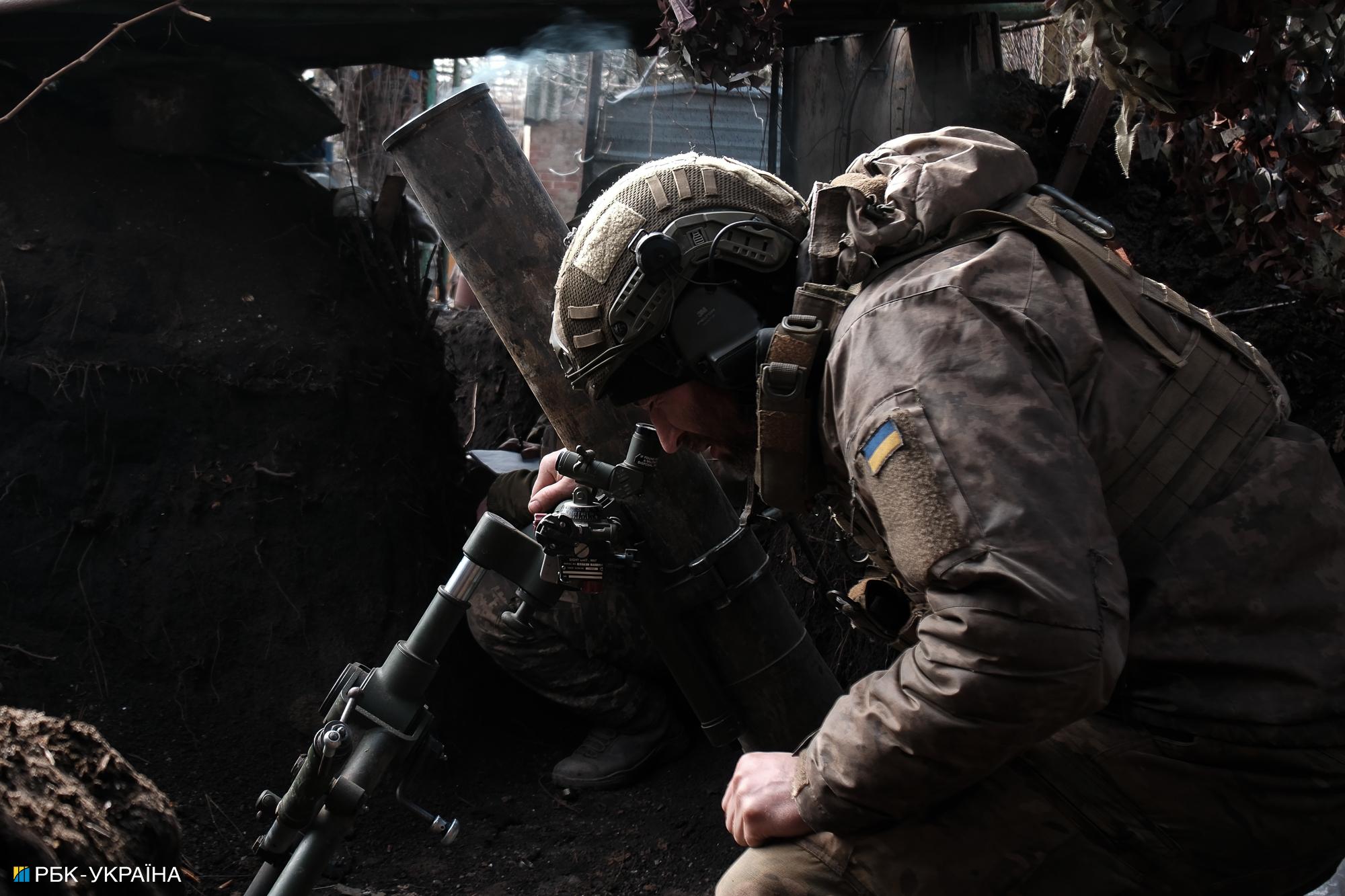
The battle for Donbas' Fortress Belt could become decisive in 2026 (photo: RBC-Ukraine, Vitalii Nosach)
The Russian campaign to militarily seize the rest of the Donetsk region, including Ukraine's heavily fortified Fortress Belt, would pose significant challenges to the Russian military and result in difficult and costly battles that Russia may not be able to sustain. Russian forces have also experienced disproportionately high casualty rates in their multiple-month effort to seize Pokrovsk and will face significant difficulties in this regard.
— What key risks do you foresee for the Ukrainian military and overall defense in 2026?
One of the main reasons for Russian advances on the battlefield is Russia’s military learning and the development of an operational concept to deny Ukrainian logistics at the operational level with drones, enabling more effective Russian infantry assaults. Ukraine will need to defeat Russia's BAI campaigns and replicate BAI effects against Russian forces' logistics lines at operational depths to maintain a successful defense.
This requires developing weapons with sufficient payloads that can effectively strike targets 30 to 120 kilometers from the frontline, and smart mission planning to cripple Russia's operational logistics to push Russian forces' assembly areas further into the rear. Continued Western support for Ukraine remains the center of gravity for this war and is vital to Ukraine’s defense, innovation, and sovereignty. Continued European military assistance and European-financed American weapons sales to Ukraine could also strengthen Ukraine’s defenses and possibly reverse some Russian gains, assuming assistance comes timely and in sufficient quantities.
— Do you currently see any readiness from Russia for a peace settlement or an end to the war, and what is your overall assessment of the prospects for ending the conflict?
Russia consistently signals it will not agree to a peace settlement that does not result in the complete capitulation of Ukraine or achieve Moscow's maximalist territorial claims. Russian president Vladimir Putin and other Kremlin officials have repeatedly made statements that reinforce Russia's goals of restoring Moscow's political control over all of Ukraine.
Kremlin officials have repeatedly referred to Ukrainian cities such as Odesa as Russian, and the Kremlin's oft-citing of its "root causes" – a deliberately vague term that the Kremlin has long used as shorthand for its original war justifications and demands, such as the destruction of Ukrainian sovereignty and the NATO alliance – necessitates that any peace deal or settlement subjects Ukraine to a status of de-facto Russian territory.
Putin's self-articulated theory of victory posits that Russian forces will be able to continue gradual, creeping advances indefinitely while preventing Ukraine from conducting successful counteroffensive operations, thereby winning a war of attrition against Ukrainian forces.
Putin's theory of victory rests on the idea that the West will abandon Ukraine. Putin's calculus still faces many challenges on and off the battlefield that complicate Russia's ability to win the war. Russia still faces the significant tasks of seizing Ukraine's Forest Belt, crossing the Dnipro River, and continuing to exploit momentum and battlefield gains while facing economic and domestic challenges. The war will likely continue as Russia's inflexible demands are largely incompatible with Ukraine's survival as a state.
Russia must make concessions to end the war on terms acceptable to Ukraine, the US, and Europe. European states have explicitly linked Ukrainian independence and sovereignty with European security. Russia is unable to achieve its objectives as long as Ukrainians are willing to defend their country and Western states continue to support Ukraine.