Zelenskyy-Trump meeting in New York: Expert outlines key expectations


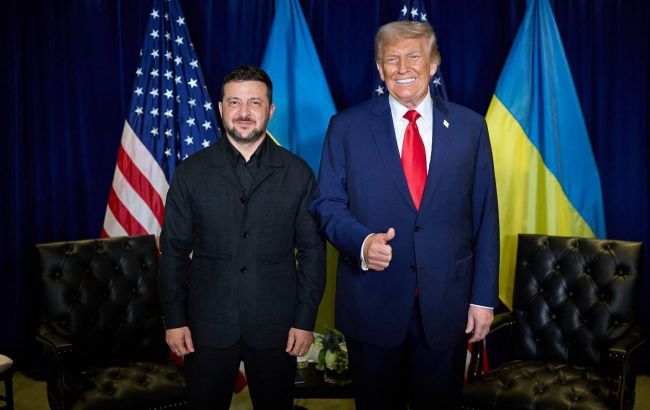 Photo: Volodymyr Zelenskyy and Donald Trump (Getty Images)
Ukrainian President Volodymyr Zelenskyy and US President Donald Trump will meet in New York today, September 22. The very fact that such a meeting is taking place is a positive signal, states Oleksandr Leonov, executive director of the Penta Center for Applied Political Studies, in a comment to RBC-Ukraine.
The very fact that the meeting is important
According to Leonov, the very fact that Zelenskyy and Trump are meeting is a positive development, as just a few days ago the meeting had not been confirmed.
"The very fact of the meeting is already a good sign. Let’s remember that just a few days ago this meeting had not been confirmed at all. The White House was saying that no contacts were planned whatsoever," the expert noted.
At the same time, he said that after the strikes on Moscow and the Moscow region, Trump called and confirmed the meeting.
Leonov also drew attention to Trump’s statements about Russia, particularly his remarks that Russian President Vladimir Putin does not control the country’s oil and gas sector.
What can be expected from the talks
The expert believes it is difficult at this point to speak about any immediate outcomes from the meeting. At the same time, he said that one possible result could be a joint declaration or statement.
"The only thing that could realistically emerge from the meeting here and now is a joint declaration or joint statement that peace negotiations must be preceded by a full and unconditional ceasefire," Leonov said.
According to him, the United States has gradually begun returning to this idea. American representatives at the UN and US diplomats have been advocating such an approach, the expert noted.
At the same time, Leonov said that India and Kazakhstan have also voiced support for this position, while China has expressed itself more cautiously on the issue.
"The formation of a common approach — first a full and unconditional ceasefire, then peace negotiations — could become an important outcome. It would amount to fairly serious pressure on Russia," the expert noted.
What could be discussed regarding weapons
As for arms supplies, Leonov believes that the United States is unlikely to provide Ukraine with PAC-3 missiles.
According to him, following recent Iranian attacks on US bases in the Middle East, the United States has only about 500 of these missiles remaining, making their transfer to Ukraine unlikely.
At the same time, the expert believes that Washington could confirm its readiness to grant a license for the production of such weapons.
However, this process could take a long time. Leonov cited Japan as an example, saying that it took the country about five years to move from obtaining a license to launching industrial-scale production of these missiles.
"Therefore, it is unlikely that Ukraine will be able to significantly accelerate this process," he said.
Leonov also noted that the meeting could raise the issue of new types of weapons.
"If we speculate a little, the United States was speaking quite actively about Tomahawk missiles for Ukraine a year ago. Revisiting that topic could serve as useful pressure on Russia," Leonov said.
Graham–Blumenthal Act
Another issue that could be discussed, according to Leonov, is the Graham–Blumenthal Act (a major US sanctions package against Russia and Iran signed by Trump in September 2026. The legislation was drafted by Senators Lindsey Graham and Richard Blumenthal).
According to him, the discussion could focus on how to implement the law through increased pressure on Russia and its allies, particularly to encourage them to agree to a ceasefire.
At the same time, the expert noted that the objectives currently under discussion remain fairly vague and are unlikely to produce immediate results.