Kyiv faces sixth straight day of attacks: How long can Russia maintain pressure?


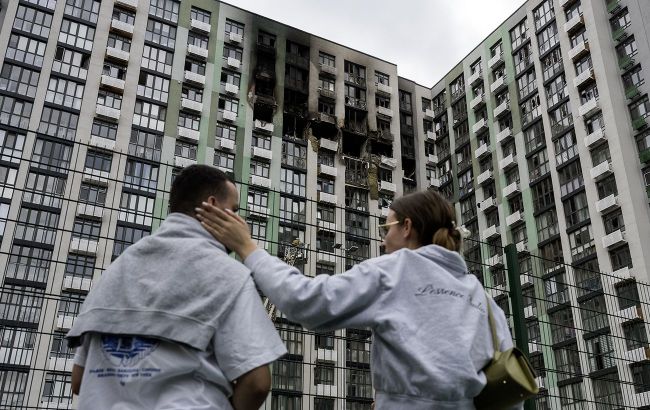 Photo: A 16-story apartment building in Kyiv was hit during the morning drone attack on September 1 (Getty Images)
Russia has attacked Kyiv and the surrounding region for six consecutive days, increasingly relying on jet-powered drones. This tactic could continue at least until Russia's State Duma elections in late September, with western regions of Ukraine also facing a growing risk of strikes, Anton Zemlianyi, a senior analyst at the Ukrainian Security and Cooperation Centre, told RBC-Ukraine.
Key questions:
- How long could the prolonged air raid alerts continue
- Why Russia is launching jet-powered drones in small batches
- Why Kyiv is currently bearing the brunt of the attacks
- How long the prolonged air raid alerts could continue
- Whether jet-powered drones can reach western Ukraine.
From August 27 through the end of the month, the intensity of attacks targeting the capital remained critically high. Drones approached Kyiv from the north, crossing the border area with Belarus before heading toward the city via the Kyiv Reservoir.
In just four days, Russia launched around 1,500 drones, including 800 jet-powered UAVs. The growth trend has been rapid: in July, Russia increased its use of jet-powered drones fivefold, while in August alone the number exceeded 2,800.
According to the Ukrainian Air Force, about 60% of jet-powered drones are being intercepted, compared with a 90–95% interception rate for conventional attack drones. Despite this, Russian strikes continue to result in impacts that cause destruction and casualties.
How long can Russia keep attacking Kyiv
According to Anton Zemlianyi, a senior analyst at the Ukrainian Security and Cooperation Centre, it is difficult to predict how long such attacks will continue, as their intensity depends on Russia's available resources and the objectives set by its military command.
Russia is currently launching jet-powered drones in small groups to keep Kyiv under what is effectively a near-continuous air raid alert.
"Most likely, this could continue until the Russian State Duma elections scheduled for late September (September 18–20). The goal is to create a media narrative of 'victory' for the Russian public," Zemlianyi said.
At the same time, the key factor remains the capacity of Russia's defense industry. Available data suggests that many of the jet-powered drones used in recent attacks were manufactured in July or August.
"They are essentially deploying weapons almost straight off the production line to sustain the pace of attacks. And this could be the fine line where they simply become unable to maintain the tempo due to a shortage of drones," the analyst said.
Can jet-powered drones reach western Ukraine
Russia's main targets currently remain the Kyiv region and northern border areas, southern Ukraine, as well as frontline regions — Dnipropetrovsk, Zaporizhzhia and Kharkiv.
According to Zemlianyi, this geography is consistent with Russia's broader campaign to weaken Ukraine by targeting logistics and critical infrastructure.
The analyst believes large-scale attacks on western regions are unlikely unless Russia's military command changes its priorities. However, the potential threat to western Ukraine remains constant.
"Newer jet-powered drones, such as the Geran-4 and Geran-5, can penetrate deep into the rear thanks to their high-altitude flight. There have already been cases of jet-powered UAVs covering up to 900 km across Ukrainian territory. Given that, according to Ukrainian intelligence estimates, the Geran-5 has a potential range of around 1,000 km, the entire country could potentially remain under threat," Zemlianyi concluded.