Ukraine's winter energy test: Will there be enough gas and electricity?


 Ukraine is preparing for a difficult winter (collage by RBC-Ukraine)
Ukraine is approaching another heating season under constant attacks on its energy infrastructure. While officials report on gas accumulation and new generation capacity, experts point to disputed figures and problems connecting new capacity to the grid.
RBC-Ukraine examines how Ukraine's winter preparations are progressing.
Key points:
- Russian attacks are heightening risks to gas production. Regular attacks on extraction facilities increase the likelihood that output will fall.
- The figures on distributed gas generation raise questions. The stated 1.8 GW may include not only gas-fired generation but also solar and wind power.
- The main problem is connecting new capacity. Regions face difficulties linking new generation to the electricity and gas grids.
- The government wants to simplify grid connections. But any noticeable effect is unlikely before the heating season begins.
Preparing Ukraine for the new heating season was the top task of Yulia Svyrydenko's government and has been named the main priority of Serhii Koretskyi's Cabinet of Ministers.
"If we're heading into winter, we need to be ready. We've been preparing for a long time, but the priorities are clear – winter preparation," President Volodymyr Zelenskyy said before appointing the new prime minister. Koretskyi's experience in the energy sector was reportedly one of the factors behind his selection.
Winter preparations are built around three main priorities. First, implementing resilience plans to protect and maintain critical infrastructure. Second, installing alternative generation and expanding overall grid capacity. Third, accumulating the required volume of gas.
RBC-Ukraine has already reported in detail on the resilience plans. Their implementation remains at around 40%. The single Ministry for Development of Communities and Territories, which was responsible for carrying out these plans, has been split into two separate agencies. Winter preparation is now the responsibility of the Ministry of Infrastructure.
So far, the ministry's new head, Mykola Kalashnyk, has not offered any assessment of the situation or specific next steps. Ministers have, however, been instructed to present their vision of priority tasks within a week.
Gas production under attack
In recent weeks, Russian forces have been regularly striking gas infrastructure, using various types of drones, including jet-powered ones. Naftogaz reports attacks on its facilities in the Kharkiv, Poltava, and Sumy regions – sometimes several times a week. These regions account for most of Ukraine's gas production.
The strikes hit both extraction and gas-processing facilities. Damage is being repaired quickly, and so far the attacks haven't significantly affected the pace of gas storage or supply to consumers.
Injection volumes have held steady at over 30 million cubic meters per day on average, which supports hopes of reaching the required 13.2 billion cubic meters of gas in storage before the heating season begins.
However, after repeated repairs, equipment durability is declining. This means the closer winter gets, the greater the risk that extraction infrastructure could be knocked out for an extended period.
Serhii Fedorenko, acting head of Naftogaz, said the goal of the strikes is ultimately "to destroy our gas production, complicate winter preparations, and create problems during the heating season."
Distributed generation
Almost no one mentions the plan to launch 4 GW of distributed generation in Ukraine anymore. That target, announced back in 2024 as a goal for the coming years, has not been achieved yet.
Official statistics by generation category (gas, solar, wind) remain unclear, while officials' statements often look like an attempt to manipulate the numbers for the sake of a good report.
First Deputy Prime Minister and Minister of Energy Denys Shmyhal recently announced that roughly 1.8 GW of distributed gas generation – gas turbine and gas piston units – had been brought into operation.
But sources told RBC-Ukraine that this figure includes not only new gas generation but also solar and wind. Solar generation is not effective in winter.
Actual gas generation is significantly lower. "1.8 is the total figure for new generation installed since last year," said a representative of one energy company.
The minister's figures are more likely an attempt to present wishful thinking as fact, according to Hennadii Riabtsev, energy expert.
"Perhaps the minister simply cited the total volume of generation installations, but this can't be called generation until it's fully connected to the power grid," he told RBC-Ukraine.
Oleksandr Kharchenko, director of The Energy Industry Research Center (EIR Center), was likewise surprised by the figure cited. "If all the resilience plans are carried out, the number Denys Shmyhal mentioned might be achievable. But I think that due to a lack of funding and some degree of mismanagement, actual generation will be somewhat lower. Still, if we assume the plans are carried out, distributed gas generation could reach 1.5–1.8 GW."
No significant increase in distributed gas generation should be expected in the near term. It may be enough for critical infrastructure, but experts interviewed by the outlet doubt it will be sufficient to serve as flexible capacity within the wider grid – and the issue isn't only about the volume of equipment purchased and installed.
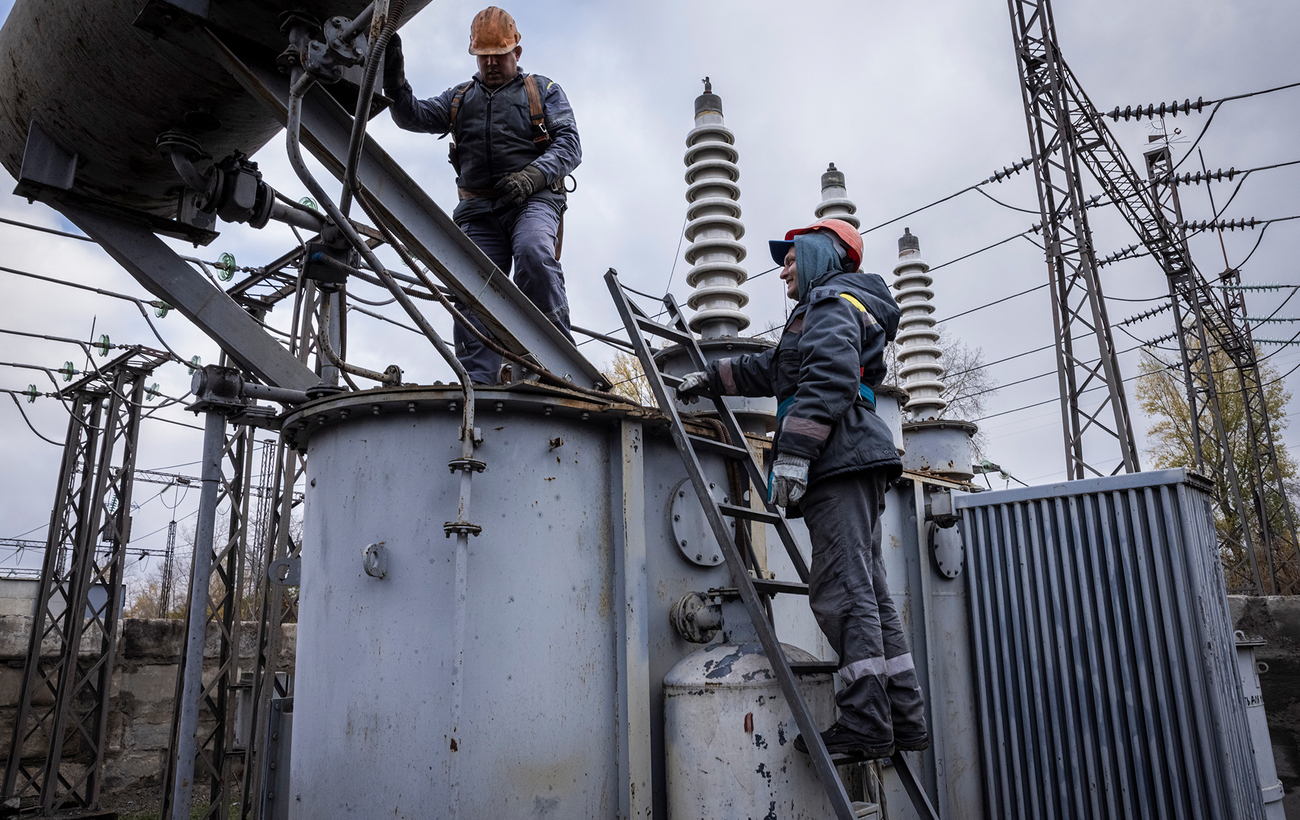
Repairs to energy facilities in Ukraine (photo: Getty Images)
Grid connection problems
Installing gas generation doesn't necessarily mean it will help reduce the shortfall in the overall power system. If new installations aren't connected to the grid, only their owners benefit – the units can supply electricity to themselves alone. Ukrenergo's dispatcher won't see that generation, and the number of consumer blackouts won't decrease.
There are problems with the connection process for both electricity and gas networks – and not only bureaucratic ones tied to obtaining permits and approvals.
In many locations where a gas generator needs to be installed, there's simply no available connection capacity. It has already been bought up, largely by industrial consumers. Oleksandr Vizir, Sectoral leader for Energy & Climate at the Ukraine Facility Platform, told the outlet that such cases are quite common across the regions.
For example, a company may have purchased connection capacity for a year, hoping to expand production. When those hopes didn't pan out, the capacity ends up blocked but effectively unused.
Another consumer can no longer use it for their own needs – they would have to ask the capacity holder to resell it, or the holder would have to give up part of their reserved allocation.
"Legally, we have no available capacity where consumption is taking place. In practice, 50% or more of that capacity isn't actually being used," he told RBC-Ukraine. Resolving such issues is quite difficult.
Regions also often lack specialists who could provide professional guidance on speeding up equipment installation and connection processes – something Vizir has personally encountered many times during his trips around the regions.
The situation with gas is similar. Many locations that need distributed generation installed simply don't have gas pipelines running to them.
"In Ukraine, there are, in principle, few places that have both ready gas and electrical infrastructure in place to connect distributed generation," Kharchenko noted.
Ukraine isn't alone in facing this – other countries also run into connection difficulties. "But there, most companies build their own new connection points when installing new capacity. They either negotiate compensation with the authorities, or the authorities simply cover the costs themselves," the expert said.
Riabtsev also confirms that connection processes move very slowly, sometimes taking several months. "Connecting to both networks often requires laying additional lines and getting approval from regional power and gas companies," he noted.
He advises anyone planning to install generation or cogeneration units to contact the National Energy and Utilities Regulatory Commission (NEURC) as early as possible. "The regulator has to review each specific case and can speed up the connection process," the expert explained.
At a recent forum on winter preparations, the Minister of Energy said the government intends to adopt a series of measures to simplify the process of connecting new installations to the grid.
The government's initiatives may help speed up the connection of new generation capacity. The first assessments of winter preparedness will become clear within a few months – after a possible intensification of strikes on energy facilities. Both the President and the Prime Minister of Ukraine have already spoken openly about the possibility that this winter could be harder than the last.
Quick Q&A
Will Ukraine have enough gas for the winter?
Current injection rates support expectations of meeting the plan to accumulate at least 13.2 billion cubic meters of gas before the heating season begins. However, Russian attacks raise the risk of a drop in production as winter approaches.
Has Ukraine really brought 1.8 GW of new gas generation online?
Experts are skeptical of this estimate. According to them, the figure cited by the government may include not only gas generation but also solar and wind power.
Why doesn't installing new generation capacity guarantee there won't be blackouts?
Because the equipment must be connected to the electricity and gas networks. Otherwise, the additional generation doesn't help cover the shortfall in the unified power system.
What's preventing faster connection of new capacity?
The main problems are a lack of available connection capacity on the electricity and gas networks, lengthy approval procedures, bureaucratic red tape, and insufficiently developed infrastructure in the regions.