Russia develops its own Starlink: Who's behind Rassvet and where it could fail


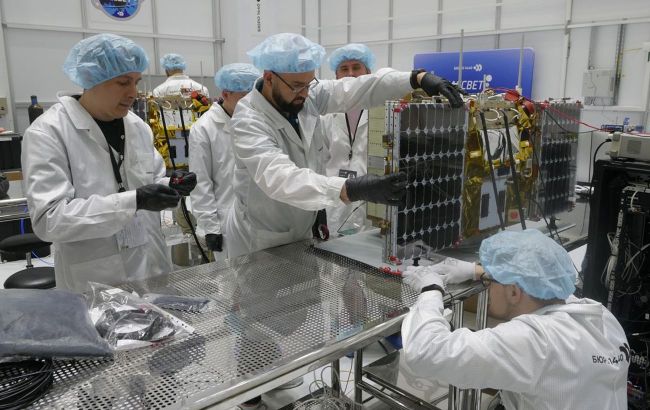 Photo: Russia is building its own Starlink (t.me/bureau_1440)
Russia is accelerating the deployment of its Rassvet ("Dawn") satellite communications system, which could also be used for military purposes. The Center for Defense Reforms conducted an extensive investigation into Russia's Rassvet project — who is behind it, how it is being deployed, where its technologies come from, and what its vulnerabilities are.
RBC-Ukraine reviewed the Center's research and summarizes the key findings.
Russia is deploying its own low-Earth orbit satellite communications system, Rassvet, which is intended to become its answer to Starlink. Officially, the project is aimed at providing civilian broadband internet. However, the Center for Defense Reforms points to potential military applications as well, including communications between command posts and frontline positions, coordination of artillery and aviation, intelligence sharing, and drone control.
According to the researchers, Vladimir Putin has effectively acknowledged that the system is being used to control UAVs on the battlefield.
The roughly $6.1 billion project is being developed by the private company Bureau 1440. But behind the facade of a private space company are the resources of the major X Holding group, ties to Russia’s security services, support from Roscosmos, personnel from Russia’s space industry, and a manufacturing network of more than 1,300 companies.
One of Rassvet's main weaknesses is precisely what Moscow claims it wants to eliminate: dependence on foreign components, Chinese supply channels, and Western equipment that remains accessible despite sanctions.
What is Rassvet and why Russia needs it
The Rassvet constellation is expected to consist of 292 low-Earth orbit satellites, along with ground control infrastructure, gateway stations, and user terminals. The federal project calls for a total of 383 satellites to be launched between 2025 and 2030: 292 for the main constellation and another 91 as replacements.
The project began in 2020 as a research initiative of mobile operator MegaFon. Rassvet was gradually integrated into Russian state programs. This was formally established in 2025, when Bureau 1440 was included in the federal project "Internet Network Access Infrastructure."
Moscow publicly presents the system as a secure communications tool for remote areas, transportation, industry, and government users. Some Russian officials have openly called it a "sovereign response" to the US Starlink.
However, the Center for Defense Reforms points to a number of indicators suggesting that Rassvet could have dual-use applications. These include communications between command posts and frontline positions, artillery and aviation coordination, intelligence and mapping data exchange, maintaining communications while on the move, and controlling unmanned aerial vehicles.
In June 2026, Vladimir Putin, according to the researchers, effectively acknowledged the use of Rassvet to control drones on the battlefield. The authors also believe Rassvet could be used to improve the accuracy of Russia's GLONASS navigation system.
31 satellites now, with 2027 as the target
The deployment of Rassvet is already behind its original schedule. The first satellites were supposed to be launched in 2025, but the first batch of 16 satellites reached orbit only in March 2026. One of them later deorbited. The second launch took place on July 19 and, according to specialized tracking services, also included 16 satellites.
The constellation therefore grew to 31 satellites. The current use of this group is likely limited to checking onboard systems, conducting tests, and preparing for further deployment. This is consistent with comments by Bureau 1440 CEO Alexey Shelobkov, who said 2026 is expected to be a period of experimental operation and testing under real-world conditions.
By the end of 2026, Russia plans to increase the Rassvet constellation to 156 satellites. The coming months will therefore show whether Bureau 1440 can launch new satellites regularly and rapidly expand the system.
If the plan is carried out, Rassvet could move from testing to limited practical use as early as the beginning of 2027.
According to the researchers, 156 satellites should already be enough for the system to support communications and data transmission, although its capabilities will remain limited. For the Russian military, this would mean the emergence of not yet a full Starlink equivalent, but a practically usable satellite communications system.
Bureau 1440 also plans to begin commercial operation of Rassvet in 2027.
In other words, it is still too early to call the system a fully operational Russian Starlink. One of the key elements of such a network is the user terminals through which customers connect to the satellites. According to the official roadmap, mass production of these terminals is planned only for 2030.
Although Bureau 1440 CEO Shelobkov has said the terminals are already being produced in significant quantities, the Center for Defense Reforms found no convincing evidence that the company is actually ready for mass production.
Who is behind Rassvet: X Holding and FSB links
The key owner of Bureau 1440 is X Holding LLC, which owns about 57% of the company. Another 4% was owned by CEO Shelobkov at the time the ownership structure was concealed, while Artem Ikoyev and Sergey Stolyarov each held 3%.
Around 33% was linked to the closed Olymp-M fund, managed by Mercury Capital Trust Management Company. It is difficult to establish the ultimate owners of this stake. Current information about the owners of Bureau 1440 was concealed by order of a Russian state agency back in 2022.
X Holding's structure includes several other major assets besides Bureau 1440, including YADRO, Citadel, Garda, Kryptonit, and Micran. Some of these entities are under US or EU sanctions. At the same time, Bureau 1440 LLC and its CEO Shelobkov do not appear in the Western sanctions registries reviewed by the researchers.
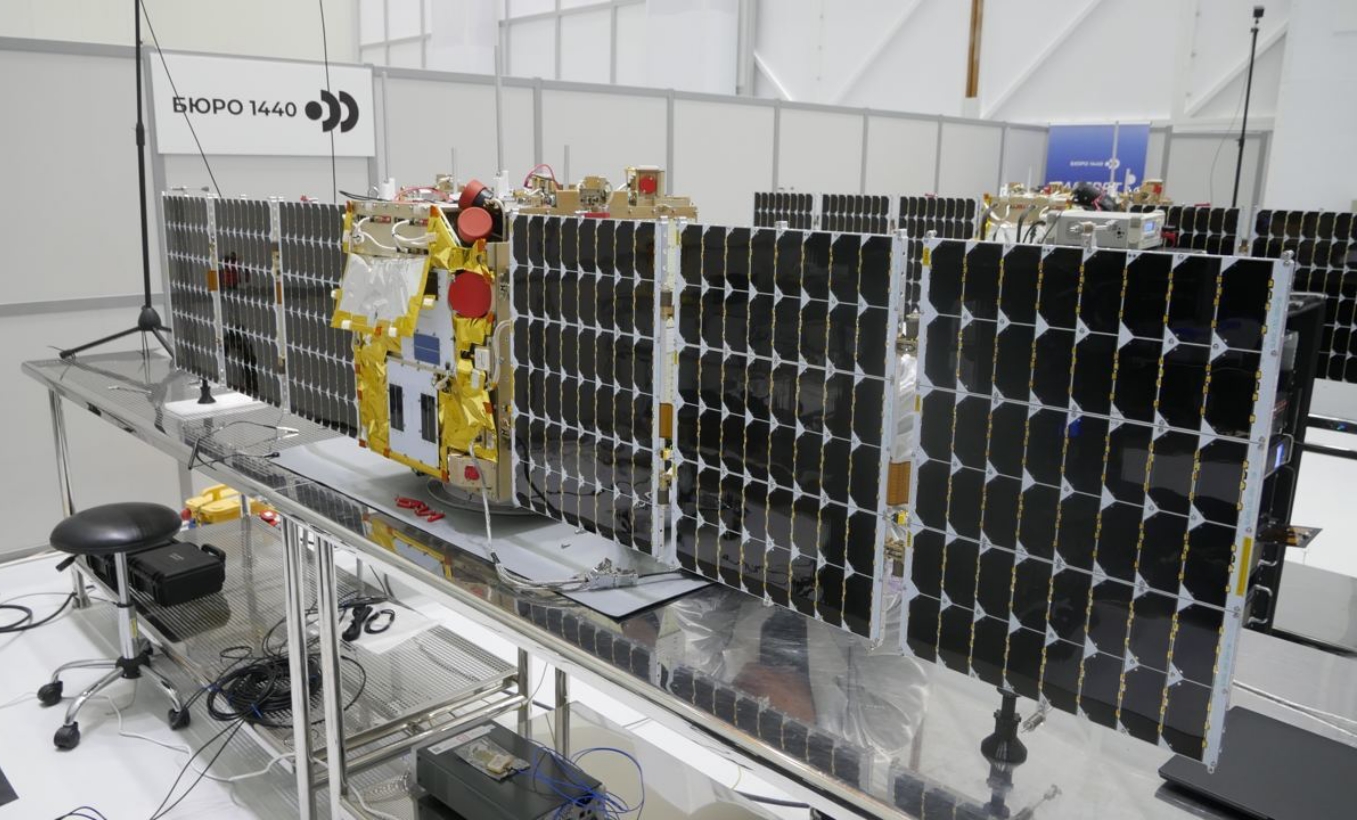
Photo: Russia's Starlink equivalent, Rassvet (Bureau 1440 website)
Shelobkov simultaneously heads Bureau 1440, X Holding, and several other companies within the group. This means the space project is effectively embedded in the much larger X Holding technology ecosystem, which spans IT, telecommunications, cybersecurity, and radio electronics. Yet sanctions do not currently target the key executive or the main legal entity behind Rassvet.
According to the Center for Defense Reforms, Bureau 1440 actively uses YADRO's infrastructure, computing, and organizational resources, Citadel's hardware and software systems, and Micran products.
Bureau 1440 also has its own subsidiaries. Labs 1440 manufactures solar panels for spacecraft, FAB Rassvet is developing a production base for telecommunications equipment, satellites, and user terminals, while Belarusian company Aerospace Instruments works on development and specialized technical products.
The Center for Defense Reforms also traced links between X Holding and Russia's Federal Security Service, or FSB. Citadel's hardware and software solutions are used by Russian security agencies to monitor telephone communications and internet traffic.
In 2017, Boris Miroshnikov joined Citadel's management. He had previously headed the FSB's Department of Computer and Information Security, now known as the FSB's 18th Center.
In addition, in 2018 Citadel acquired a 51% stake in Bastion. One of Bastion's co-owners was Boris Korolyov, the son of Sergey Korolyov, first deputy director of the Russian FSB. Most notably, in 2023 Boris Korolyov became deputy CEO of X Holding.
At the same time, the private space project receives substantial state support. The overall cost of Rassvet was estimated at roughly $6.1 billion as early as 2024, with about 26% expected to come from the state budget.
In 2025, Bureau 1440 received 3 billion rubles — about $41 million — through the Federal Treasury to compensate for production and technology costs. The company also received about $197 million in loans from Perspective Technologies, an X Holding affiliate.
Where Bureau 1440 gets its space technology
Bureau 1440 says its satellites, laser terminals, platform components, and ground infrastructure are all developed in-house. However, the researchers consider another model more likely: the company operates as an integration hub combining X Holding resources, state launch and regulatory infrastructure, and personnel from Russia's space industry.
The Center's analysis indicates that Roscosmos and its current head, Dmitry Bakanov, played a significant role in developing Rassvet. In effect, he helped integrate the project into Russia’s state space policy.
Roscosmos (State Corporation for Space Activities) also provided Bureau 1440 with access to launch facilities and supported the procedures required to put Rassvet satellites into orbit.
Some specialists working on Rassvet previously worked at Sputnix, the TsNIImash Mission Control Center under Roscosmos, Russian Space Systems, and other organizations.
The researchers suggest that Bureau 1440 may have used technologies developed by OneWeb, including through reverse engineering — the detailed study of another company’s technology to reproduce or adapt it for its own products.
This theory is reinforced by an investigation by Treadstone 71, which found that Russian specialists had studied Starlink terminals, potentially helping accelerate the development of Russia’s own system. In addition, in early 2025 Bureau 1440 was looking for a testing engineer whose qualifications explicitly included reverse-engineering experience.
1,300 suppliers and millions flowing beyond Western sanctions
According to the Center for Defense Reforms, there is no reason to believe that Bureau 1440 has a fully domestic production cycle for satellites and ground systems. The likely exception is solar panels, for which subsidiary Labs 1440 provides a full production cycle. Overall, the company appears to function primarily as a center for development, procurement, coordination, and systems integration.
Its production and supply network includes more than 1,300 companies. The Center identified 150 legal entities that received payments exceeding 10 million rubles. Of these, 21 formed the core group of suppliers, each receiving more than 100 million rubles from Bureau 1440 in 2025. The group received a total of 7.4 billion rubles, or about $89 million.
According to the Center's analysis, only five of those 21 companies are under Western sanctions: Sotis, RPC Micran, Elesar Group, OKB Fakel of Roscosmos, and Rezonit. OKB Fakel is the most likely supplier of engines for Rassvet satellites. In 2025, Bureau 1440 paid it about $1.86 million.
The remaining 16 companies are not under Western sanctions.
The largest recipient of Bureau 1440 payments in 2025 was Pallada LLC, which received 1.6 billion rubles, or about $18.9 million. The researchers note that the company is not under Western sanctions and that most of the goods in its imports originated in China.
Another roughly $8.3 million went to Belarusian Aerospace Instruments CJSC, which is involved in research and development. Other companies that the CDR identifies as not being under sanctions include RPE TEKS LLC, which received about $3.64 million; Aquamash Production Association JSC, $3.62 million; Kazakhstan’s Alternative Solutions LLP, $2.5 million; Radio Gigabit LLC, $2.18 million; and Belarusian Belrobot CJSC, $1.93 million.
The same group includes Newton Steel LLC, which received about $1.8 million; Macro Solutions LLC, $1.58 million; SPC Small Spacecraft LLC, $1.42 million; subsidiary Labs 1440 JSC, $1.35 million; and telecommunications and laser equipment supplier El-Optics LLC, $1.21 million. The CDR table also lists all of them as not being under sanctions.
Four other major suppliers do not have Western sanctions listed in the study but are under Ukrainian sanctions. They are Infostera LLC, which received about $3.94 million; MicroEM Component LLC, $3.44 million; Yue Tech JSC, $1.7 million; and Keldysh Research Centre JSC, about $1.31 million.
The researchers emphasize that the sanctions regimes of different countries are not synchronized: some companies are restricted only in certain jurisdictions, while others are not sanctioned at all.
According to the Center for Defense Reforms, this fragmented approach allows the supply of components for strategic satellite infrastructure to continue.
The Achilles heel: China and Western equipment routed through third countries
One of Rassvet's key vulnerabilities remains its dependence on imports.
In 2025, Bureau 1440 made foreign-currency payments for nearly $68 million worth of goods, in dollars, yuan, and euros. For some suppliers, customs data showed that more than 90% of imports came from China.
The Center for Defense Reforms separately highlights euro-denominated payments totaling nearly €5.8 million. Infostera, for example, received more than €2 million as an advance payment for specialized measuring equipment.
Customs data show that equipment made by Western manufacturers, including Rohde & Schwarz, TOPTICA, Keysight, and others, entered Russia through Chinese and Turkish suppliers. Such equipment can be used for satellite communications, testing ground stations, terminals, antenna systems, and other equipment.
At the same time, the researchers caution that euro-denominated payments alone do not prove direct supplies from the EU. But together with customs data, they may indicate that Russia continues to have access to equipment and components connected to Western technology supply chains.
China’s role is particularly notable. In 2025, Bureau 1440 employees traveled to China almost every month, with about 90 people taking part in such business trips overall. Their destinations included major Chinese centers for commercial space, satellite internet, and satellite manufacturing.
One of the most sensitive issues is radiation-hardened electronics, which satellites need to operate in space. In 2023, then-Roscosmos chief Yuri Borisov called the electronic component base the Achilles heel of Russian space systems and reported agreements with China on purchases.
In 2024, Russia's Ministry of Industry and Trade announced two tenders to develop radiation-hardened microchips as alternatives to Western products. However, no company submitted an application.
The Center for Defense Reforms also found no direct purchases of such chips by Bureau 1440 from key Russian manufacturers. This does not mean that Rassvet contains no Russian-made components — they could have arrived through intermediaries or as part of finished modules — but it strengthens the case that the project’s component base remains vulnerable.
The case of Materik LLC is also revealing. In 2025, Bureau 1440 paid the company about $1.42 million, with almost the entire amount denominated in yuan. Materik imported SMA-D-6 attitude-control reaction wheels made by Shanghai Modern Aerotech from China. The Chinese company is linked to Germany's Vectronic Technology GmbH, while the specifications of the SMA-D-6 closely match those of the VRW-D-6 reaction wheel made by Germany’s Vectronic Aerospace.
The researchers suggest that the Chinese product could be a localized or adapted version of a German design, with Materik potentially serving as a channel through which Bureau 1440 gains access to space-grade components, including those of Western origin, through the Chinese market.
Why it matters
Rassvet is not yet Russia's Starlink, either in scale or capabilities. But Moscow is investing billions of dollars in it, integrating it into state space policy, and leveraging Roscosmos and a large network of private and state contractors. And the system’s potential military use is already moving beyond purely theoretical scenarios.
Russia is trying to build a sovereign satellite system while relying on international technology and financial channels that remain open to it.
If the announced schedule is met, Russia could have a limited but practically usable low-Earth orbit communications system as early as the beginning of 2027, one that could also be used for military purposes. This would not make Rassvet a full-fledged Starlink equivalent, but it would give Russia a new tool for communications, data transmission, and operating unmanned systems.
That is why the Center for Defense Reforms recommends taking action before Rassvet is deployed on a much larger scale: sanctioning Bureau 1440, its management and affiliated entities; strengthening export controls on critical space components and testing equipment; and shutting down supply channels through China, Belarus, Kazakhstan, and other transit jurisdictions.