The new frontline is digital

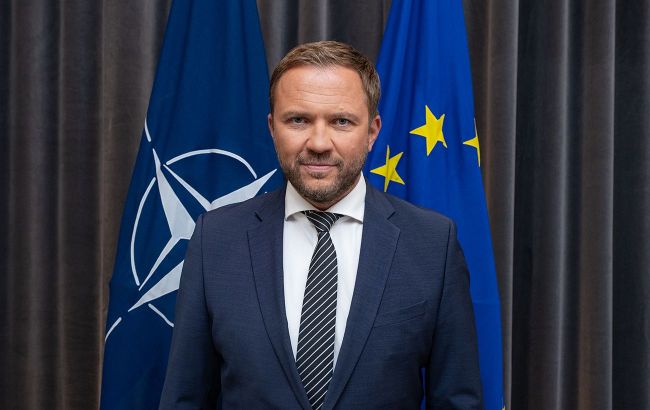 Margus Tsahkna (Photo: Press Service of the Estonian Ministry of Foreign Affairs)
Russia continues to use digital tools and cyberattacks as full-fledged weapons against civilian infrastructure and government institutions. Ukraine's experience has shown that a country's digital resilience is essential to its national survival.
Read more in an opinion piece by Estonian Foreign Minister Margus Tsahkna for RBC-Ukraine.
Key points:
-
Digital resilience is a matter of survival. The war in Ukraine shows that systems must be designed to withstand attacks and ensure government institutions continue operating without interruption, even during large-scale strikes.
-
Cybersecurity requires ecosystem-wide coordination. Governments cannot protect cyberspace on their own. It takes cooperation between the public sector, private businesses, and international partners, including through the Tallinn Mechanism.
-
Artificial intelligence is becoming a strategic choice. Using AI in public administration can reduce bureaucracy and boost productivity, but these technologies must remain subject to democratic oversight and human control.
-
Accountability starts with attributing threats. Effective protection requires clearly identifying those behind cyberattacks to enable sanctions and establish deterrence, as Estonia has done by sanctioning Russian GRU officers.
For Estonia, digital policy is not a question of technology alone. Russia's war against Ukraine has shown how digital infrastructure is essential for a country's security and resilience.
Over the past decade, the Tallinn Digital Summit has brought governments, companies, and technologists together to tackle questions that now sit at the center of foreign policy debate: who controls critical digital infrastructure, how artificial intelligence should be governed, and how open societies can stay secure. Estonia knows what it takes to build a digital state.
Now we need to carry that experience into the next technological era.
These issues have become more urgent as technologies develop at unprecedented speed, particularly in the field of artificial intelligence. Russia's war against Ukraine has demonstrated how digital tools and emerging technologies are used both in warfare and in civilian life.
This experience points to the next frontier of digital policy: how to shape the development and deployment of agentic AI in a way that strengthens security and resilience while upholding democratic governance and human control.
Read also: Zelenskyy confirms Ukraine retaliated after Russian cyberattack on emergency alert system
For Estonia, AI is a policy bet. The Eesti.ai program sets a steep target: using AI in governance and public services to double the value of Estonian labor by 2035, while adding 25% to the economy within 5 years and 50% within 10. Our approach is pragmatic rather than utopian: test where autonomous systems can cut paperwork, support public servants and raise productivity, while keeping humans in control.
But as a neighbor of Russia, we understand that technological openness cannot be separated from resilience. This lesson was reinforced already in 2007, when large-scale cyberattacks against Estonia showed that cyber threats were not only technical incidents, but matters of national security and foreign policy.
Estonia’s response was to turn crisis into institutional reform: in 2008 we adopted our first Cyber Security Strategy and created stronger coordination mechanisms under the government.
Lessons from Ukraine
Ukraine continues to prove the same point today: in the conditions of Russia’s full-scale invasion, digital resilience is a condition for national survival. I saw how this works first-hand this September on my latest travels to Kyiv while leading a Nordic-Baltic Eight (NB8) visit. Air-raid alerts accompanied the visit day and night. Russian drones and missiles hit shops, petrol stations, passenger trains and homes. Yet, Ukrainian institutions kept services running, maintaining trust and connecting citizens to the state even under attacks.
Already in 2022, Ukraine demonstrated remarkable digital resilience, rapidly adapting existing digital services and developing new apps and solutions to meet wartime needs.
Firstly, Ukraine demonstrates that cyber resilience matters more than preventing every attack. The key lesson is therefore to design systems to withstand disruption and to continue essential functions when digital systems are compromised
Another important Ukrainian lesson is that the state cannot defend national cyberspace alone. Cyber defense is an ecosystem: government, private sector and international partners need to operate as one. Estonia's support to Ukraine illustrates this in practice. Through the Tallinn Mechanism – an international cooperation framework on civilian cybersecurity assistance to Ukraine – Estonia has helped bring together public and private expertise to strengthen Ukraine’s cyber resilience.
Also, last year, the Estonian Center for International Development (ESTDEV) and the Swedish International Development Cooperation Agency (Sida) signed a cooperation agreement worth several million euros to strengthen the digital infrastructure of Ukrainian government institutions.
Thirdly, Ukraine also shows that cyber threats cannot be separated from the broader security environment. This impact is becoming even bigger with the rise of artificial intelligence. Estonia is responding by treating AI-related cyber risk as part of national resilience. We are strengthening cyber coordination across government and working closely with the private sector. The Cyber Defense Unit of the Estonian Defense League, the NATO CCDCOE in Tallinn, and exercises like Locked Shields all help us stay ready and adapt to new threats.
But resilience also depends on accountability, which begins with attribution. By identifying who is behind an attack, we can impose costs, build deterrence, or prevent the same actors from striking again.
In 2024, Estonia did this for the first time by attributing the 2020 cyberattacks against state institutions to members of Russia’s military intelligence service, the GRU, with three GRU officers declared internationally wanted.
Innovating responsibly through international governance and cooperation
Nowadays, the same AI capabilities that can strengthen the governance of democratic states and improve economic competitiveness can also be used against them. AI can generate disinformation at scale, automate influence operations and help hostile actors identify and exploit social divisions. AI-powered systems also introduce new questions of accountability and control.
In a world increasingly depending on AI, states must be able to understand, exercise democratic oversight and, where necessary, control the technologies they rely on. As AI is becoming a new layer of digital infrastructure, we must be able to have sufficient national capability for critical needs, access to European capacity for scale, and the freedom to use trusted global technologies.
Estonia’s path from the 2007 cyberattacks to 51% online voting shows that citizens trust digital systems when security, transparency and accountability are built in from the start.
Estonia also sees digital governance as an international project. At this year’s UN General Assembly, AI was one of the major cross-cutting themes, underlining that its impact is no longer only technological or economic, but geopolitical, societal and security-related.
Estonia’s experience as the co-chair of the UN Global Dialogue on AI Governance supports this broader approach, promoting an open and secure internet and a rules-based order in digital space. That cooperation also runs through formats such as the NB8, where Estonia chairs cooperation in 2026, and close transatlantic work on cybersecurity, trusted connectivity and emerging technologies.
From discussion to delivery
The desired outcome is not just a better conversation. Together with our allies and partners, we must turn those discussions and shared lessons at the Tallinn Digital Summit into practical cooperation: stronger cyber cooperation, clearer democratic positions on AI governance, deeper engagement with technology companies and innovators, and continued support for Ukraine’s digital defense and reconstruction.
This latter track will be further explored at the upcoming Ukraine Resilience and Recovery Conference (URC) in Tallinn in January 2027. The URC will provide an opportunity to mobilise resources for Ukraine’s emerging needs in the technological sphere.
From Estonia, the message is clear: the next phase of technological development must be shaped by democratic states and trusted partners who are willing to move fast, while ensuring that new technologies strengthen freedom, economic development, resilience, and human agency.