Witkoff and Kushner see Russia as a potential Eldorado for US — WSJ

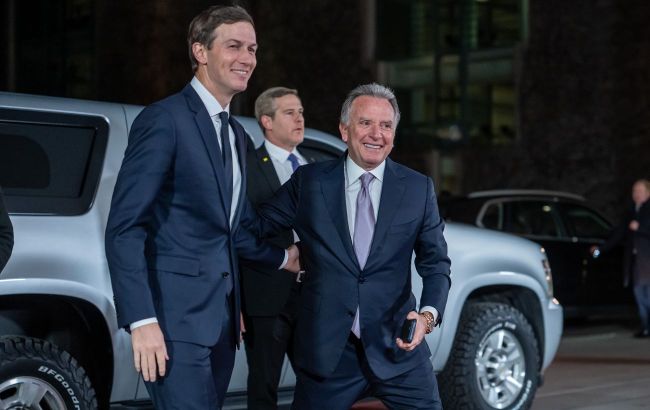 Photo: Trump's special envoys Jared Kushner and Steve Witkoff (Getty Images)
Special envoys of US President Donald Trump — former real estate developer Steve Witkoff and the president’s son-in-law Jared Kushner — want to turn Russia into an El Dorado for the United States. However, there are far too many obstacles standing in the way, according to The Wall Street Journal.
Witkoff and Kushner believe that Russia could become something akin to the mythical El Dorado for the United States — a country of vast natural resources and lucrative business opportunities. Reintegrating Russia into the global economy, they argue, would bring profits to American investors and help stabilize relations between Russia, Ukraine, and Europe.
However, they are far from the first US businessmen to promote the idea of “peace through profit.” Many other American experts and business figures are deeply skeptical about cooperation with Russia. They argue that a country with a weak economy and a dictatorial regime will not reward American capital. Investors are unlikely to rush into Russia even if Washington lifts sanctions.
A trap, not a profit
"Russia is not the Emerald City or El Dorado. The size of the prize is smaller than some people think. The general animus of Russia towards the West will stay as long as Putin is in the Kremlin and arguably even longer. It’s unwise to assume that now, all of a sudden, the red carpet comes out for Western companies,” said Charles Hecker, a Soviet and Russia specialist and geopolitical risk analyst.
Russia’s economy is extremely weak — about $2.5 trillion, roughly comparable to Italy. Russia has poor growth prospects, a shrinking population, and declining recoverable oil reserves.
Another risk is losing assets instead of making profits — or even ending up in prison. Russia operates under a dictatorial system that ignores the rule of law, rewrites contracts, seizes foreign businesses, and remains hostile toward the West.
Even peace in Ukraine would not break Russia’s cycle of hostility toward Western countries. As a result, Western companies operating in Russia would always remain at risk.
"Empty talk"
"The notion of companies flocking back to Russia is empty talk," said Alexandra Prokopenko, a former official at Russia’s Central Bank and a researcher at the Carnegie Center. “For any ordinary foreign investor, Russia is still uninvestable,” she said.
According to her, there will be no mass return of companies to Russia. Even if sanctions are lifted, exporters and investors will face dominant Chinese imports in the Russian market.
Investors whose assets were seized by Russia after the start of the full-scale invasion of Ukraine may be able to recover part of their losses. But speaking of a real new investment would be an exaggeration.
From profits to prison
"If there are unique assets, such as extraordinary gas fields in the Arctic, I wouldn’t be surprised if companies moved to secure an option to access those. But I’d be surprised if anyone starts sinking billions into real investments for years," explained Michael Calvey.
Calvey, who worked with Russia for more than 30 years, said there are two main deterrents to investing in the country. One is the risk that sanctions could return due to another war with Ukraine or a hybrid conflict with Europe.
The second factor is personal risk. Calvey knows this from experience: his firm Baring Vostok financed Russian tech companies, but in 2019, amid a conflict with investors close to Putin, Russia’s FSB arrested him.
Russian security services fabricated criminal charges against Calvey, accusing him of “embezzlement.” The conviction was later overturned, but the businessman left Russia and vowed never to return.
Kremlin thieves
Since the start of Russia’s full-scale invasion of Ukraine, the Kremlin has seized the property of many foreign and domestic investors, allegedly in retaliation for Western sanctions. These seizures are labeled “confiscations” and transferred to businessmen loyal to the regime. By some estimates, as of summer 2025, the Kremlin had stolen assets worth $49 billion.
Moreover, any economic agreements between Russia and the US would likely be honored by Putin’s regime only while Trump remains in power in Washington. This was stated by Pavel Khodorkovsky, the son of Mikhail Khodorkovsky, who was arrested and imprisoned in 2003 so the state could seize his business.
“Putin will honor his word only to the person he gives it to. Anything that involves infrastructure, physical assets—I just don’t think this is going to be an acceptable level of risk,” Khodorkovsky said.
Is there money to be made?
Still, the idea of profiting from Russia continues to attract some American businessmen. For them, the lure of profit outweighs all risks. Yet even among supporters of renewed economic ties with Russia, doubts remain.
"The question is should you do business with them at this time. Of course, Russia should eventually be reintegrated into the world economy. If you have a nonaggressive Russia, then that economic linkup makes a lot of sense. But not at a time when they’re invading and threatening their neighbors,” said Alan Bigman, former CFO of Russian oil producer TNK.
Bigman noted that Putin uses trade with the West to strengthen Russia’s military. Russia has no real protections for property rights, no institutions that work for capital rather than the Kremlin’s authoritarian whims.
This view is echoed by Bill Browder, whose firm Hermitage Capital once managed the largest foreign investment fund in Russia. In 2005, Browder was expelled from Russia after exposing corruption, and his lawyer Sergei Magnitsky later died in a Russian prison, prompting the US to adopt the Magnitsky Act.
"I thought we can make money if this place goes from terrible to bad. You could lose all your money or multiply it 20 times—and the chance was fifty-fifty," Browder concluded.
Europe’s experience and Russia’s bleak outlook
Western Europe once fell into the same trap the US now appears to be heading toward. Europe — especially Germany — believed that trade and investment could make Russia more democratic and restrain its revanchism.
Germany even developed a doctrine known as “Wandel durch Handel” — “change through trade.” That hope persisted after 2014 and finally collapsed on February 24, 2022, when Russia launched its full-scale war against Ukraine.
Another issue is the poor outlook for Arctic investment projects. Most resource fields are located in remote, hard-to-access areas. The same applies to oil: most major fields in Western Siberia and the Volga-Ural region were depleted before the war. What remains are complex and costly projects.
Such investments would require massive upfront spending long before any profit emerges. For foreign investors, restoring economic ties with Russia would not only be dangerous but also pointless.
Witkoff as Russia’s "asset"?
According to media reports, Putin, using ties with the Saudi crown prince, effectively selected former real estate developer Steve Witkoff as his preferred negotiator with the Trump administration.
Additionally, Witkoff and US Secretary of State Marco Rubio are reportedly competing behind the scenes over advancing peace proposals for Ukraine. Witkoff promotes ideas favorable to Russia, while Rubio remains highly skeptical of the Kremlin.
A scandal erupted on November 26 when Bloomberg published a transcript of Witkoff’s conversation with Putin aide Yuri Ushakov. Witkoff allegedly advised Ushakov on how to present Russia’s peace proposals to the US president and derail cruise missile supplies to Ukraine.
Several members of Congress and US politicians reacted angrily to the leak. Congressman Ted Lieu called Witkoff a traitor, while Congressman Don Bacon urged his dismissal, calling him a Russian agent. In response, Trump said nothing unusual happened and stated that Witkoff’s job was to “sell Ukraine to Russia.”
It is also worth noting that during talks with the United States, Russia actively promoted several economic initiatives to the Trump administration, including a project to develop massive natural gas fields in Arctic seas — proposals that were also pushed through Witkoff.