US pushes Russia to bring Europe into next round of Ukraine peace talks – Politico

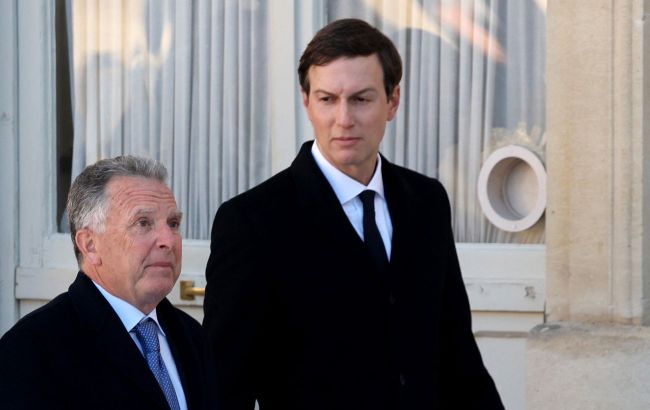 Photo: US President Donald Trump's envoys Steve Witkoff and Jared Kushner (Getty Images)
US President Donald Trump's envoys are pressuring Russia to allow Europe to join the next round of peace negotiations. Washington wants the meeting in Abu Dhabi to be the last one held without European participation, Politico reports.
The media outlet cited US officials who spoke on condition of anonymity. Trump's son-in-law Jared Kushner and special envoy Steve Witkoff will push for Europe's right to participate directly in the negotiations in Abu Dhabi on Tuesday.
They are mediating trilateral discussions involving Russia and Ukraine, which are being held in this format for the first time since February.
According to the officials, Kushner and Witkoff want to accelerate the negotiations. They therefore want this week's meeting to be the last one without Europe's full participation.
"We need Europe at the table," one official said.
"So our proposal is to bring the Europeans into the discussion after this trilateral," he added.
Europe is not yet part of the main negotiations
US officials welcomed a phone call made by the leaders of Finland and Norway to Russian leader Vladimir Putin on October 27, saying that more active engagement was needed.
"We need a lot more European discussions with Russia so that they could be hearing what we’re hearing and the message that they’re conveying to us they could be conveying to Russia directly," the officials said.
There is no consensus in Europe on who should speak on behalf of the continent or whether Ukraine's European allies should engage with Putin at all. EU leaders will discuss the issue at an informal summit in Dublin later this week.
Senior European officials are expected to be in Abu Dhabi this week.
Kushner and Witkoff are expected to consult with them, but they will not take part in the main negotiations due to Russia's objections.
Those attending include security advisers from the United Kingdom, Germany, and France, as well as officials from Italy, NATO, the European Commission, and the European Council.
Since Trump returned to the White House last year, EU officials and diplomats have been concerned that they could be sidelined as the United States holds direct talks with Russia on ending the war.
What will be discussed in Abu Dhabi
According to US officials, the first day of negotiations will focus on security guarantees for Ukraine and a possible overhaul of Europe's security architecture.
The second day will be devoted to territorial issues, including where borders and lines of separation should be drawn.
European governments fear that Trump could agree to Putin's long-standing demands to reduce NATO's influence in the region.
US officials insist that NATO will continue to play a central role in Europe's collective defense. At the same time, they are not ruling out a fundamental reassessment of the continent's relationship with Russia.
"Obviously, something isn't working," the same official said.
He added that Europeans have "a lot of concerns" about restructuring the security architecture. Russia has previously proposed various changes, while earlier arrangements have failed.
"We have to build something new that works today," the official added.
According to officials, NATO Secretary General Mark Rutte is actively involved in discussions with the US administration and has been putting forward his own ideas for reforms.
As for the most difficult issue for Ukraine — the fate of territories occupied by Russia — both sides have reportedly shown some "flexibility" in private discussions.
The goal of this week's negotiations is to maintain the momentum of recent weeks rather than secure a final ceasefire. The US side stressed that territorial issues and future security guarantees for Ukraine and Europe must go hand in hand and be resolved together.
As a reminder, US Secretary of State Marco Rubio said that Ukraine would receive only those security guarantees that Russia agrees to.
According to him, the guarantees must also be acceptable to Russia; otherwise, they will not work.
RBC-Ukraine also reported that US officials do not expect an agreement to be reached following the meetings in Abu Dhabi.
According to Radio Free Europe/Radio Liberty correspondent Alex Raufoglu, the goal is to clarify positions and identify the remaining gaps.