US national debt hits record $40 trillion under Trump

 Donald Trump, President of the US (photo: Getty Images)
The US national debt has exceeded the $40 trillion mark for the first time in history. The Treasury Department recorded this figure amid warnings from economists about growing fiscal risks, according to Reuters.
This debt total includes Treasury securities held by private investors — $32.266 trillion — as well as intragovernmental debt holdings of $7.782 trillion.
The national debt has more than doubled in less than a decade — from $19.95 trillion in January 2017, when Donald Trump first took the presidential oath of office.
Approximately one-third of this increase came from two years of active government borrowing to fund COVID-19 pandemic response measures during the presidencies of Trump and his successor, Joe Biden. The remaining growth was driven by the fiscal decisions of both presidents, combined with a persistent imbalance between government spending and revenues.
What each president contributed
During Biden's term, the national debt increased by $8.4 trillion. This growth was also largely attributed to post-pandemic recovery spending, as well as large-scale expenditures on infrastructure projects, clean energy subsidies, and other priorities promoted by his Democratic Party.
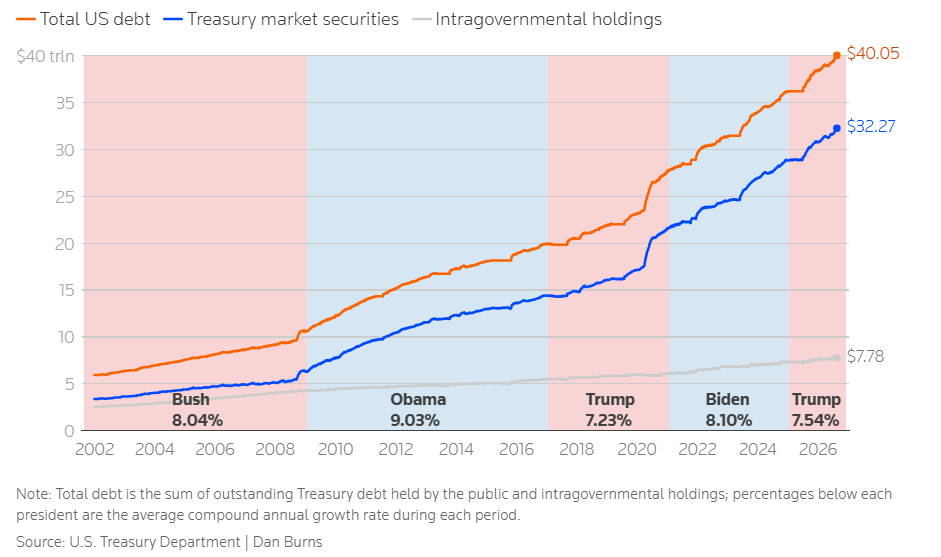
US national debt growth by presidential administration (photo: US Treasury Department)
The analytical center Committee for a Responsible Federal Budget calculated that the fiscal decisions of both presidents accelerated the growth of debt compared to what was projected under the legislation in effect at the time they took office.
In particular, the large-scale legislative package One Big Beautiful Bill Act, signed by Trump during his second term, will add another $4.7 trillion to the debt, according to the nonpartisan Congressional Budget Office.
Warnings of a fiscal crisis
Analytical organizations monitoring the state of public finances had been expecting the crossing of this threshold for weeks and had already warned of the possibility of a full-blown debt crisis if lawmakers fail to address the country's unsustainable fiscal trajectory — either by raising taxes, cutting spending, or both.
US national debt growth by presidential administration (photo: US Treasury Department)
Bipartisan Policy Center Director Margaret Spellings, on the eve of reaching the $40 trillion mark, stated that this grim milestone is yet another reminder of the need to finally address the fundamental imbalance in the country's public finances.
Why the US still feels economically confident
The reason is that the debt is denominated in dollars — the US's own currency. Unlike countries that borrow in foreign currencies, Washington can always service its debt by printing money or issuing new bonds in its own currency — default is technically unlikely as long as the debt is in dollars.
The dollar remains the world's primary reserve currency (about 55–58% of global central bank reserves), meaning demand for US bonds as a "safe haven" persists even as debt grows.
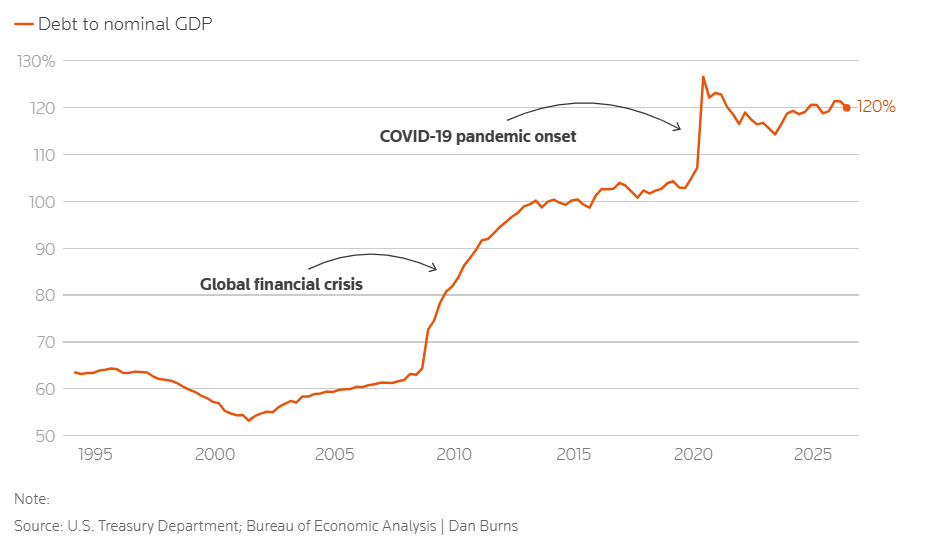
The size of the US economy (GDP over $29 trillion) means that $40 trillion in debt represents a debt-to-GDP ratio of approximately 120–130% — high, but not unique (Japan, for example, has over 250% and remains a stable economy).
The bond market responds not to the debt itself, but to expectations regarding the ability to service it — as long as bond yields do not spike sharply, the market does not see an immediate crisis.
What about the dollar exchange rate in Ukraine?
As of today, August 20, the National Bank of Ukraine has lowered the official exchange rate of the dollar. The central bank is covering the currency deficit on the market through its own interventions, allowing the hryvnia to both weaken and strengthen depending on the market situation.
In addition, the National Bank of Ukraine is introducing a new package of measures to ease currency restrictions. In effect, this involves a gradual restoration of the free movement of private capital.