Unique Martian fragment discovered disguised as ordinary desert stone

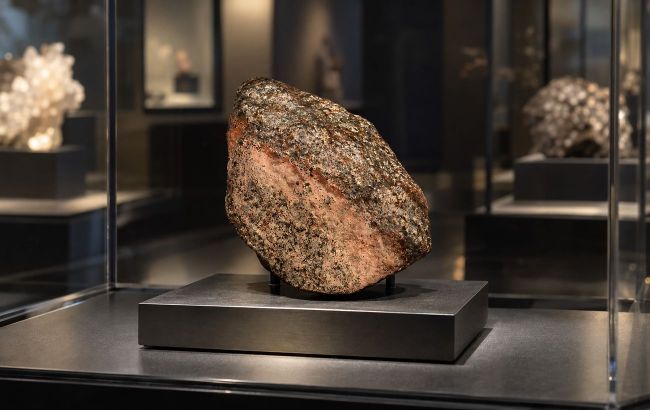 The Teghaza 001 meteorite reveals the secrets of Mars (collage: RBC-Ukraine)
An ordinary-looking stone weighing 800 grams, found in the desert of Mali, turned out to be a meteorite from Mars. NASA research has shown that it belongs to the oldest samples of the Martian crust ever to reach Earth, according to Futura.
Researchers from the University of New Mexico and NASA's Jet Propulsion Laboratory (JPL) compared the oxygen isotopic composition of the found rock with other Martian meteorites.
The results matched perfectly, confirming its Martian origin.
The mineral and chemical composition of the stone also supports this conclusion. In particular, volcanic minerals containing zircon correspond to data collected by the Mars Reconnaissance Orbiter spacecraft during its study of the Martian southern highlands.
Previously, scientists knew of only 435 Martian meteorites that had reached Earth. They were formed as a result of powerful asteroid impacts that ejected rock fragments from the surface of the Red Planet.
Key results of the scientific analysis
Precise dating using a tiny fragment showed that water altered the rock's structure approximately 4.1 billion years ago, and the geological formation itself may be even older.
Researchers call the find the "Rosetta Stone for Mars," as it provides access to the study of ancient crust from previously unexplored areas of the Red Planet.
Mineral similarity gives reason to associate the meteorite with the Martian southern highlands. However, the exact location from which it was ejected into space, and the circumstances under which the stone ended up in the Malian desert, remain unknown.
Although the meteorite provides only indirect clues about the origin of Martian rocks, the team led by Yang Liu from JPL hopes to apply this dating method to other samples.
This will help scientists better explore the early history of Mars, particularly to determine what the situation with water on the planet was like.