Two days in Abu Dhabi, Putin's demands, and hope for POW swap: Results of talks


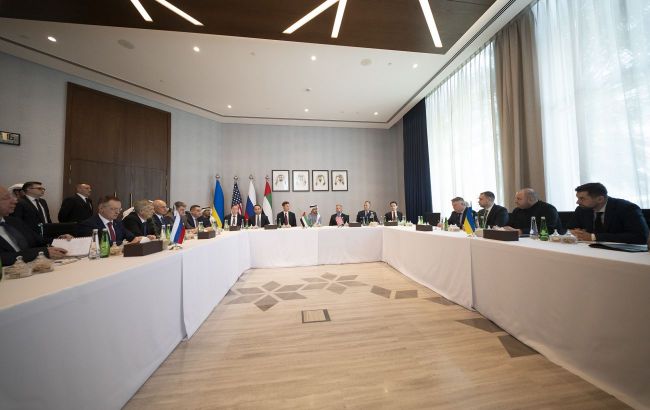 Photo: Meeting of the delegations of Ukraine, Russia, and the US in Abu Dhabi (Foreign Intelligence Service press service)
Two days of talks in Abu Dhabi, a meeting between US envoys and the leaders of Ukraine and Russia, and a new round of negotiations involving Europe. The diplomatic contacts resulted in an agreement on a large-scale prisoner exchange, while another round of talks is expected as early as next week.
RBC-Ukraine has compiled what is known about the intensification of negotiations to end the war in Ukraine and what to expect next in its material.
Two days of talks in Abu Dhabi: Key outcomes
On November 11, the second day of trilateral talks between delegations from Ukraine, the US, and Russia concluded in Abu Dhabi. They were the first talks in this format since February this year. The first day of negotiations lasted 4.5 hours, while the second lasted two hours.
The Ukrainian delegation was led by Foreign Intelligence Service head Rustem Umerov, the Russian delegation by Putin's aide Vladimir Medinsky, and the US was represented by presidential envoys Steve Witkoff and Jared Kushner.
Davyd Arakhamia, head of the Servant of the People parliamentary faction and one of the members of Ukraine's negotiating team, described the two days of talks in Abu Dhabi as "tough" due to the strict directives given to the Russian delegation, which left no room for agreements.
Nevertheless, following the meeting, the parties managed to agree on preparations for a large-scale exchange of prisoners of war. President Volodymyr Zelenskyy said it could involve an exchange of 1,000 for 1,000 or 1,500 for 1,500.
At the same time, according to RBC-Ukraine sources, the Russians refused to discuss a ceasefire, territorial issues, energy, and security in the Black Sea, insisting instead on returning to their security demands dating back to December 2021.
At the time, Russia demanded, among other things, that NATO stop expanding and limit the Alliance's military cooperation with Ukraine.
Kremlin spokesperson Dmitry Peskov has already said that verbal assurances that NATO would not expand eastward were "not enough" for Russia. He hinted that this point should therefore be put in writing.
Russian Foreign Ministry representative Alexey Drobinin, in turn, said that Russia was considering concluding so-called "non-aggression pacts" with individual NATO countries.
Trump's envoys meet with Putin and Zelenskyy
After the talks in Abu Dhabi, US presidential envoys Steve Witkoff and Jared Kushner traveled to Moscow. On November 12, they met with Russian President Vladimir Putin.
The meeting lasted about three hours. Medinsky, as well as Kremlin representative Kirill Dmitriev and Putin's aide Yuri Ushakov, also took part.
At the beginning of the meeting, Putin claimed that Russia was supposedly ready to organize a humanitarian mission in Kostiantynivka, following the example of Oleshky. He also repeated claims that Russian forces "control" the city, which is not true.
Separately, Putin said that the presence of foreign troops in Ukraine after peace is achieved would be unacceptable to Moscow. He warned that if such troops were deployed, they would become a "legitimate target" for the Russian army and the war would resume.
Putin also opposed the creation of gray zones between Ukraine and Russia, saying that the only line of demarcation should be the state border. He claimed that any other interpretation would lead to "disputes" and "instability in the agreements."
During the meeting, Witkoff described the upcoming large-scale prisoner exchange as progress toward resolving the war. He also said he would brief Zelenskyy on the contacts with Putin.
Kushner, for his part, said that the US had begun discussing the security architecture on the continent with European countries.
Witkoff and Kushner meet with Zelenskyy in Ireland
After the talks at the Kremlin, the US envoys traveled to Dublin, where they met with Ukrainian President Volodymyr Zelenskyy late in the evening on November 12.
The Ukrainian leader once again confirmed that one of the main outcomes of the meeting was the reaffirmation of an agreement on the largest prisoner-of-war exchange since the start of the full-scale war.
"It will be the biggest, as Steven and Jared told me, the biggest exchange of war prisoners," Zelenskyy said.
Kushner also confirmed that the US side had managed to finalize the arrangements for the exchange.
Europe wants a seat at the negotiating table
The issue of European partners' participation was one of the key topics during the meetings. Alongside the trilateral meeting in Abu Dhabi, separate talks were held between Ukraine, the US, and European partners. Representatives of NATO, the European Commission, the United Kingdom, Germany, France, and Italy took part. The Russian delegation did not join these talks.
However, Ukraine and its European partners themselves insist that Europe should continue to participate directly in meetings involving Russia, since the issue concerns the future security of the European continent.
Kushner said he considered it impossible to reach any agreement without European representatives. According to him, the US side discussed this issue with both Putin and Zelenskyy.
According to RBC-Ukraine sources, Europeans may join the next round of joint talks with Russia.
At the same time, the question of who exactly will represent Europe remains open.
According to Politico, the possible candidates to represent the EU include European Council President António Costa and EU High Representative for Foreign Affairs Kaja Kallas.
However, EU member states have yet to reach a consensus. Some countries support Costa, while France and Germany favor maintaining the participation of individual countries in the negotiations.
German Chancellor Friedrich Merz, in particular, has called for maintaining a format involving five countries: Germany, the United Kingdom, France, Italy, and Poland.
In addition, the president named two more outcomes of the diplomatic contacts: greater involvement of Europe in the negotiations and preparations for new multilateral meetings.
Europe's security architecture
A separate topic of the negotiations was the formation of Europe's future security architecture. Its discussion is linked to how Russia's war against Ukraine will end and what security guarantees Kyiv will receive.
Zelenskyy stressed that future security arrangements directly depend on when and how the war ends.
According to him, security guarantees for Ukraine are also part of the security guarantees for all of Europe.
The president said that Ukraine is already Europe's defensive line, has capabilities significant for Europe, and is part of both Europe and its security architecture.
He also explained that Ukraine's potential NATO membership would mean one model of European security, while the absence of membership would mean another.
What to expect next and when the next meeting will take place
Following the meetings, the US side announced an agreement to expand the next round of negotiations by involving European countries.
According to Kushner, multilateral talks on ending the war in Ukraine will take place next week.
He explained that this would make it possible to discuss broader post-war security arrangements in Europe alongside territorial issues between Ukraine and Russia. However, he noted that Europeans should choose a single representative at the negotiating table.
In Zelenskyy's view, Europe should decide by the end of November who will represent it in the negotiations on ending the war in Ukraine. According to him, it would be preferable for this issue to be resolved during the Coalition of the Willing meeting in Germany on November 19.
Finnish President Alexander Stubb, in turn, announced a technical meeting involving Ukraine, the US, Russia, and Europe within the next one to two weeks.
Zelenskyy said that the next peace talks on ending the war, this time with Europe's participation, could take place in the UAE or Switzerland, but "it all depends on the teams."
The Ukrainian president stressed that his message was very simple: to speed things up if possible, so that people could be brought back from captivity, move toward a ceasefire, and take the next steps.
Read also: US possibly slowed Starlink to leverage Ukraine in negotiations with Russia - FT