Galactic catastrophe: Scientists detect mysterious signal in deep space

 Galactic collision creates rare cosmic laser (photo: Magnific)
An international group of astronomers has discovered the most distant and most powerful microwave laser ever observed. The signal was detected in the distant galaxy HATLAS J142935.3–002836, located 8 billion light-years from Earth, according to arXiv.
Nature of the cosmic laser
The object discovered by scientists is a maser — a radio-wave analogue of a laser. While a standard laser emits visible light, a maser focuses electromagnetic radiation in the radio range. In particular, the detected signal belongs to the category of hydroxyl masers.
“Gigamasers are markers of the most dynamic processes in the universe, and studying them may radically change our understanding of how the chaos of galactic collisions creates new stellar worlds,” scientists explain.
Why does this happen?
Such phenomena occur during catastrophic galaxy collisions. When two giant star systems collide, the gas inside them becomes compressed, which excites hydroxyl molecules. These molecules begin to amplify radio waves passing through them, turning them into a narrow, highly concentrated beam.
The wavelength of the discovered gigamaser is about 18 centimeters — significantly longer than the wavelengths of visible light.
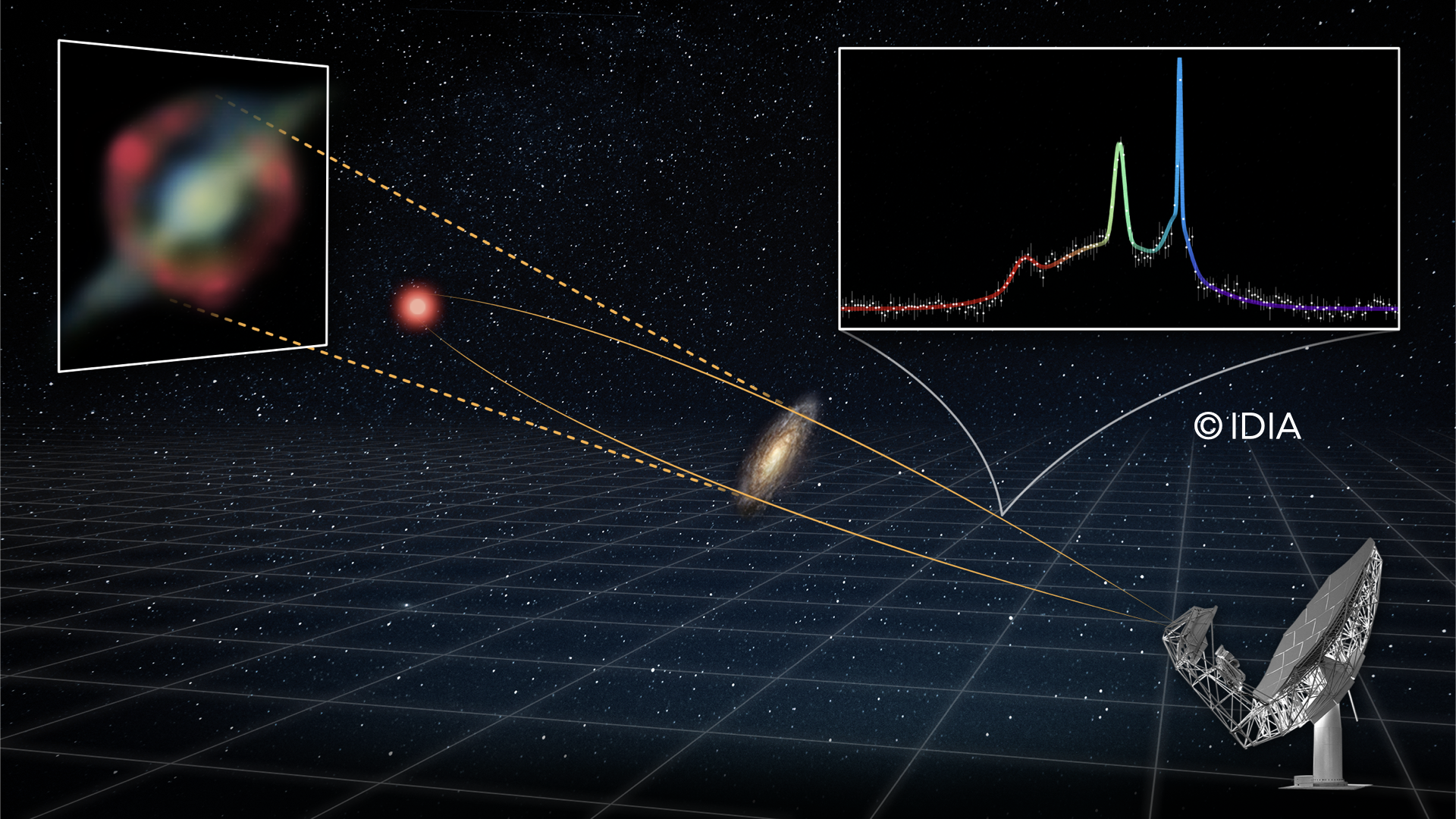
An illustration of a distant galaxy located 8 billion light-years away (in red), magnified by an unrelated foreground disk galaxy (image: IDIA)
How the discovery was made
The discovery was made using the MeerKAT radio telescope in South Africa. It is one of the most sensitive instruments in the world, capable of processing about 2.5 terabytes of data per hour.
However, even MeerKAT’s power would not have been enough to detect a signal from such a distance if it were not for a rare cosmic coincidence.
Between Earth and the signal source, another massive galaxy happened to lie along the same line of sight. Its gravity acted like a giant magnifying glass — a so-called gravitational lens.
By bending space-time around it, the intervening galaxy amplified the gigamaser signal, allowing it to travel 8 billion light-years and reach the telescope’s receivers.
“In fact, we are seeing this beam as it was 3 billion years before our planet was born,” scientists noted.
Why this matters for science
The galaxy HATLAS J142935.3–002836 is currently undergoing an extremely violent merger. This triggers bursts of star formation and feeds supermassive black holes. A similar scenario awaits the Milky Way in the distant future, although on a smaller scale.
Studying such objects allows astronomers to look into the Universe’s past and understand how galaxies formed and evolved. Scientists hope to discover hundreds more such signals.