SpaceX spacecraft makes historic first-ever return from orbit to launch pad

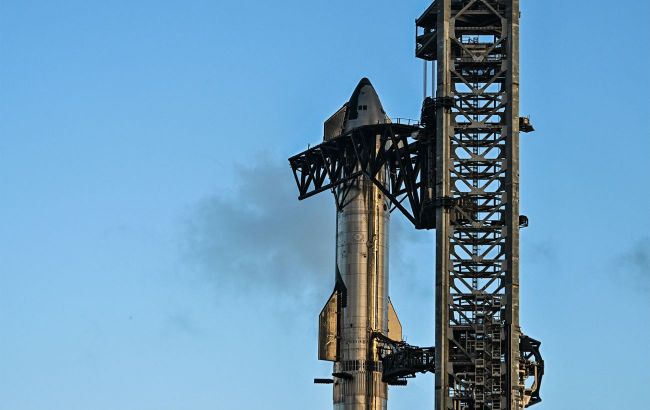 Photo: The Starship spacecraft on the SpaceX launch pad in Texas (Getty Images)
After a 22-hour flight in orbit, the Starship returned for the first time to the SpaceX launch tower in Texas, where it was caught by so-called mechanical arms. This is an important step toward creating a fully reusable rocket, according to Reuters.
The rocket launched on November 13 from the Starbase spaceport in Texas. This was its 15th test flight.
The Starship's upper stage orbited Earth 14 times in 22.5 hours, marking the longest mission in the program's history. At an altitude of about 260 km, the spacecraft deployed 26 Starlink satellites into orbit.
On November 14, Starship fired its engine over the Pacific Ocean and began its descent into the atmosphere, withstanding immense heat. Above Starbase, the spacecraft flipped upright and slowly descended into the mechanical arms of the tower, nicknamed Mechazilla.
"That was the missing link, the holy grail of spaceflight," comments SpaceX broadcast host Dan Huot.
At the same time, the first stage, the Super Heavy booster, was unable to return to the launch pad. Thus, the plan to recover both parts of the rocket in a single mission failed for the first time.
Elon Musk wants to create a rocket that will fly to space and back as regularly as commercial airplanes, with minimal maintenance between flights. Currently, only the first stage of the Falcon 9 rocket is reusable, while the second stage falls into the ocean after every launch.
However, Starship's heat shield, made of black hexagonal tiles, is not yet fully reusable, and SpaceX is developing new versions.
The Ukrainian military also relies on SpaceX systems. Recently, Ukraine has been detecting signal restrictions for Starshield, the military version of Starlink, along the front lines and in occupied territories. As a result, according to the Ministry of Defense of Ukraine, military missions are being disrupted.
Meanwhile, Ukraine is taking steps toward establishing its own satellite communications network. On October 1, the Ukrainian company HIMERA, together with the Danish firm GomSpace, launched the OBRIA NANO test satellite into orbit—the first for Ukraine's future independent network. At the same time, the country's space industry has been operating without an approved state program for over seven years.