Russia's ballistic missiles use components from the US, France and Japan, Ukraine reveals


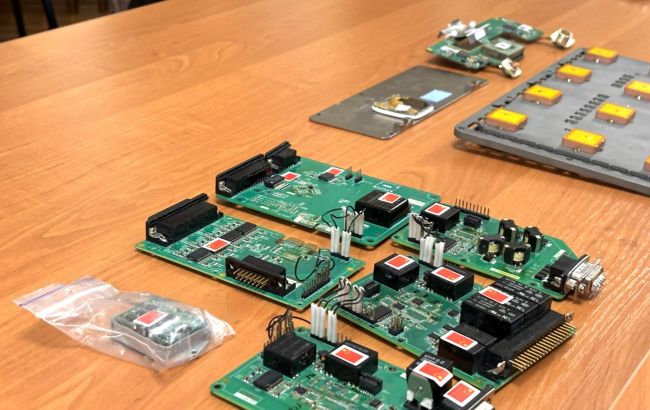 Photo: components of Russian missiles (Lev Shevchenko, RBC-Ukraine)
The Office of the President showed which foreign components and materials Russians continue to use to assemble Iskander and RM48U ballistic missiles launched from S-400 systems.
Kometa navigation module and other critical components
According to Vladyslav Vlasiuk, the president’s commissioner for sanctions policy, Ukraine is working to maximize the synchronization of sanctions measures against Russian manufacturers of ballistic weapons in different jurisdictions.
“One of the first points of our plan is maximum synchronization,” Vlasiuk said.
One of the key components requiring foreign manufacturing is the Kometa navigation module — it provides jamming-resistant navigation and is used for precise guidance correction of ballistic missiles toward their targets. Some autonomous inertial systems with laser gyroscopes have historically relied on French components.
Particular attention was also paid to components of rocket fuel, missile bodies, and guidance systems. Russia does not have sufficient domestic production capacity and depends on imports of critically important materials:
- Ammonium perchlorate (the main oxidizer in solid rocket fuel);
- Carbon fiber;
- Epoxy and phenolic resins for bodies, nozzles, and thermal protection;
- Aluminum powder;
- Titanium and aluminum alloys for control surfaces and heat-exposed components.
Among the externally sourced materials were also tungsten, polybutadiene, and aramid fiber.
Ukraine has also provided its partners with complete information on these items and expects sanctions decisions in response, the Office of the President said.
Among the companies involved in producing components for rocket fuel, Vlasiuk named the Kamensky Combine. According to him, the company produces thickeners for the polymerization of rocket fuel and is part of the work plan concerning missile batteries and ballistic weapons.
This is a Russian defense industry enterprise that produces solid rocket fuel for Uragan, Smerch, and Tornado-S multiple rocket launcher ammunition, as well as for missile systems and aviation weapons. The combine was struck during the night of August 16.
According to experts working on analyzing the insides of Russian missiles, a French component is used in the RM-48U ballistic missile, while a laser gyroscope of the same origin is also used in the Iskander missile system.
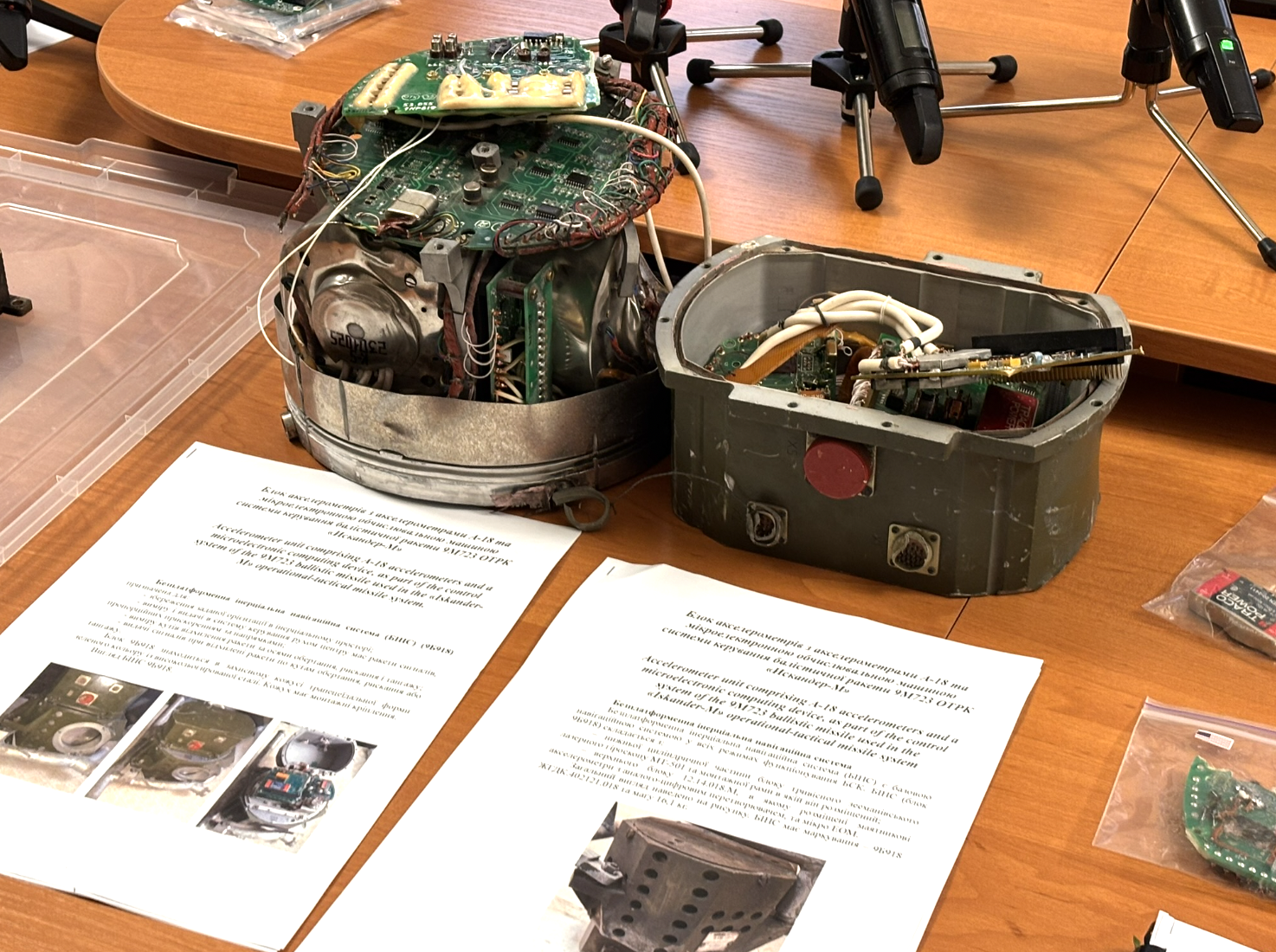
Photo: components of Russian missiles (Lev Shevchenko, RBC-Ukraine)
Machine-tool manufacturing was also addressed. According to Vlasiuk, ballistic weapons production depends on precision metalworking machines, including computer numerical control machines. Their components — CNC modules, servo-drive and measurement systems, precision bearing assemblies, machining monitoring and balancing systems — are supplied by manufacturers from the United States, Britain, Spain, Germany, Japan, Sweden, and Italy.
According to Vlasiuk, the particular challenge with these machines is that their components can be supplied through third countries, making such shipments difficult to track.
“Machines are often [supplied] with many components that are assembled or supplied as components through third countries. So, they are difficult to track,” he said.
List of foreign manufacturers and sanctions plans
The presentation showed a list of foreign companies whose products have been found in ballistic weapons used by Russia.
According to Vlasiuk, the United States leads in the number of such components because ballistic weapons place high demands on the quality and characteristics of electronics.
Among the American companies named were Advanced Micro Devices, Analog Devices, ATMEL Corporation, Bourns, Burr-Brown Corporation, Coilcraft, Cortina Systems, Cypress, Diodes Incorporated, MaxLinear, Microchip Technology, Micron Technology, ON Semiconductor, Qorvo, Skyworks Solution, Texas Instruments, Vishay Intertechnology, Xilinx, Fairchild Semiconductor, FOX Electronics, Hittite, Holt Integrated Circuits, Integrated Silicon Solution, Intel Altera, Kemet Corporation, Linear Technology Corporation, Maxim Integrated Products, and others.
Components also originate from Taiwan (including TSMC, Winbond, Macronix International, DM&P Electronics, and SYNTEC Technology), Japan (Murata Manufacturing, Kyocera AVX Components, Panasonic Semiconductor, Elna Co. LTD, Renesys), Germany (Infineon Technologies, HARTING Technology Group, EPCOSA, Dunberg Electromics Ltd), Switzerland (STMicroelectronics, U-Blox, TRACO POWER), France (3SP Technologies), Britain (Renishaw), and China (Simchip, Elitestek).
Vlasiuk emphasized that the issue of foreign components concerns not only the missiles themselves but the entire production cycle.
“Ukraine has also provided all partners with information about materials such as chemicals and other substances, as well as production equipment,” he said.
According to him, sanctions decisions alone cannot always completely cut off Russia’s access to components, since Russia is trying to create new companies and use third countries. Therefore, strengthening export controls is also an important area.
“It’s not just about sanctions, but about export controls. We think more can be done,” Vlasiuk said.
Vlasiuk said Ukraine is conducting systematic work with its partners: providing them with files containing serial numbers and information about components identified in Russian equipment, and seeking sanctions against all manufacturers involved in producing ballistic weapons in all jurisdictions that support sanctions pressure on Russia.
According to the commissioner, Ukraine has identified more than 1,600 machine tools and more than 200 enterprises linked to Russia’s defense industry. A separate area of work involves identifying engineers and designers at these enterprises.
Regarding materials, particularly chemicals for rocket fuel, the Office of the President also expects the relevant jurisdictions to introduce additional sectoral sanctions or strengthen export control measures within the next month or two.
Vlasiuk emphasized that, in addition to introducing new sanctions, Ukraine is working with partners to strengthen export controls.
“Like any decisions, it takes time: the decision-making process, adopting the decision, then implementing it, maintaining it, and cooperating to ensure compliance,” Vlasiuk said. According to him, sanctions and export control measures should force Russia to revise its production plans and the pace at which it uses its existing weapons.
As previously reported, Britain and France agreed to grant Ukraine a license for its own production of Storm Shadow/SCALP. Unlike air defense interceptors, Ukraine already has the technological base for a project to assemble Storm Shadow and SCALP.