Putin attempts to conceal Russia's economic troubles, ISW says

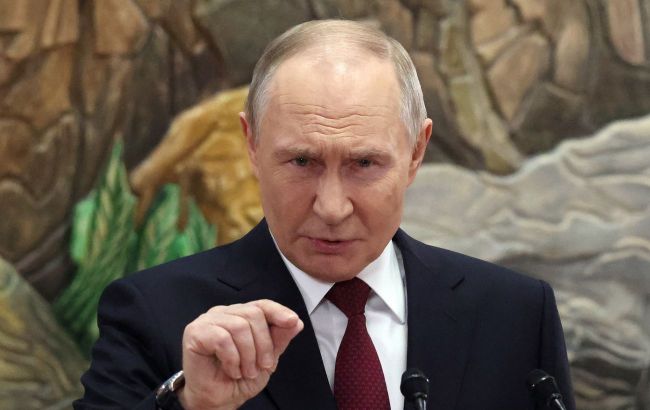 Photo: Russian dictator Vladimir Putin (Getty Images)
Russian dictator Vladimir Putin claims there are "positive results" for Russia's economy. However, real figures point to major budget problems, rising war-related spending, and a worsening business environment, according to the Institute for the Study of War.
Analysts emphasize that official Kremlin statements do not reflect the real state of the Russian economy.
On May 15, Putin said that measures taken by the Russian government had already produced "moderate but positive results."
According to him, in March 2026 wholesale trade in Russia grew by 8%, retail trade by 6.2%, industrial production by 2.3%, and overall production by 3%.
The dictator also claimed that Russia's GDP grew by 1.8% in March, while unemployment remained at 2.2%.
However, an independent Russian media outlet noted that Putin did not mention other key data. In particular, Russia's GDP in January and February 2026 declined year-on-year.
In addition, Russia's Ministry of Economic Development worsened its 2026 growth forecast from 1.3% to 0.4%.
The Foreign Intelligence Service of Ukraine reported that in the first four months of 2026, Russia's budget deficit reached $78.4 billion. This is almost twice as much as in the same period in 2025 and already exceeds more than 150% of the total deficit planned for the entire year.
According to the intelligence agency, in the first four months of 2026 the Russian government spent $235 billion, which is 15.7% more than last year. A significant portion of this money went to military spending, social programs, and support for selected sectors of the economy.
To compensate for rising expenses, Russian authorities increased the value-added tax in January 2026.
According to Ukrainian intelligence, Russia is likely to further increase domestic borrowing. At the same time, only in the first four months of 2026, Russia spent $14.8 billion on interest payments on public debt.
Business conditions also reflect economic strain. Forbes reported that in the first quarter of 2026, 209,000 small and medium-sized enterprises closed in Russia — nearly 9% more than in the same period in 2025. One of the reasons cited is the VAT increase.
Analysts also pointed to rising regional spending on military recruitment.
According to an opposition project, average monthly regional spending on bonuses and payments to military personnel in 2026 more than doubled, from 358 million rubles to 802 million rubles.
This creates additional pressure on the federal budget, as Moscow regularly provides financial support to regions and writes off their debts. On May 14, Russia wrote off debts for the Arkhangelsk, Kaluga, Lipetsk, Orenburg, Smolensk, and Tula regions.
The ISW notes that Russia's economy is now largely sustained by state spending and war-related funds rather than private sector development.
Analysts also recall that Putin has repeatedly cited low unemployment as evidence of a strong economy. However, they say it also reflects a serious labor shortage intensified by the war.
Russia's economic situation
Recall that earlier this year intelligence released a new intercepted communication indicating a critical state of Russia's regional budgets.
At the same time, recent reports suggest that trust in Vladimir Putin among Russians has fallen to its lowest level since the start of the full-scale invasion of Ukraine, according to even official polling data.
According to Ukrainian intelligence, Russia's economy contracted by 0.3% in the first quarter of 2026, while Belarus’s economy fell by 0.4%. Both countries entered the year with optimistic growth forecasts, but the outcome turned negative.