Property held hostage: How Igor Kushnarov case got trapped in a prosecutorial loop

 New details emerge in the Kushnarov case (photo: facebook.com/kushnarovigor)
Years-long property seizures, failure to comply with court rulings, and drawn-out investigations create opportunities to put pressure on businesses. Meanwhile, attempts to "resolve issues" in exchange for money raise questions about the legality of certain officials' actions. RBC-Ukraine analyzes how seized assets become bargaining chips and why such cases require proper oversight by anti-corruption agencies.
Key points:
-
Assets belonging to companies owned by Igor Kushnarov have remained under restrictions for many years.
-
In 2019, a court lifted the seizure of real estate belonging to one of the foundations, but the assets were seized again just eight days later.
-
In a complaint to Ukraine's National Anti-Corruption Bureau (NABU), the businessman reported alleged demands for $240,000 and cryptocurrency in exchange for "resolving issues" involving the property.
-
The case raises questions about the enforcement of court rulings, the preservation of seized assets, and oversight of law enforcement agencies.
High-profile corruption scandals such as "Mindichgate" and Operation "Carthage" have exposed the broader deterioration of Ukraine's law enforcement system. But the most dangerous source of corruption lies within the system itself: powers intended to uphold the law have turned into an opportunity to keep other people's property under seizure for years and trade its release for money.
Despite billions in taxpayer spending, the system appears to be doing little more than creating the illusion of action. Criminal proceedings are still reportedly initiated at politicians' behest for self-promotion, while business owners are subjected to pressure and treated as sources of illicit payments.
The case of Igor Kushnarov, a Ukrainian businessman and philanthropist, is a telling example. For years, he has been fighting to clear his name, ensure that evidence challenging the prosecution's case is considered, and have the restrictions on his companies' assets lifted.
According to the prosecution, the businessman's companies allegedly purchased real estate only on paper, while actual control over the properties remained with the previous owner. The case concerns two properties purchased in 2012–2013 from the family of former Interior Minister Vitalii Zakharchenko — specifically, from his ex-wife.
The transactions were officially registered, the money was transferred through banks, and, according to the businessman, documents submitted to prosecutors for review confirm their legality. Despite this, the properties have remained under seizure for years.
At the same time, more than 30 other properties belonging to Kushnarov were also seized, even though they had no connection to Zakharchenko or his family members.
How a real estate case turned into years of persecution
In 2014, amid a wave of political purges, the prosecutor's office was effectively given a free hand to pursue anyone with even an indirect connection to the former government.
Kushnarov served as an adviser at the Ministry of Internal Affairs both before and after Zakharchenko headed the ministry. In particular, he also held an advisory position under Interior Minister Arsen Avakov. However, it was likely his work at the ministry before 2014 that provided investigators with an opportunity to link him to the former Interior Ministry chief.
The property purchase agreements then became one of the grounds for tying the prominent businessman to the case. Such attempts to establish connections later evolved into a systemic tool for putting pressure on big businesses and extracting money from them.
However, the prosecutor's office's trademark approach becomes particularly evident in the details. Under pressure from their superiors, who at the time were demanding any results that could move the stalled investigation forward, prosecutors decided to target the director of the Dutch office of Kushnarov's companies.
He received an unofficial phone call in which he was told that sanctions had been imposed and that he faced the threat of 50 years in prison. He was also instructed to notify local government authorities immediately.
The calculation was straightforward: intimidation instead of following formal international procedures, apparently because prosecutors understood they would lose if they pursued the matter through legal channels. The director, however, believed the threats and contacted regulators without first verifying the claims.
Dutch authorities froze the assets but, following a court order, conducted their own investigation. On February 5, 2016, the Dutch Ministry of Finance officially concluded that there was insufficient evidence linking the foundations to sanctioned individuals and no grounds for continuing the asset freeze.
Ukrainian investigators should have taken this conclusion into account, particularly given the circumstances under which the information about the alleged sanctions was communicated to Dutch authorities.
The former head of the Dutch company has already given formal testimony in court about the threats and the misleading information provided by Ukrainian law enforcement officials. His testimony could provide grounds for a legal assessment of the prosecutors' actions.
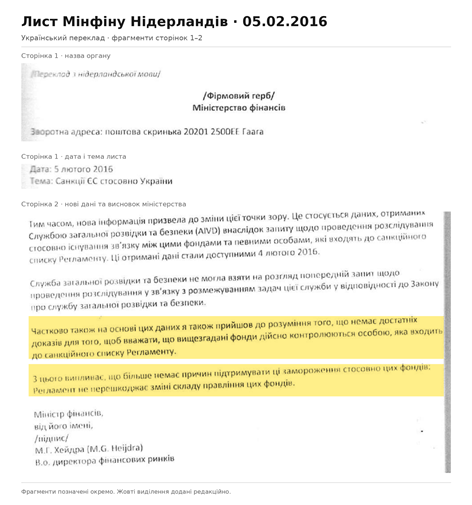
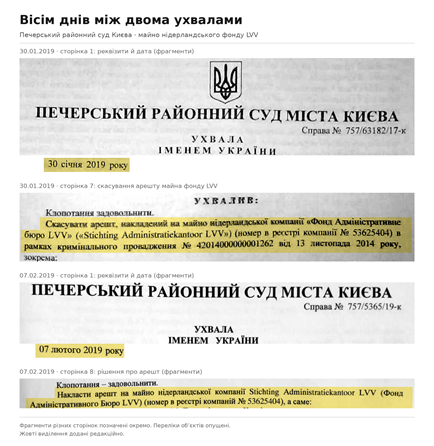
Despite this, Ukrainian authorities continued to rely on the "sanctions" narrative. Eventually, on January 30, 2019, the Pecherskyi District Court of Kyiv lifted the seizure of real estate belonging to one of Kushnarov's Dutch foundations (LVV), taking into account bank transaction records and the position of the Dutch Ministry of Finance. But the relief did not last long.
Just eight days later, on February 7, the property was seized again following a new motion by investigators, based on the same "sanctions" arguments. The case was back to square one.
Property seized without charges: why the case has yet to reach trial
There is another contradiction in this case. The prosecution has linked the businessman to these assets for years. However, according to a response from the Office of the Prosecutor General dated December 9, 2025, he has never been formally notified of suspicion, and his procedural status remains that of a "witness."
In the same letter, the prosecutor's office refused to provide his lawyer with copies of procedural documents, arguing that he represented a witness rather than a party to the defense. This creates a vicious circle: a person is forced to spend years challenging allegations that he secretly owns the assets, yet cannot obtain access to the case files needed to mount a full defense precisely because of his procedural status.
Kushnarov has repeatedly requested to be questioned and to have evidence added to the case file. However, even after questioning and the submission of formal motions, investigators have continued to respond with the same standard wording: "The arguments will be examined during the investigation."
For proceedings that were opened back in November 2014, this formula looks like little more than a way to drag things out. Or could it simply be professional incompetence by prosecutors who have been unable to get to the bottom of the case for years?
According to Kushnarov, the situation went as far as a demand for $240,000, allegedly conveyed through an intermediary in exchange for "resolving" the property seizure issue. In November 2025, the businessman filed a criminal complaint with Ukraine's National Anti-Corruption Bureau (NABU).
But getting an investigation started turned into a separate ordeal. To make NABU simply register the complaint, the businessman had to turn to the High Anti-Corruption Court (VAKS).
As a result, in a ruling dated December 5, 2025, the VAKS ordered NABU to enter the information from the complaint into the Unified Register of Pre-trial Investigations. In other words, the alleged victim had to go to court just to compel the anti-corruption agency to launch an investigation into a reported bribe demand.
The house that was never transferred to ARMA: new questions for law enforcement
Another high-profile episode concerns a Kyiv property owned by the Global Investment Foundation, which is linked to Kushnarov. The building became the focus of a public scandal after then-Energy Minister Herman Halushchenko moved in. But behind the high-profile names lies a series of alleged official misconduct and irregularities involving seized property.
According to the Asset Recovery and Management Agency's (ARMA) response to a lawyer's request dated October 6, 2026, the prosecutor's office had sent the agency a court ruling ordering the transfer of the property to ARMA's management back in 2021. The real estate had also been recognized as physical evidence in criminal proceedings.
However, the court ruling was never implemented: the house was never actually transferred, nor was the handover formalized through an acceptance certificate. In other words, the ruling remained unenforced for years. The property was never handed over to ARMA, and the agency never took it under its management.
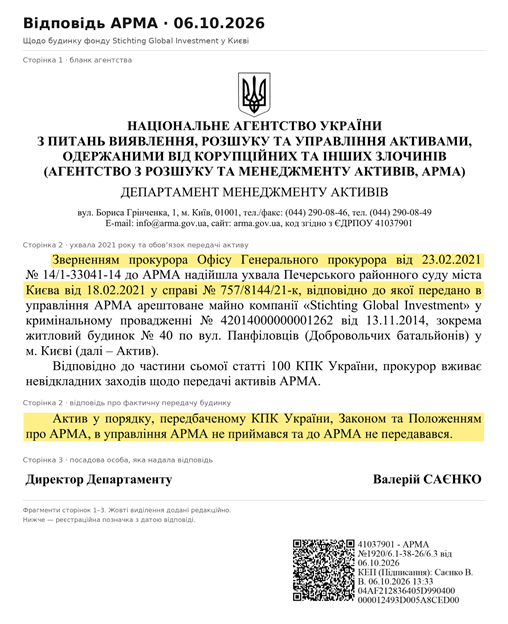
Furthermore, back in 2021, the investigator was required to document and assess the property recognized as physical evidence and ensure its proper preservation. A seizure does not relieve the state of responsibility for the condition of real estate. It must not be allowed to deteriorate, become damaged, or lose value due to a lack of maintenance.
Yet the property was left without proper upkeep for years and gradually fell into disrepair. This is not merely a matter of procedural negligence but also raises questions about the accountability of officials responsible for safeguarding the assets.
Meanwhile, Kushnarov's lawyers are preparing multimillion-hryvnia lawsuits on behalf of the companies that own the property. The claims will be filed with the commercial court against the state, represented by the Office of the Prosecutor General and the State Bureau of Investigation (DBR). They will seek compensation for damages caused by the failure to properly maintain the seized real estate over the years.
As a result, the property remained in limbo for years. Tenants have been living in the house, and some continue to do so legally. Yet their right to stay there has repeatedly been challenged by law enforcement agencies. According to Kushnarov's side, the tenants have faced blackmail and pressure, while their homes have been subjected to repeated searches.
Clearly, only a court can determine whether the tenants' occupancy is lawful. However, once all the case materials are brought before the court, the facts should become clear: the tenants had been living there before 2021, they are not the owners but simply renters, and their occupancy is legal.
Nevertheless, the impression is that prosecutors have little interest in bringing the case to trial, which could clarify the circumstances and call into question the grounds on which the investigation was launched in the first place.
Later, a new chapter emerged in the story surrounding the property: Herman Halushchenko moved into the house, reportedly promising to "guarantee peace" and act as a kind of "protector" of the property for as long as he stayed there.
But after Halushchenko's arrest, investigators and prosecutors faced the same problems that had existed from the outset: the property had not been professionally appraised and had never been transferred to ARMA. In what appears to have been an attempt to justify their negligence and legal violations, the DBR opened criminal proceedings against the tenants, effectively suggesting that they were the ones obstructing the transfer of the property to ARMA for management.
In the fall of 2026, the story took another turn, with yet another offer to "resolve the issue" for money. During a search of the Kyiv house where Halushchenko had been living, an ARMA representative approached Kushnarov's lawyer and asked him to tell the businessman to get in touch.
According to a complaint Kushnarov filed with NABU, a copy of which has been obtained by our editorial team, the ARMA representative allegedly demanded cryptocurrency during a subsequent conversation in exchange for "resolving" the property issue.
On October 8, 2026, NABU confirmed that the complaint had been added to criminal proceedings opened on January 23, 2026. The agency will examine allegations of possible corrupt conduct by officials from ARMA, the DBR, and the Office of the Prosecutor General.
This leaves some serious questions for the prosecutor's office. Who was responsible for preserving the seized property all these years? Why was the court ruling ordering the transfer of the assets to ARMA never implemented? And how did seized real estate end up at the center of alleged corrupt arrangements?
Ultimately, the impression is that seized property has become a kind of shadow marketplace for law enforcement officials, where businesses are forced to pay a price for inaction, ignored violations, and possible protection rackets.
Who will be held accountable for the seized property and possible abuses of power
This case must now become the subject of an investigation into the conduct of law enforcement officials themselves. NABU and the Specialized Anti-Corruption Prosecutor's Office (SAP) must examine the allegations of extortion, establish the role of each official involved, and determine whether years-long property seizures were used as a way to profit from other people's assets.
Simply adding yet another complaint to an existing case file is not enough. If the allegations are supported by evidence, the next steps should include formal notices of suspicion, indictments, and court proceedings.
Another key issue is effective judicial oversight of both the enforcement of court rulings and investigations that remain open for years without charges being brought, while restrictions on property remain in force.
Prosecutors must explain to the court why the seizures are still necessary, what steps have been taken to examine the evidence, and why the investigation has taken so long. The claim that "the investigation is ongoing" cannot serve as an endless justification for keeping assets frozen. If there are no longer lawful grounds for the restrictions, they must be lifted.
Anyone found responsible for extortion, unlawful pressure, abuse of office, or resulting financial losses must be held personally accountable, including through criminal prosecution where warranted. Society pays billions of hryvnias in taxes not so that law enforcement officials can spend years creating the appearance of vigorous activity, keeping business owners in limbo, and undermining public trust in Ukraine's justice system.
When property seizures become a years-long tool for putting pressure on businesses without charges or a court verdict, public trust in the state is undermined. This demands urgent systemic reforms and accountability for those responsible.