Poland releases new findings on Smolensk plane crash, reveals possible causes

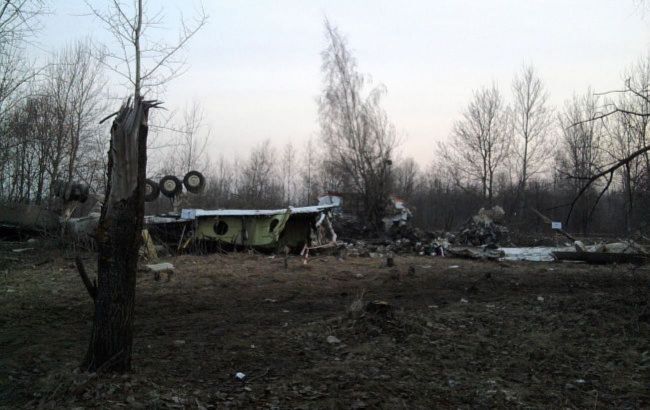 Smolensk air disaster (photo: wikipedia.org)
Polish prosecutors have released experts' findings on the Smolensk air disaster that killed Polish President Lech Kaczyński. According to the experts, neither an explosion nor a technical malfunction caused the crash, RMF24 reports.
An international group of experts found that the Tu-154M aircraft crashed on April 10, 2010, due to a series of events during its approach to Smolensk North Airport. One of these was an incorrect assessment of the aircraft's actual altitude.
The National Prosecutor's Office spokesperson, Przemysław Nowak, presented the report on Friday. An international team of more than 20 experts prepared it. Nowak recalled that the group was established in 2019 under the Law and Justice party's government.
The experts worked on the report for five years and completed it in August 2024. Prosecutors translated the document into Polish, deemed it incomplete and unclear, and submitted 66 questions to the experts.
In May this year, the experts provided an additional report. After translating it, prosecutors concluded that the entire body of expert materials was complete and clear.
According to the prosecutors, the experts examined the preparation, organization, and execution of the flight, including the operations of the 36th Special Air Transport Regiment. They also reviewed the crew's qualifications and actions, the aircraft's technical condition, flight recorder data, weather conditions, and preparations at Smolensk North Airport.
The experts also examined the crash circumstances, the aircraft damage, the injuries sustained by the victims, and the results of physicochemical analyses. In particular, they assessed whether an explosion could have occurred.
"The experts have established the cause of this disaster," Nowak said.
He also stressed that there was no evidence of an attack or sabotage.
The spokesperson clarified that the press conference focused on the experts' report, including their findings and assessments.
"Therefore, these are not the conclusions or assessments of the prosecutor's office or individual prosecutors," he noted.
Nowak added that this body of evidence would, of course, be taken into account in further proceedings.
What happened during landing
In addition to the incorrect altitude assessment, the experts pointed to an unstable approach and a delayed decision to abort the landing and go around.
The landing took place in extremely difficult weather conditions, with dense fog at the airport. The aircraft descended too quickly and dropped below the minimum permitted altitude, even though conditions were unsuitable for a safe landing and the runway was not visible.
During the final stage of the approach, the Terrain Awareness and Warning System (TAWS) issued several alerts warning of the risk of a collision with the ground.
At 10:40:51 am Smolensk local time (8:40:51 am Polish time; all times below are local), the aircraft's captain decided to abort the approach and go around. This was approximately 15 seconds before the aircraft struck the ground.
Błędna ocena wysokości samolotu, niestabilne podejście do lądowania wśród głównych przyczyn katastrofy smoleńskiej według opinii biegłych Prokuratury Krajowej.
— Michał Dobrołowicz (@MDobrolowicz) November 27, 2026
Pierwsze ostrzeżenie „Terraina Ahead” pojawiło się 57 sekund przed katastrofą - mówią eksperci. @RMF24pl @Radio_RMF24 pic.twitter.com/Z3SYmlfUvy
However, according to the report, the first signs of the go-around maneuver appeared only a few seconds later.
At approximately 10:41 am, the aircraft, traveling at around 270 km/h, struck a birch tree with its left wing. The outer section of the wing broke off.
As a result, lift became unevenly distributed, causing the aircraft to roll sharply to the left and begin rotating around its longitudinal axis. It then struck other obstacles and crashed upside down, short of the runway and to the left of its centerline.
Nowak also discussed one of the experts' theories. According to it, the barometric altimeter settings may have been changed in a way that prevented the TAWS system from activating, at least temporarily. The system was supposed to issue a "Terrain Ahead" warning. However, crew members heard such a warning about one minute before the crash.
Nowak says the crew changed the altimeter settings almost three seconds after the first warning signal, about 54 seconds before the crash. The reasons for this change remain unknown.
The spokesperson had previously said that, in the experts' view, changing the settings caused the crew to lose their understanding of the aircraft's altitude. He said this contributed to the crash.
The impact completely destroyed the aircraft. All 96 people on board were killed, including Lech Kaczyński and his wife, members of the Polish delegation, and the crew.
Experts say the crash was a controlled flight into terrain (CFIT). This term refers to an accident in which an otherwise airworthy aircraft, under the control of its crew, collides with the ground or an obstacle.
Factors behind crash, people in cockpit
The international team identified four factors that contributed to the crash. The experts listed them without assigning any order of significance:
-
Actions by Russian air traffic controllers in Smolensk
-
Activities of the 36th Special Air Transport Regiment
-
Choice of Smolensk North Airport
-
Failure to follow sterile cockpit procedures and inadequate coordination among the crew.
An analysis of the cockpit voice recorder (CVR) readings showed that unauthorized individuals who were not members of the flight crew entered the cockpit and held conversations there. The experts identified one passenger who entered the cockpit three times. His voice was last recorded at approximately 10:30 am, 11 minutes before the crash.
The recordings also contain voices of other individuals who could not be identified. According to the experts, these conversations were unrelated to aircraft operations, distracted the crew, and contributed to the crash.
The experts found no evidence that Lech Kaczyński or General Andrzej Błasik, then commander of the Polish Air Force, had been in the cockpit.
Smolensk tragedy
On April 10, 2010, a Russian Tu-154M aircraft crashed near Smolensk, killing all 96 people on board. Among the victims were Polish President Lech Kaczyński and members of the country's military and political leadership.
The Russian Interstate Aviation Committee conducted the investigation and claimed that the Polish crew's pilot error caused the crash. However, Poland rejected these findings.
Immediately after the disaster, a theory emerged that Russian intelligence services might have been involved in organizing a terrorist attack. In 2020, a Polish commission concluded that explosions inside the aircraft caused the crash.
Notably, during the investigation, Russia refused to allow Poland to reconstruct the crashed Tu-154M aircraft using its wreckage.