Moon formed in just 5 hours: Scientists rewrite Earth's satellite origin

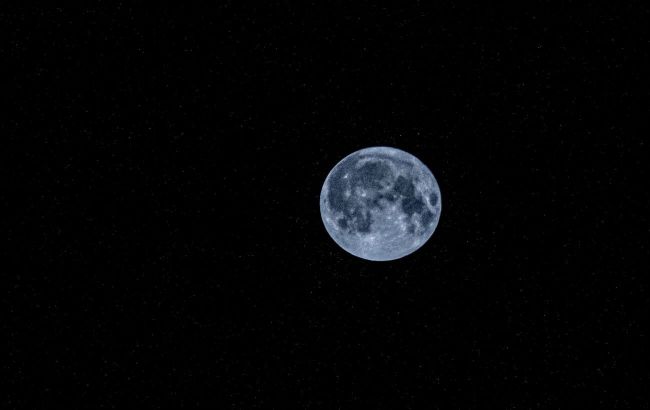 The Moon may have formed incredibly quickly (photo: Ziad Madkour)
The Moon may have formed significantly faster than previously thought - a new evolutionary simulation has proposed a different scenario for the birth of our natural satellite, according to Futura.
Classical theory of "slow creation"
For decades, scientists believed that the Moon emerged as a result of a long and gradual process.
About 4.5 billion years ago, young Earth collided with another planetary embryo the size of Mars, named Theia after the mythological mother of the moon goddess Selene.
As a result of the powerful impact, a huge amount of debris from both bodies was ejected into space.
According to the classical hypothesis, these fragments formed an Earth-orbiting disk, where they gradually clumped together under the influence of gravity. Over thousands of years or even longer, these pieces merged into what is now the Moon.
Fast scenario: Moon formation in five hours
A new study published in the journal The Astrophysical Journal Letters offers a completely different view of these events.
Using digital simulations, researchers modeled a head-on collision between young Earth and a Mars-sized body, taking into account the mechanical strength of materials for the first time. It turned out that the state of the rocks- their temperature and plasticity - plays a decisive role.
Researchers set the initial temperatures of Earth and Theia within the range of 400, 800, and 2,000 Kelvin.
Results showed the following scenarios
If the colliding bodies were hot and malleable, the impact pushed a large amount of material outward, leading to the classical scenario of slow accumulation from an orbital disk.
However, if the objects were cold and mechanically strong, Theia could have partially survived the impact as an intact chunk and immediately settled into orbit.
Under some simulation conditions, a full-fledged Moon appeared just 5 hours after the collision.
Although this does not definitively prove the correctness of such a scenario, scientists have demonstrated its physical possibility, which was previously dismissed due to the neglect of material strength.
New mysteries of the Earth's satellite's origin
This scientific approach opens up new possibilities for studying the Moon's history. If the satellite formed as a ready-made monolithic object, its initial temperature and volatile content could provide more precise data on the conditions of the fateful collision.
At the same time, one fundamental question remains open. Samples of lunar rocks delivered by the Apollo missions are extremely similar to Earth's in terms of isotopic composition.
This creates a paradox, since Theia, according to calculations, formed in a different part of the protoplanetary disk.
The new simulation does not yet solve this mystery, but it leaves room for the assumption that Earth and Theia could have formed in the same region from similar cosmic elements.