Life may hide beneath Mars' surface as Earth microbes survive extreme conditions

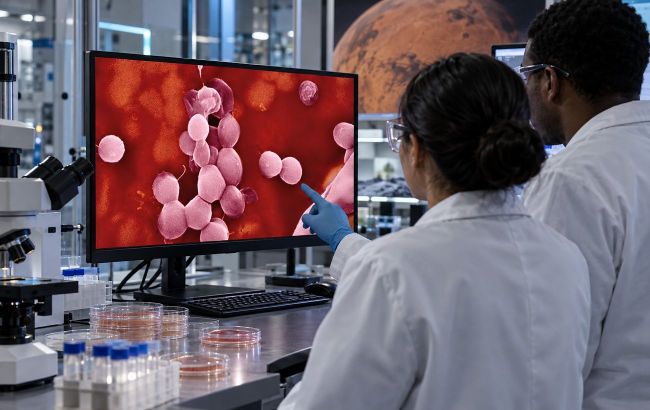 Earth microbes survive in Martian conditions (collage: RBC-Ukraine)
Mars may be more hospitable to life than scientists previously believed: Earth bacteria not only withstood the conditions of the Red Planet but also began to actively multiply, according to the Daily Mail.
Сore of the experiment
A research team from the University of Florida, led by Dr. Adam Robinson, conducted a 180-day trial on the microorganism Haloferax volcanii.
In their natural habitat, these bacteria thrive in highly saline bodies of water, such as the Dead Sea or the Great Salt Lake in the US.
Scientists placed the cultures in sealed chambers designed to replicate a combination of extreme Martian conditions:
- Atmospheric pressure amounting to only a tiny fraction of Earth's;
- A complete absence of oxygen coupled with a high concentration of carbon dioxide;
- A saline solution seven times saltier than Earth's ocean water;
- The presence of perchlorates and nitrates, which are toxic to most living organisms.
The primary distinction of this study from previous experiments was the simultaneous application of all these hazardous factors, rather than testing them in isolation.

Image of microorganisms grown in a Mars-like environment, captured using an electron microscope in false color (photo: Adam Robinson)
How did they retain water?
During the study, it was revealed that the microbes not only remained viable but also continued to reproduce, albeit at a significantly slower rate than under normal conditions.
They adapted to utilize Martian chemicals instead of oxygen for respiration and energy production.
To protect against dehydration, the bacteria formed biofilms—protective clusters enveloped in a slimy matrix. Over the six months spent in the extreme environment chamber, the colonies lost almost none of their internal water.
Scientists note that if potential Martian microorganisms have evolved on the planet over billions of years, their resilience would be significantly greater than that of their Earthly counterparts.

Scientists recreated Martian conditions in the laboratory (photo: Adam Robinson)
Is there life on Mars now?
The authors of the study emphasize that these results do not constitute direct evidence of life on the neighboring planet.
Furthermore, the laboratory tests were conducted at a favorable temperature of 21 degrees Celsius, whereas the average temperature on Mars is -60 degrees.
Nevertheless, the experiment demonstrated that the subsurface layer of the Red Planet could possess conditions suitable for sustaining active metabolism.
The team of scientists is currently preparing a new series of trials under even lower temperatures and pressure.