Germany unveils first Seetaube sea drone: What Russia's shadow fleet has to do with it

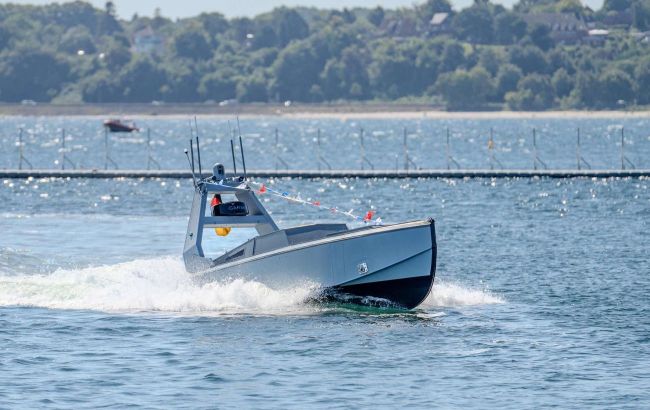 Photo: Seetaube (Bundeswehr)
The Bundeswehr has received a new unmanned surface vessel, the Seetaube, developed by the German company STARK based on the Vanta platform, according to STARK Defenсe.
Seetaube
The new unmanned surface vessel (USV) Seetaube was developed entirely by STARK on behalf of the Cyber and Information Space Forces Command (Kommando CIR) in partnership with the Cyber Innovation Hub Bundeswehr. The vessel was handed over to the German Armed Forces and became one of the first USVs ever received by the Bundeswehr.
The Seetaube is a nearly 6-meter-long unmanned surface vessel (USV) equipped with cameras, radar, and other sensors. It is designed to enhance the Bundeswehr's reconnaissance capabilities at sea, particularly for locating signal sources.
The vessel can be used as an additional moving reference point for cross-bearing, as well as to carry out pre-planned missions autonomously.
The technological foundation for the new vessel is the Vanta—a maritime unmanned surface vessel from STARK that underwent testing during the international REPMUS and NATO Dynamic Messenger exercises in Portugal.
For nearly a month in the Atlantic, the drones carried out various missions daily: escorting high-value targets, monitoring ports, conducting beyond-line-of-sight reconnaissance, and performing nighttime ISR patrols.
How this relates to countering Russia's shadow fleet
The development of unmanned maritime systems is also important for countering Russia’s shadow fleet—a network of vessels that Russia uses, in particular, to circumvent international sanctions and continue oil exports.
Such vessels often have opaque ownership structures, fly the flags of third countries, and may conceal or manipulate data regarding their location. This complicates the monitoring of shipping and creates additional risks to maritime security and critical infrastructure.
Maksym Cherkis, COO of STARK Ukraine, says that modern maritime threats require new approaches to the surveillance and control of maritime space. He explains that autonomous platforms could ensure a constant presence at sea, reduce the workload on crews, and quickly transmit information to support decision-making, adding that this was one of the key advantages of unmanned systems. He emphasizes that these are precisely the technologies Europe needed to strengthen maritime security.
On the night of August 12, the Ukrainian Armed Forces used the long-range Palianytsia and Peklo drone missiles for the first time in a single operation, striking a Russian naval base in Novorossiysk along with unmanned surface vessels. Earlier, India unveiled a portable launcher equipped with the Harpy Eagle interceptor drone, designed to counter small unmanned aerial vehicles.