Europe records hottest June on record as heat claims thousands of lives

 Heatwave in Europe (photo: Getty Images)
June was the hottest ever recorded in Western Europe, with extreme heat shattering temperature records, Reuters reports.
According to the monthly bulletin of the European Union's Copernicus Climate Change Service (C3S), the average temperature in Western Europe last month was 20.74°C (69.3°F). This was more than 3°C (5.4°F) above the average June temperature recorded between 1991 and 2020.
In addition, June 2026 was the second-warmest June globally on record, while sea surface temperatures reached their highest level since records began.
The abnormal heat affected a vast area stretching from Spain and the United Kingdom eastward to Italy, Germany, and parts of Austria. Overall, Western Europe has experienced three major heatwaves over the past three months.
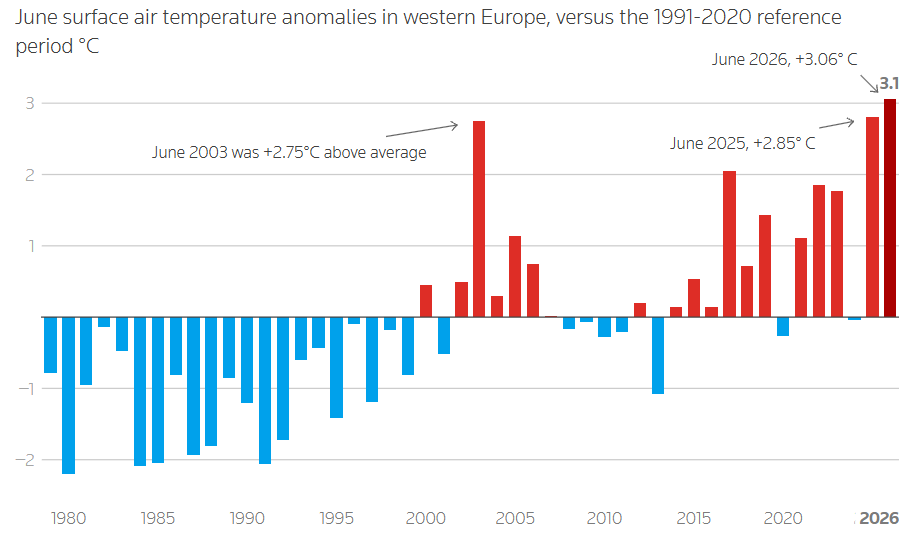
June became the hottest on record in Western Europe (photo: Reuters)
Consequences for people and nature
The extreme weather caused power outages, school closures, and serious health impacts. More than 4,700 excess deaths linked to the heat were recorded in France, Belgium, Spain, and the Netherlands.
Scientists believe the total death toll in other countries could be significantly higher.
The high temperatures also triggered large wildfires across the Iberian Peninsula and in France, significantly worsening drought conditions.
Samantha Burgess, Strategic Lead at the European Centre for Medium-Range Weather Forecasts, stressed that this June highlighted the scale of climate change, which poses growing risks to people, ecosystems, and infrastructure.
Causes of global warming
According to the World Meteorological Organization, the main cause of these anomalies is greenhouse gas emissions from burning coal, oil, and gas.
These emissions have already increased the planet's average temperature by about 1.4°C (2.5°F) compared to the pre-industrial period in the 19th century. Because of this higher baseline, temperatures during heatwaves now reach much higher peak levels.
"The relationship between heatwaves and global warming is about as straightforward as it gets: on a hotter planet, there will be more heatwaves, and they will become more intense," said Joeri Rogelj, a climate scientist at Imperial College London.
US Energy Secretary Chris Wright previously commented ironically on the reaction of European countries to the extreme heat, saying that, in his opinion, cold causes more deaths than high temperatures.
American tourists and social media users have repeatedly mocked the French because many homes in the country still do not have air conditioning.
In response, Paris Deputy Mayor Audrey Pulvar stressed that the United States remains one of the world's largest sources of greenhouse gas emissions and, according to her, is largely responsible for the consequences of global warming.