Europe fears US peace plan could play into Russia's hands, Bloomberg reports

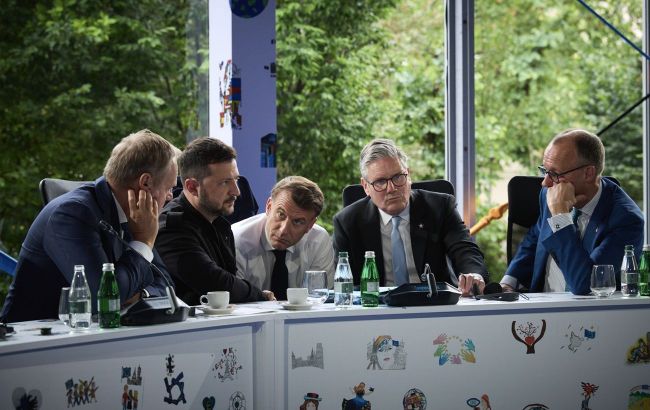 Photo: Ukrainian President Volodymyr Zelenskyy and European leaders (Getty Images)
European officials are concerned that Russia could exploit a new US-mediated peace deal to end the war in Ukraine, potentially paving the way for a renewed invasion of the Donbas region, according to Bloomberg.
According to sources, "a main sticking point in recent talks, is that the US plan for a demilitarized zone would give the Kremlin cover to deploy covert forces in the contested area."
The Kremlin could then use hybrid tactics, including so-called false-flag operations, to undermine US security guarantees and create conditions for a new invasion.
Ukrainian President Volodymyr Zelenskyy said the US discussed turning Donbas into a "free economic zone" under special administration, while Russia preferred a "demilitarized zone."
This week, Zelenskyy also proposed a referendum on potential territorial solutions for the region.
"But Russia could take advantage of any withdrawal of Ukrainian troops from areas that Kyiv controls. That makes Europe's main objective in the coming days and weeks to ensure that any peace deal doesn't contain a Russian Trojan horse." sources familiar with the matter said.
While Russian dictator Vladimir Putin "likely retains his maximalist goals in Ukraine, a key question is whether Moscow continues to reject any peace deal or tactically backs American attempts to get an agreement over the line in the coming weeks."
Beyond the potential to exploit the peace process with its usual hybrid attacks, another risk is Russian interference in any public referendum or elections following a peace settlement.
Zelenskyy plans to travel to Berlin on Monday to meet German Chancellor Friedrich Merz and other European leaders, including UK Prime Minister Keir Starmer, to continue negotiations.
According to sources familiar with the matter, "ahead of the meeting, national security advisors from Ukraine, Europe and the US are expected to hold talks on the draft plans."
Former UK national security advisor Peter Ricketts said European concerns about the US proposal for a demilitarized zone are justified.
He noted that once US attention shifts elsewhere, Putin could "create incidents as pretexts" — for example, claiming to protect Russian-speaking populations.
"This would leave the rest of Ukraine vulnerable to the next Russian advance. So this is not just a technical point, but a fundamental issue — for Ukraine and for European security.," Ricketts said.
US peace plan
The US, Ukraine, and Europe continue working on a peace plan, discussing three key initiatives: a framework document, a security guarantees agreement, and a post-war reconstruction document.
The most difficult issue remains the territories, specifically Donbas, which Washington has demanded Ukraine cede, while Ukraine rejects such proposals.
According to Politico, European leaders are considering creating a 40-kilometer buffer zone between the frontlines of Ukraine and Russia as part of a peace deal.
Under the European idea, peacekeepers would be deployed to monitor the ceasefire. However, the number of peacekeepers required has not yet been determined.
Le Monde reported on December 12 that Ukraine had supposedly agreed to a "demilitarized zone" in Donbas.
Later, Ukrainian presidential communications advisor Dmytro Lytvyn denied this, clarifying that Ukraine had not agreed to anything. Rather, different security models could theoretically be discussed, depending on details, control mechanisms, and legal guarantees.
Additionally, Putin's aide Yuri Ushakov suggested yesterday that after a ceasefire in Donbas, neither Ukrainian nor Russian troops might remain, with Russia's National Guard taking their place.