EU not discussing lifting sanctions on Belarusian potash, Lithuanian Foreign Ministry says

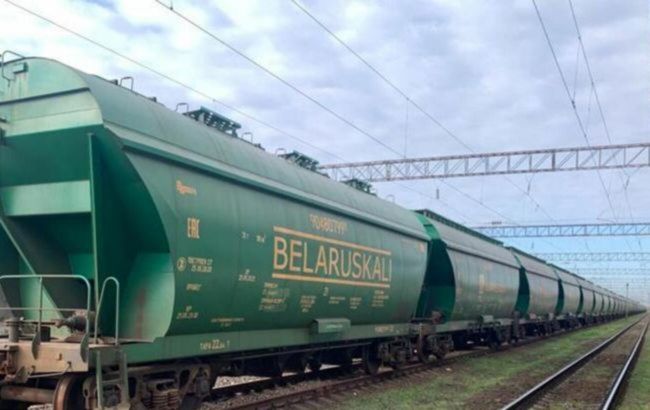 Photo: Railcars belonging to the Belaruskali company (Security Service of Ukraine)
Lithuania’s Foreign Ministry said that there are currently no discussions within the European Union about a possible lifting of sanctions on Belarusian potash, despite a relevant decision by the United States, according to Lithuanian outlet LRT.
The Lithuanian Foreign Ministry said the United States makes independent decisions on sanctions against the Belarusian regime that are not linked to European Union sanctions. The EU is not holding any discussions on easing sanctions against the Belarusian regime.
The ministry stressed that none of the reasons why the EU imposed sanctions on Belarus have disappeared. These include internal repression, the undermining of democracy, the instrumentalization of migration, assistance to Russia in its aggression against Ukraine, and now a combined hybrid attack.
The ministry added that while the release of political prisoners is an important diplomatic achievement, Lithuania’s position remains unchanged: Belarus’s actions pose a serious threat to the security of Lithuania, the EU, and NATO.
Lukashenko releases more than 100 political prisoners
As previously reported, on December 13, following talks with the United States, Belarus’s self-proclaimed president, Alexander Lukashenko, announced an amnesty for 123 political prisoners. Those released included prominent opposition figures Viktar Babaryka and Maria Kalesnikava, 2022 Nobel Peace Prize laureate Ales Bialiatski, and others.
Lukashenko’s press service said the pardons were granted as part of agreements with US President Donald Trump, citing sanctions relief as one of the reasons.
It also said the decision was taken following requests from other world leaders and was guided by humanitarian principles as well as universal and family values.
At the same time, Lukashenko’s side claimed that the political prisoners were allegedly exchanged for wounded Russian forces personnel and captured Belarusian mercenaries who had fought on Russia’s side.
According to Lukashenko’s spokesperson Natalia Eismont, "more than 100 people" were sent to Ukraine, while Belarus allegedly received wounded Russian forces personnel held in Ukrainian captivity, as well as captured Belarusian mercenaries.