Estonia shifts to 'active defense' as Russia threat grows, moves brigade near border

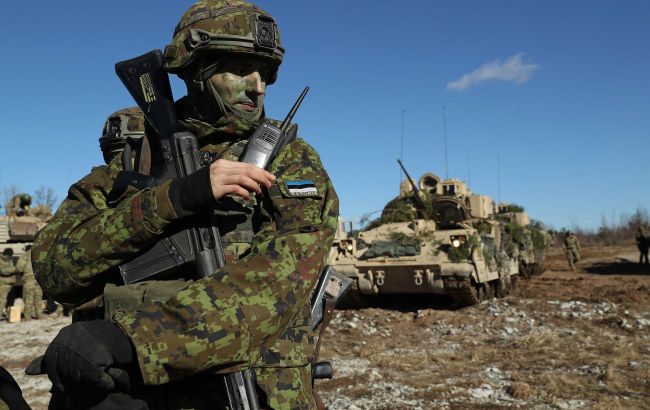 Photo: Estonian military personnel (Getty Images)
Estonia is changing its defense strategy in response to the threat from Russia and is moving a key brigade closer to the border as it prepares for a possible invasion, according to the Financial Times.
According to the FT, Estonia’s military command is relocating the First Brigade from the city of Tapa to Jõhvi. The new base is located about 50 kilometers from the Russian border. At the same time, a military base capable of housing 1,000 troops is being built in the border city of Narva.
Why Estonia changed its strategy
For the past decade, Estonia had been preparing for a different scenario. In the event of an attack, the plan called for rapid mobilization and guerrilla warfare until reinforcements arrived from NATO allies.
However, Russia’s full-scale war against Ukraine has forced the Estonian military to reconsider those plans. After observing the actions of the Russian army, the military command concluded that Moscow is willing to suffer significant losses and destroy territory in order to capture and hold it.
Estonia is now shifting to a concept of “active defense.” It involves confronting Russian forces directly near the border and fighting for territory from the first hours of a possible invasion.
“We have to start from the border and win from the first battles,” said Colonel Tarmo Kundla, commander of Estonia’s First Brigade.
According to him, the military must begin building defensive lines at forward positions now, as they can no longer count on maneuvering against the enemy and gradually withdrawing.
What weapons Estonia is receiving
At the same time, Tallinn is strengthening its long-range strike capabilities. Over the past year, Estonia has signed contracts for US-made HIMARS systems, M57 ballistic missiles and South Korean Chunmoo launchers.
These systems are capable of striking targets at distances of up to 300 kilometers. This means that from Estonia’s new military bases, missiles could potentially reach St. Petersburg, which is located about 260 kilometers away.
Thus, the new defense concept involves not only protecting Estonia’s own territory but also the ability to strike targets far beyond the country’s borders.
What Estonia is concerned about
Estonian intelligence and military officials believe the next one to four years could be a critical period for the Baltic states.
Narva is a particular concern. The city lies on the border with Russia and has a large Russian-speaking population. Estonia fears Moscow could use provocations in the city to test NATO’s readiness to respond to a threat.
The Estonian Ministry of Defense emphasizes that, to effectively deter aggression, the country must make a potential attack too costly for the adversary.
“Our aim is clear: to keep the enemy and the destruction of war away from Estonian territory,” the ministry said.
The Atlantic previously reported on how the Baltic states are preparing for a possible Russian attack and practicing scenarios without direct US support.
As for Estonia, the country is strengthening its defense capabilities, developing unmanned systems and preparing to deter Russian forces from the first hours of a potential conflict.
The Baltic states are also drawing on the experience of the war in Ukraine and preparing for the critical first 72 hours, while allies deploy reinforcements.