Earth threatened by solar storm not seen in 20 years: What experts warn about

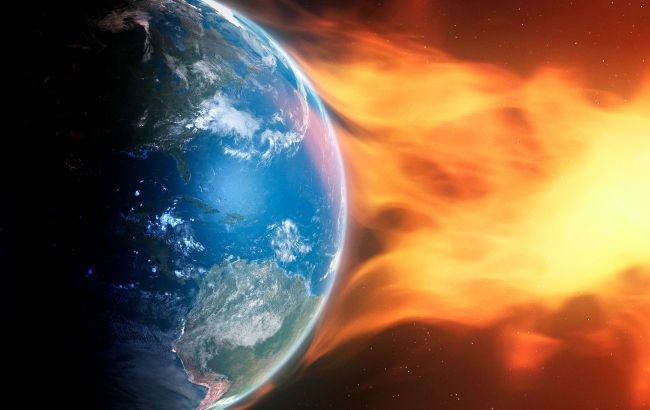 Rare solar storm approaches Earth for the first time in over 20 years (photo: Getty Images)
In the second half of January, a rare high-level S4 radiation storm was recorded on Earth, caused by a powerful burst of charged particles from the Sun. Such events are uncommon, and the last storm of this magnitude was observed over two decades ago.
NOAA Space Weather Prediction Center explains what this storm is and its potential impact on Earth.
What is a radiation storm?
Radiation storms differ from typical geomagnetic storms. They occur when a strong solar flare sends a stream of highly energetic protons toward Earth.
These particles travel almost at the speed of light and reach our planet much faster than coronal mass ejections, which cause classic geomagnetic storms.
According to NOAA’s international classification, radiation storms have five levels — from S1 (minor) to S5 (extreme).
Level S4 is considered severe and occurs extremely rarely. Observations show that the proton flux exceeded 17,000 units, one of the highest readings in modern history. Level S5 exists only theoretically and has never been recorded near Earth.
Why is a rare event
Experts emphasize that S4 is not a regular event of the solar cycle but results from the combination of a powerful flare and the favorable trajectory of particles toward Earth.
NASA explains that most similar particle streams either miss the planet or are largely “absorbed” by the magnetosphere. In this case, some high-energy protons reached Earth’s vicinity, triggering the S4 storm alert.
Potential risks of a radiation storm
It’s important to understand that for most people on Earth’s surface, there is no direct danger. The atmosphere and magnetic field effectively protect us from solar particle streams.
However, these storms carry technical and professional risks:
-
Possible disruptions to satellite operations, especially navigation and telecommunications;
-
Temporary radio signal disturbances in polar regions;
-
Errors in navigation systems using satellite signals;
-
Increased radiation exposure for airplane crews on high-altitude, polar routes;
-
Risks for astronauts in orbit.
During such events, satellite operators and aviation services enter heightened alert mode. The last storm of this intensity occurred in October 2003.
Is a radiation storm the same as a geomagnetic storm?
Radiation storms can precede or coincide with geomagnetic storms, but they are different phenomena. Geomagnetic storms occur later, when a coronal mass ejection reaches Earth and interacts with the magnetosphere.
According to NOAA experts, geomagnetic conditions may remain unstable in the coming days, but strong geomagnetic storms are not an automatic consequence of a radiation storm.
Will ordinary people feel it?
Unlike geomagnetic storms, radiation storms rarely affect human well-being directly. They do not cause headaches, weakness, or blood pressure changes. The main risks are technical and professional, not everyday.
Still, such events serve as a reminder that the Sun is entering a period of increased activity, meaning periods of geomagnetic instability in 2026 may occur more frequently.
Geomagnetic storm forecast for January 20
According to the updated SWPC forecast, a red-level geomagnetic storm is expected on Tuesday, January 20.
Peak activity is predicted in the morning, with levels potentially reaching Kp 8. By midday, activity should decrease, with a Kp 5–6 storm expected in the afternoon.
By the end of the day, activity will gradually decline, with a moderate Kp 4 storm forecast for the morning of January 21.
You may be interested in:
This material is for informational purposes only and should not be used for medical diagnosis or self-treatment. Our goal is to provide readers with accurate information about symptoms, causes, and methods of detecting diseases. RBС-Ukraine is not responsible for any diagnoses that readers may make based on materials from the resource. We do not recommend self-treatment and advise consulting a doctor in case of any health concerns.