Big Bang experiment on Earth confirms existence of primordial matter

 New discovery made at the Large Hadron Collider (photo: Unsplash)
At the Large Hadron Collider, scientists have managed to recreate conditions similar to those that existed in the first microseconds after the Big Bang. The experiments confirmed the formation of an extremely hot state of matter, which is considered the "primordial substance" of the universe, according to SciTechDaily.
Scientists explained that quark-gluon plasma (QGP) forms under extreme pressure and temperatures over 100,000 times those at the center of the Sun.
Under such conditions, complex particles break down into their fundamental components — quarks and gluons.
Nearly 14 billion years after the emergence of the universe, physicists have managed to briefly recreate this state using high-energy nuclear collisions at the collider.
Breaking old axioms
Previously, the scientific community held the view that quark-gluon plasma could only arise during collisions of very heavy ions, such as lead, which are over 200 times heavier than protons.
However, new experimental data have refuted this claim:
- The ALICE, ATLAS, CMS, and LHCb detectors found clear signs of QGP in collisions of oxygen-oxygen and neon-neon pairs;
- Earlier, the ALICE experiment confirmed the presence of plasma signals even in proton-proton and proton-lead collisions;
- The studies prove that the mass of significantly lighter atomic nuclei is sufficient to create an extreme environment.
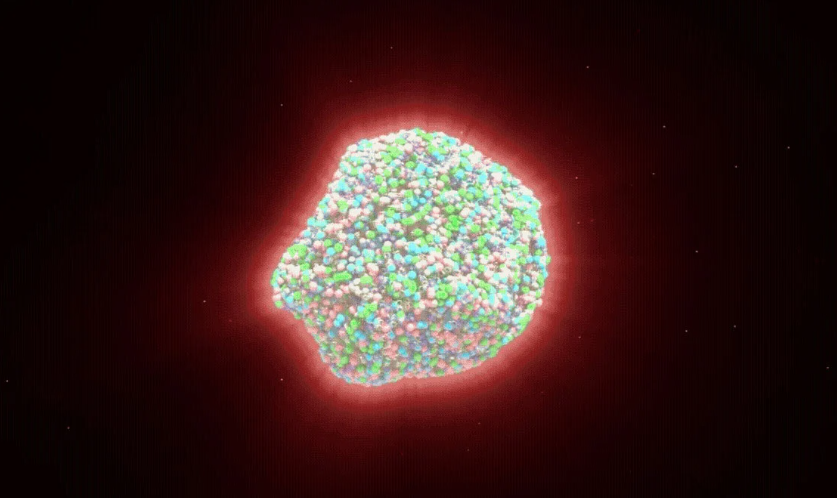
Collisions of oxygen and neon nuclei at the Large Hadron Collider show signs of quark-gluon plasma – the primordial state of matter believed to have filled the universe immediately after the Big Bang (source: CERN)
Key evidence for the existence of plasma
The main confirmation of the formation of a hot environment was the loss of energy by fast quarks and gluons as they passed through the plasma – the jet quenching effect.
The ATLAS collaboration recorded this phenomenon through an imbalance in pairs of particle jets, which increased in head-on collisions with a larger volume of plasma.
Scientists said that the CMS and LHCb detectors confirmed the suppression of energetic particle production, and in neon-neon systems this suppression was stronger due to the larger size of the resulting plasma volume.
In addition, the ALICE detector recorded another important feature. The particles produced after the collision did not move chaotically but in a coordinated manner, as if they were being carried by a common flow.
This indicates that quark-gluon plasma behaves not like a collection of individual particles, but like a single liquid-like substance.