Ancient cannibalism exposed: Ancestors may have eaten Neanderthal children

 Could our ancestors have been cannibals (photo: Getty Images)
Archaeological finds in Europe are increasingly revealing gruesome chapters of our past. A new study of bones from Belgium’s Goyet caves has shocked the scientific world: researchers found evidence that 45,000 years ago, Neanderthal women and children fell victim to brutal cannibalism.
Scientific Reports details this discovery, including who may have been the cannibals and why scientists compare this behavior to chimpanzee warfare.
Bloody secret of the Goyet caves
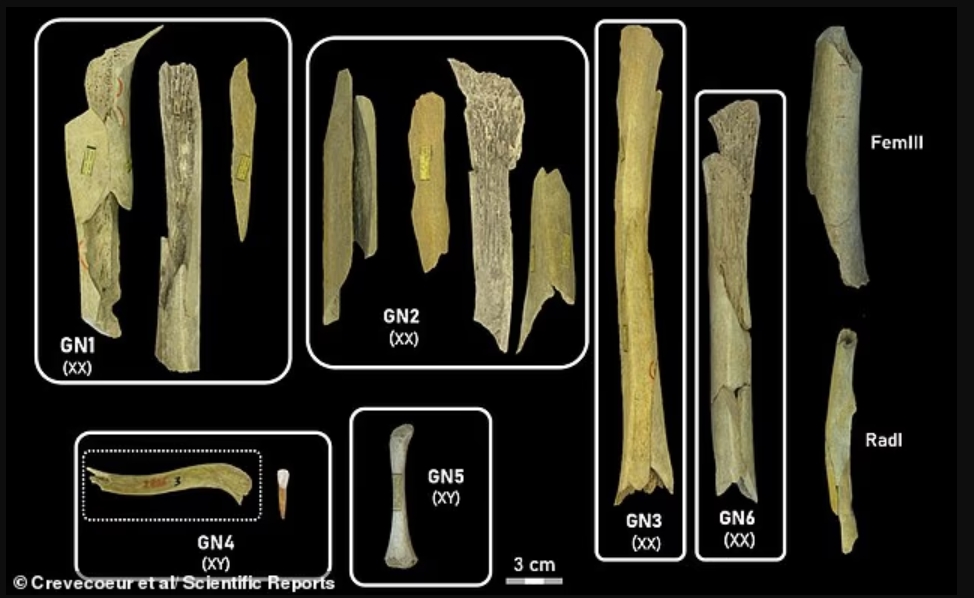
The Goyet caves, located in present-day Belgium, have long been known as one of the richest sites for Neanderthal remains in Northern Europe. However, a detailed analysis of 101 bones conducted by an international team of researchers revealed a horrifying pattern: a third of the remains showed clear signs of butchery: cuts, chops, and traces of circular strikes.
What shocked researchers the most was the demographic profile of the victims. Among the six identified individuals were:
- Four adult women or teenage girls (about 1.5 m tall);
- Two boys and an infant;
- A child aged 6.5 to 12.5 years.
“The overrepresentation of short, morphologically gracile, non-local females, alongside two immature individuals, suggests a strong selection bias in the individuals present at the site,” said Isabelle Creveker, research director at the French National Centre for Scientific Research.
Exocannibalism: hunting outsiders
Genetic and isotopic analysis showed that these women and children were not local. They had been brought to the Goyet caves from other regions to be prepared and eaten. Scientists call this exocannibalism — the consumption of members of external groups.
The bones showed characteristic break marks used to extract high-calorie bone marrow. This indicates that the cannibalism was not only ritualistic but also had a purely practical, nutritional purpose.
 Could our ancestors have exterminated Neanderthals (screenshot)
Who was the cannibal: Homo sapiens or Neanderthals?
This is the key question dividing the scientific community. There are two main theories:
Hunting by early humans
45,000 years ago, Homo sapiens were actively spreading across Europe. It is possible that our direct ancestors hunted their evolutionary competitors, the Neanderthals, to gain territory. Similar behavior is observed in modern chimpanzees, which attack weaker members of neighboring groups to establish dominance.
Intergroup wars among Neanderthals
Researchers suggest that the cannibals may have been Neanderthals themselves. Evidence for this comes from the fact that some fragmented human bones were used to retouch stone tools, a practice characteristic of this species. During the Neanderthals’ decline, competition for resources between groups may have become extremely violent.
The study’s authors note that in Goyet, the demographic profile of cannibalism deaths (teenagers, adult women, and young individuals) is unusual and cannot be considered natural. This cannot be explained solely by subsistence needs, as the region also contains numerous animal remains showing similar butchery marks.
“These results suggest that the composition of the Goyet assemblage reflects a deliberate selection of individuals rather than random, size-affected sampling of a few individuals from a population following a natural mortality profile,” the researchers said.
Evolutionary dead end or assimilation?
Although Neanderthals began to disappear around 43,500 years ago, recent studies by scientists in Italy and Switzerland show that they did not vanish entirely. Instead of complete extermination, a “genetic assimilation” occurred. Homo sapiens and Neanderthals interbred for 10,000 years, and today some of their DNA still lives in each of us.
However, the findings at Goyet remind us that the path to our species’ dominance in Europe was paved not only by cooperation but also by bloody conflicts, where the weakest were often the targets.