Mined roads, trapped civilians and human shield: The horror unfolding in Russian-occupied Oleshky


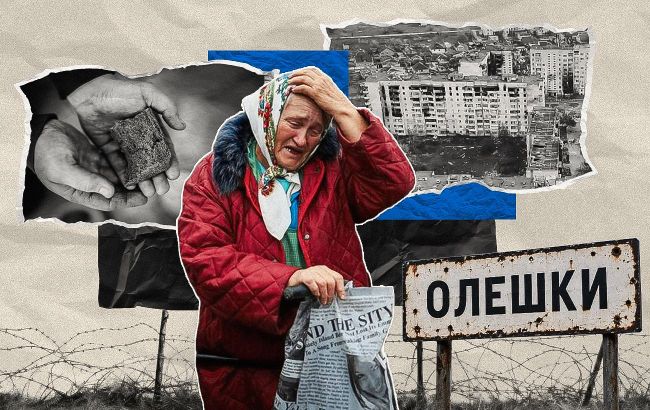 What is really happening in the occupied city of Oleshky (RBC-Ukraine collage)
Occupied Oleshky and neighboring communities in the Kherson region are on the brink of survival amid a total blockade, mined roads, and an artificially created famine. While Russian forces use local residents as human shields and thwart evacuations, Ukrainian soldiers have been forced to drop food supplies from drones.
How Russian occupation forces are turning seized cities into modern-day concentration camps and why civilians are dying without fighting — in the RBC-Ukraine report.
Key points:
-
Artificial famine and shortages: The city has been left without food, medicine, electricity, or communications. Market prices have reached 3,000 rubles for 10 eggs.
-
Total blockade: All roads have been mined, making it impossible to leave, while civilians are dying from hunger and lack of medical care.
-
Humanitarian catastrophe: The bodies of people who have died have been lying for weeks in a destroyed morgue or on the streets because Russian forces have banned burials.
-
Civilians used as a human shield: More than 2,000 residents are being held hostage on the front line.
-
Terror over aid: Ukrainian Armed Forces soldiers are dropping food supplies from drones, but locals are forced to keep this secret for fear of reprisals by occupation forces.
-
Evacuation thwarted: Russia systematically violates ceasefire agreements and blocks all attempts to establish humanitarian corridors.
Oleshky in the Kherson region has been suffering from Russian actions since the beginning of the full-scale war. First, occupation forces entered the city and established their dictatorship. Then, the enemy blew up the Kakhovka Hydroelectric Power Plant, causing severe flooding that claimed civilian lives.
Today, the city is facing a critical humanitarian situation. People are under constant attack and have no reliable supplies of food, drinking water, or medicine, and no stable electricity or gas supply. Local residents are living under occupation, surrounded by hunger.
Those who have left Oleshky have spoken of inspections, persecution, abductions of civilians, interrogations, and detention in basements. According to those interviewed, some people were detained for their pro-Ukrainian views, others were abducted for helping civilians escape after the Kakhovka Hydroelectric Power Plant was blown up, and some were forcibly made to switch sides and join the occupation forces. Others were questioned because they had Ukrainian books at home.
Russian troops have not only created conditions of famine in the Kherson region but have also deliberately attacked the city when people gathered at places where they were supposed to be able to buy food. A woman whose mother was killed in March 2026 while trying to buy groceries spoke about this.
"The city of Oleshky is virtually uninhabitable, but people and children remain there," Tetiana Hasanenko, head of the Oleshky City Military Administration, told the outlet.
According to her, the first serious supply problems began as early as December 2025. At that time, roads leading to the city began to be heavily mined, making food deliveries extremely difficult. Hasanenko noted that the winter of 2026 was already difficult.
Despite this, it was still possible to deliver food to the city several times a month in March, April, and partly in May. However, these deliveries were insufficient to provide for the entire population.
Moreover, people effectively had no way to buy and store food. There are no ATMs, communications, payment terminals, or electricity in the city. As a result, even the so-called social assistance in the form of cards distributed by the occupation authorities did not allow people to purchase essential goods properly.
"People could not stock up on food either because there was no electricity and refrigerators were not working. They bought only as much as they could eat," Hasanenko said.
Meanwhile, the Skhid-SOS charitable foundation reports that people have already died in the city due to extremely difficult living conditions.
"Residents of Oleshky have reported deaths caused by the inability to obtain medical care in time. In particular, a woman recently spoke about her father, who died of hunger and lack of assistance," the foundation told the outlet.
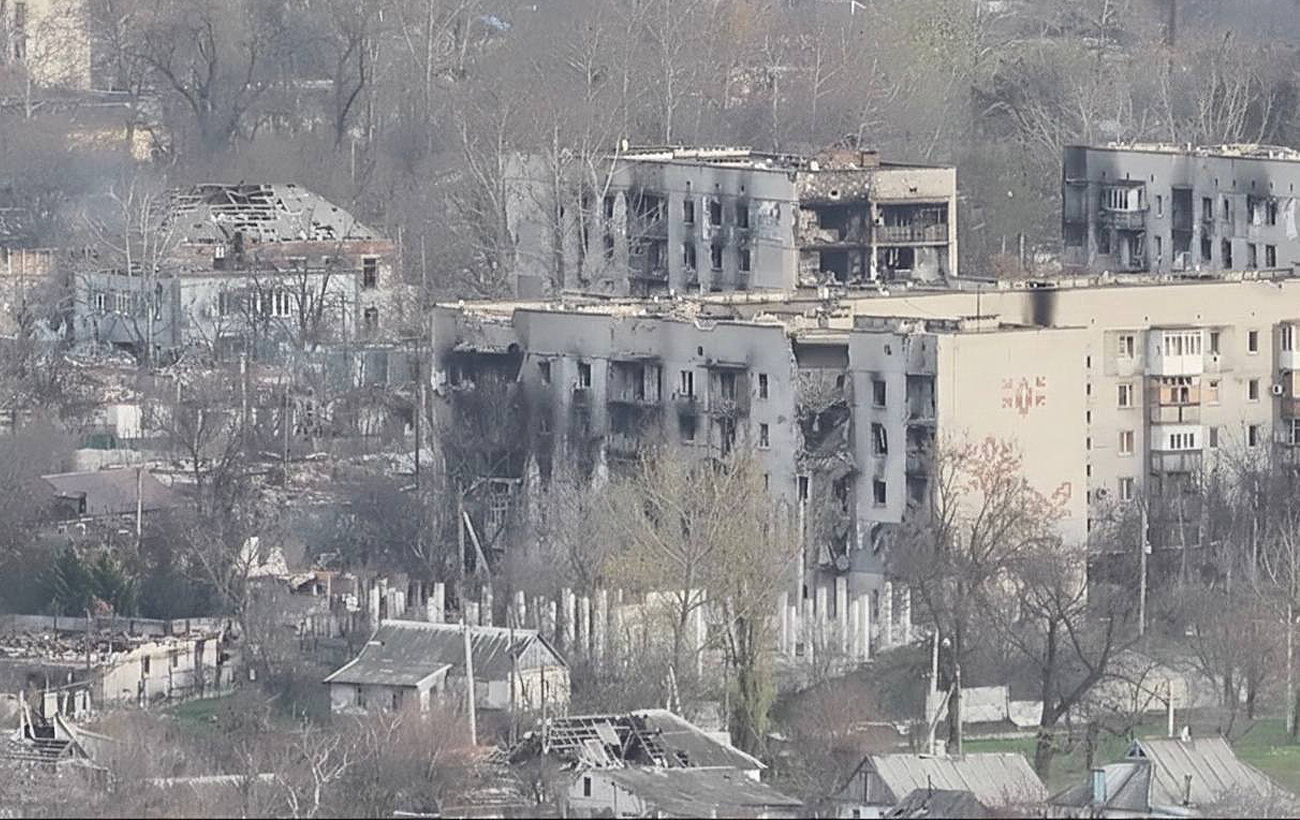
Occupied Oleshky (video screenshot)
City is filled with the stench of bodies that cannot be buried
Even burying loved ones has become a problem for local residents. The bodies of those killed may be left right on the streets. In some cases, people in surrounding villages cover the bodies with cloth and hold them down with a stone.
As the head of the community explained, reaching the cemetery is dangerous, and the occupation forces prohibit the burial of people who were killed or underwent traumatic amputations because they want to transport the bodies to Kalanchak and present them as supposed evidence of crimes committed by the Ukrainian Armed Forces.
According to her, bodies are being kept at the hospital, some of them since January. The hospital has no electricity, and the morgue has been destroyed. "I don’t want anyone to imagine the stench that hangs over the hospital, around the hospital, and throughout the city," Hasanenko said.
According to her, it was only in June that the occupation authorities allowed people who had died of natural causes to be buried. The bodies have to be carried to the cemetery on wooden stretchers because it is impossible to get there by vehicle.
'If you're lucky, you can buy 10 eggs for 3,000 rubles'
Before the full-scale war, around 24,000 people lived in Oleshky, while the population of the entire community was approximately 40,000. Of the community's 13 settlements, five no longer exist, and at least more than 2,000 civilians may still remain in Oleshky itself.
One local resident spoke to the outlet on condition of anonymity. According to him, there is currently no way to leave the city, so people are waiting for an opportunity to evacuate through a humanitarian corridor.
The man said his apartment had burned down and his house had been destroyed. He and his father moved into another apartment in a building where his father had previously lived, and they spent the winter there.
However, that building was later hit as well. According to the local resident, drones struck the building nine times on Ukraine's Constitution Day. They were unable to put out the fire themselves, and almost everything they had left burned down.
After that, the family had to spend nights in a partially destroyed house. They later managed to make it more or less habitable, and he now lives there with his father.
The house remains damaged. When it rains, water comes inside through the ceiling. The family places bowls, buckets, and other containers under the leaks.
"Food supplies are very, very scarce. At the local market, you can mostly find vegetables and fruits: tomatoes, cucumbers, zucchini, pears, and apples. Prices start at 500 rubles. If you're lucky, you can buy 10 eggs for 3,000 rubles ($35 - ed.)," the local resident said.
According to him, the situation with medicines is even worse. There are virtually none available, and even expired medications are being sold at the market. The man said one such pill costs around 100 rubles ($1,20).
The situation is particularly difficult for his father, who has suffered two concussions and has Parkinson's syndrome. The man stocked up on medication back when he was still able to travel to Skadovsk. Now, he says, he has to reduce his father's dosage by 25% to make the medication last at least until the New Year.
"The vegetable-and-fruit diet is taking its toll. Everyone has lost weight, especially my wife, who has lost more than 40 kg," the local resident said.
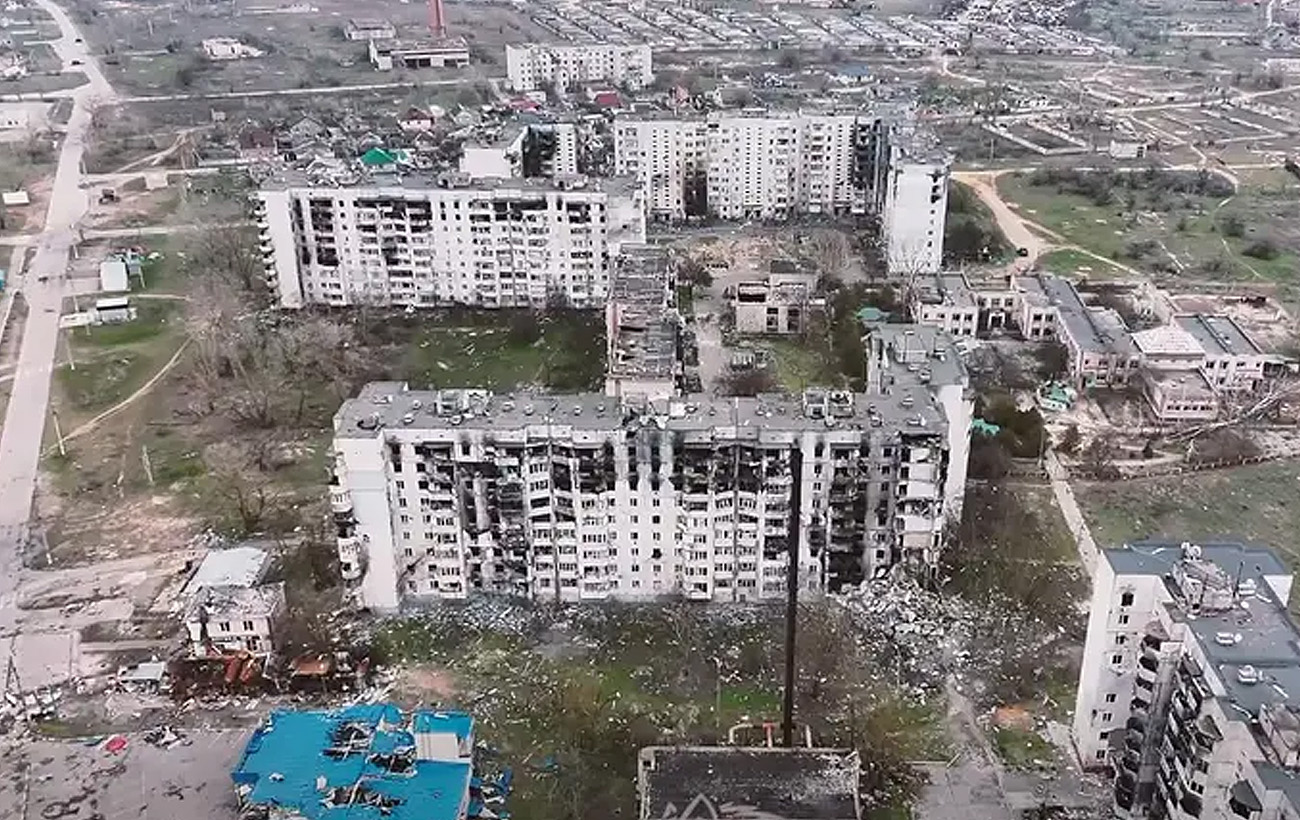
Occupied Oleshky (photo: facebook.com/34obrmp)
Not only Oleshky: Humanitarian crisis spreads to other settlements
"These problems are characteristic not only of Oleshky but also of other settlements on the left bank of the Kherson region that are under Russian occupation," the Skhid-SOS Foundation, which evacuates civilians from dangerous areas, told RBC-Ukraine.
The situation in Hola Prystan is also difficult. The city and surrounding areas are also suffering from limited access to humanitarian aid, food, and medical services.
The situation is worst in the settlements of the Hola Prystan community: Kokhany, Kardashynka, Velyka Kardashynka and Mala Kardashynka. These four villages remain effectively blocked: no transport goes there, and no humanitarian aid has been delivered for an extended period, the foundation said.
Despite the risks of landmines and drone strikes, residents are forced to travel on foot or by bicycle to other settlements to find food. It is difficult to obtain more information from the area because there is no communication with local residents.
Assistance from the Ukrainian Defense Forces and the problem of delivering it
Recently, Ukrainian troops managed to deliver up to four tons of food to Oleshky by drone. However, some people were unable to receive the food and asked for further assistance.
According to the head of the community, receiving aid from Ukraine can also pose a danger to city residents. She said that the occupying forces consider people who receive assistance from Ukrainian troops to be their enemies. Therefore, residents try to conceal the origin of the food they receive by transferring it into unmarked bags or jars.
"Because you will have to answer for it — where you got the food from," she said.
According to her, the occupying forces are also experiencing supply problems. Hasanenko said that Russian troops may enter homes where Ukrainian citizens live and demand food and alcohol. They may also demand explanations about where the food came from and resort to violence, she said.
The head of the community believes that Russian troops are using the people who remain in Oleshky as a kind of human shield.
"If they are using us as a human shield, don't they understand that this shield needs to be fed? In other words, this shield could simply die," she quoted one of Oleshky's residents as saying.
What the ombudsman says
Dmytro Lubinets, the Ukrainian Parliament Commissioner for Human Rights, also spoke about the humanitarian situation in Oleshky. According to him, he first received information that a humanitarian catastrophe was looming in the city in late February 2026.
On March 5, he officially appealed to the International Committee of the Red Cross, demanding that it verify the information and deliver humanitarian aid to the civilian population. At the same time, he said, he contacted the Russian side to initiate negotiations on an evacuation, particularly of children.
Lubinets said that after that, he sent official letters every month and held negotiations with the Russian side. However, according to him, they yielded no positive results.
Since the beginning of summer, the situation has deteriorated, according to the ombudsman. Food and water supplies began to be disrupted, and leaving the area became virtually impossible because the routes had been mined.
"The Russian army has completely mined all the routes, even pedestrian paths out of the area… There is a humanitarian catastrophe there; Ukrainian civilians are dying every day simply because they have no food or water. There have been no medicines there for a long time. According to our information, people are simply starving," the ombudsman told the outlet.
Russia blocks people from leaving the city
Lubinets also said that Russian troops are using the civilian population as a buffer and protection against the actions of the Ukrainian army.
According to him, because Ukrainian citizens remain in Oleshky, Ukraine cannot conduct active combat operations there, which, in his view, allows Russia to effectively hold civilians hostage on the front line.
The Ukrainian side continues negotiations on the evacuation of civilians. The parties worked out the technical details, and the Ukrainian side was ready to implement the agreements. According to him, they also managed to determine a route and a time period during which a ceasefire was supposed to be in effect to allow the evacuation.
Lubinets claims that the Ukrainian side honored the agreements, but Russia violated them. At the same time, he is not publicly disclosing the details of the negotiations, explaining that he does not want the Russian side to use his words to justify the failure to implement the agreements in the future.
"We hope that our international partners will exert influence on Russia, on the Russian side, and thereby help us, among other things, save our citizens," Lubinets said.
***
What is happening now in the occupied part of the Kherson region is reminiscent of eyewitness accounts from 1933, when people were dying of hunger and aid was not reaching them. In Oleshky, Hola Prystan, Kokhany, and other settlements, people are left without sufficient food, medicine, electricity, or safe transport links. These are no longer isolated cases. The humanitarian crisis caused by the Russian occupation is engulfing entire communities, leaving people alone to face hunger and isolation.